
Shoppers who want to verify the Fairtrade claim
You want to be able to point out which product a claim applies to when planning date night. A Fairtrade statement on separate chocolate says nothing about whether the currant bun is certified.


Only choose a currant bun as a Fairtrade product if that claim appears on the current packaging or product page for that specific bun. For date night, you could also serve ordinary currant buns with Fairtrade chocolate chosen separately, provided it carries an explicit Fairtrade claim. Check the ingredients and allergen information for both products.
You want to be able to point out which product a claim applies to when planning date night. A Fairtrade statement on separate chocolate says nothing about whether the currant bun is certified.
You’re serving the buns to someone who needs to pay attention to ingredients. The currant buns described by Albert Heijn and Jumbo contain wheat and milk; check the packaging for any ‘may contain’ statements too.
You’re choosing between smaller buns to share and larger ones. The packs described vary in the number of buns and their weight, so check the packaging before choosing something for two.
First, decide whether the currant bun itself needs to carry a Fairtrade claim, or whether separate Fairtrade chocolate suits your plans. Then check the allergens in both products and choose the right size.
| What to consider | What to check when buying | Who it matters to |
|---|---|---|
| Fairtrade claim | Look for the claim on the current packaging or product page for the product you’ve chosen. For chocolate, also check for any mass balance statement. | If Fairtrade matters to me, I want to know whether the claim applies to the bun or just the chocolate. For around 50% of consumers, being able to verify a Fairtrade claim comes first. |
| Ingredients and allergens | Check the ingredients and any ‘may contain’ information for both products. | When I’m serving something to someone else, I need to check whether the ingredients suit their needs. Ingredients and allergens are the main concern for around 30% of consumers. |
| Portion and presentation | Compare the number of buns, the pack weight and the shelf life. | For a small occasion, I don’t want to go by the picture alone; I want to know how many buns I’m buying. Portion size matters most to around 20% of consumers. |
Jumbo has a separate Fairtrade category, but that doesn’t automatically make the currant buns on its product page Fairtrade.
Check the claim on the packaging or product page for the exact bun you want to buy.
According to Fairtrade International, Fairtrade and other cocoa may be mixed during processing under mass balance, while Fairtrade volumes are tracked. So the statement doesn’t promise that every cocoa bean in the bar has remained physically separate.
Read the information provided with the chocolate if physical traceability is a condition of your purchase.
The currant buns described by Albert Heijn and Jumbo contain wheat and milk. Albert Heijn also lists possible traces of nuts, sesame and soya, among other things, for its product.
Before serving, check the current allergen information on both the buns and the chocolate.
Worth considering if you’d like to pair currant buns with separate chocolate.
A useful example of currant buns sold in a pack of six.
Worth considering if the size of the currant buns will determine how you serve them.
This bar suits the idea of serving currant buns with chocolate on the side. A Fairtrade claim for the bar wouldn’t mean the currant buns themselves are Fairtrade.
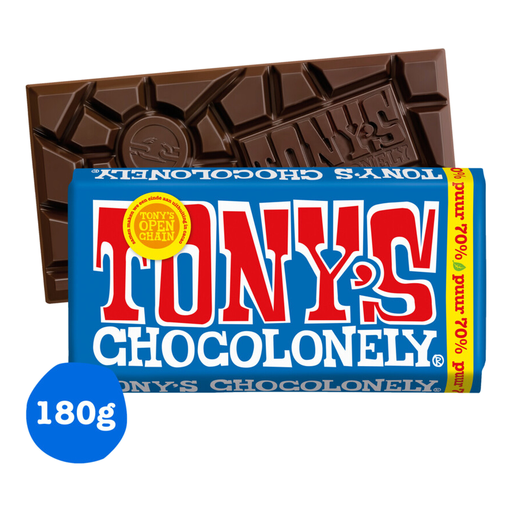 Image unavailable
A separate chocolate bar for anyone who’d like to serve chocolate alongside currant buns. The pack contains 180 g; check the current label for the Fairtrade statement and cocoa percentage, as the available listings give different figures for the percentage.
Before serving them together, check the allergens in both the bar and the currant buns.
No. A Fairtrade category says nothing about whether an individual currant bun is certified. Look for an explicit claim on the current packaging or product page for that bun.
Mass balance means that Fairtrade and other ingredients may be mixed during processing, while Fairtrade volumes are tracked. Fairtrade International says this is permitted for cocoa; the statement doesn’t mean that every cocoa bean has been physically kept separate all the way to the bar.
Yes. Check the current packaging, even if you’ve bought the same product before. The currant buns described by Albert Heijn and Jumbo contain wheat and milk; if you’re serving them with chocolate, check its allergens too.
No. A reference to iodised salt or baker’s salt isn’t a Fairtrade claim. Albert Heijn lists iodised salt and Jumbo lists baker’s salt in the currant buns described; check separately for any Fairtrade claim on the product you choose.