Who is this camera setup for?

Cupcake baker who needs accurate colours

You photograph decorations under artificial light and want icing colours to look consistent from one image to the next. Sony Netherlands and Panasonic Netherlands cover colour, white balance and lighting in their food photography advice.

Creator of close-up decoration shots

You want to fill the frame with small decorations, so you need to consider magnification, focusing distance and the space available for your light. Canon, Nikon and Fujifilm product specifications show that magnification varies between lenses.

Home photographer with a compact setup

You want to photograph whole cupcakes or a group of them without immediately putting together an extensive lens kit. Canon Netherlands Store and the Consumers’ Association highlight the need to balance framing, lens choice and a compatible camera mount.

What should you consider when choosing?

Start with the shot you want to take and the lights you use. Then assess the lens, working distance and complete setup.

What to consider What should you look for? Who is this most important for?
Colour and lighting Check the white balance and exposure, and take test shots using the lights you actually plan to use. If I want icing colours to look true under my lights, I pay attention to white balance and the direction of the light. Around 33% of consumers say colour and lighting are their top priority.
Small decorative details Check the maximum magnification and focusing distance for the exact lens, and make sure there is room in front of it for your lighting. For small piped patterns or sugar pearls, I want the details to fill a large part of the frame without having to move the light out of the way. Around 27% of consumers prioritise capturing fine decorations.
Framing and working space Measure the available distance and check whether you can frame both a whole cupcake and the crop you want. If my working space is small, I want to know whether I can photograph a whole cupcake from a practical distance. Around 20% of consumers prioritise suitable framing and working distance.
Complete setup Check which lens is included, what mount the camera has and which accessories you already own. I want to know in advance whether I can use the equipment I already have, rather than comparing camera bodies alone. Around 20% of consumers want to limit additional purchases and kit components.

Common buying mistakes

  • Assuming every lens labelled ‘Macro’ offers 1:1 magnification

    Maximum magnification varies between lenses. Canon specifies a maximum of 1:2 for the RF 35mm F1.8 MACRO IS STM, while Nikon and Fujifilm specify 1:1 for the macro lenses mentioned here.

    Compare the maximum magnification of the exact lens with the framing you want.

    If your current lens cannot achieve the close-up you want, you may need another lens.

  • Comparing camera bodies alone

    A mirrorless camera may be sold without the lens you need for your preferred shot. The mount determines which lenses are compatible with the camera.

    Check what the offer includes and compare the camera’s lens mount with the lens you want to use.

    Depending on what you already own, you may also need a compatible lens, memory card, spare battery or stable support.

  • Choosing a 1:1 lens without checking there’s room for your light

    At a very short focusing distance, there may be little room between the lens and the cupcake for your lighting. Nikon states that at its closest focusing distance, there is approximately 5 cm between the front of the NIKKOR Z MC 50mm f/2.8 and the subject.

    As well as the focusing distance, check the practical space between the lens, cupcake and light.

  • Not testing an electronic shutter under LED lighting

    Canon Europe explains that flickering from certain LED and fluorescent light sources can cause banding when using an electronic shutter.

    Take test shots with your own lights first and, if necessary, try a different shutter setting if your camera offers one.

Camera brands and lenses to consider

Canon

The EOS R50 uses an RF mount; adding a separate RF macro lens is one option for close-ups.

  • Canon specifies a maximum magnification of 1:2 for the RF 35mm F1.8 MACRO IS STM.
  • So, for this lens, the ‘Macro’ label does not mean that Canon specifies 1:1. Source: Canon Europe.

Nikon

The Z50II paired with a separately available NIKKOR Z MC 50mm f/2.8 is worth considering if you’re looking at a Nikon Z setup with 1:1 magnification.

  • Nikon specifies 1:1 magnification for this lens and lists it for use with DX cameras; on DX, its angle of view is equivalent to 75 mm on full-frame.
  • At its closest focusing distance, Nikon states that there is approximately 5 cm between the front of the lens and the subject. Allow for the space your lighting needs. Source: Nikon Netherlands.

Fujifilm

The X-S20, with its X mount, can be paired with the separate XF30mmF2.8 R LM WR Macro for close-ups.

  • Fujifilm specifies 1:1 magnification and a minimum focusing distance of 10 cm for the XF30mmF2.8 R LM WR Macro.
  • That focusing distance is not the same as the clear space between the front of the lens and the cupcake. Source: Fujifilm X.

Sony

The E 30 mm F3.5 Macro SEL30M35 is one lens option to explore if you already have a compatible Sony α camera with an E mount.

  • Sony specifies 1:1 magnification and a minimum focusing distance of 2.4 cm for this lens.
  • Check whether there is still enough room for your artificial lighting at this close range. This lens specification does not tell you what features every Sony camera body has. Source: Sony Netherlands.

Panasonic

Panasonic lists various LUMIX G lenses as options to consider for indoor photography and close-ups.

  • The manufacturer recommends the fast G 25mm f/1.7 for food photography, along with separate G macro lenses for close-ups.
  • Check which specific lens and camera body suit your shooting distance; the guide does not identify a camera body independently tested for this subject. Source: Panasonic Netherlands.

Camera and lighting bundle on Joybuy

This product selection pairs a camera with additional lighting for photography. Check that the light source and working distance suit your cupcake setup.
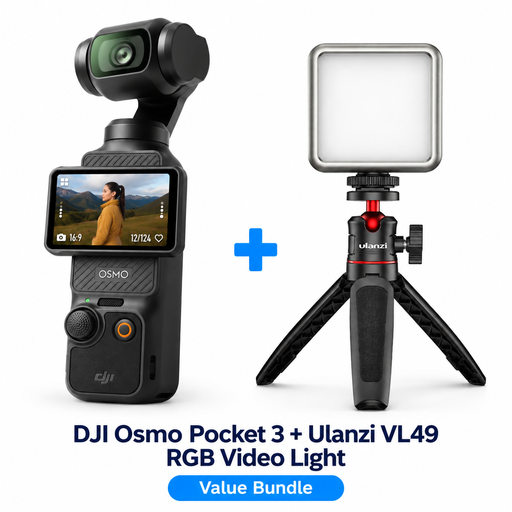
DJI Osmo Pocket 3 with Ulanzi VL49 RGB LED video light

DJI Osmo Pocket 3 + Ulanzi VL49 RGB LED Video Light bundle

This bundle pairs the camera with an RGB LED video light to provide additional lighting for photography.

The description mentions a 1-inch CMOS sensor and mechanical 3-axis stabilisation.

View at Joybuy

Frequently asked questions

Do I need a 1:1 macro lens straight away to photograph a whole cupcake?

Not necessarily. Start with the framing you want and check whether a lens you already own can focus from the required distance. Maximum magnification becomes more important for small decorations, so compare the specifications of the exact lens with what you want to photograph.

What can I do if the icing looks a different colour under my lights?

Take a test shot and, if needed, adjust the white balance to suit your lights. Sony Netherlands recommends white balance as the first step in correcting the colour of food and desserts. Also try changing the direction of the light to bring out the shape and texture you want.

Why do stripes appear in photos taken under LED lighting?

Canon Europe reports that flickering from certain LED and fluorescent light sources can cause banding when using an electronic shutter. Test your own lights and, if your camera allows it, try a different shutter setting.

What should I check when buying a camera body with a separate lens?

Check the lens mount, which lens is included and whether it can focus from the distance you need. Not every lens fits every camera, and a body-only offer will not automatically include the lens you need for a close-up.

Can I return a camera bought online?

According to the Dutch government, in many cases you have a 14-day cooling-off period when buying from a business at a distance. Check the terms for the specific purchase; according to the Dutch government, an online purchase from a private seller does not count as a distance sale in this sense.
