Choose a stick blender if you want to blend the soup in a suitable pan or mixing bowl; choose a jug blender if you want to blend and pour measured portions. For a jug blender, check its usable capacity, and for both types, see how to clean the parts between workshop sessions. The Netherlands Nutrition Centre recommends blending cold cucumber soup with either a stick blender or a food processor.
Which method is right for you?
Workshop host making one pan of soup
You want to blend the soup in a suitable pan or mixing bowl, and need to consider how the appliance handles and whether it splashes. The Netherlands Nutrition Centre lists a stick blender as an option for cucumber soup.
Host serving measured portions
You want to blend measured quantities in a blender jug and compare the recipe portion with the usable capacity.
Host running back-to-back sessions
You want to clean the parts you’ve used between preparations. If you’re running a food business, the relevant NVWA rules for hygienic working also apply.
What should you consider when choosing?
Start by thinking about how you want to prepare the soup: blend it in a suitable container or mix individual portions in a jug.
Stick blender
Best for: blending directly in a suitable pan or mixing bowl, without having to keep filling and emptying a jug. The Netherlands Nutrition Centre’s cold cucumber soup recipe recommends using a stick blender.
Bear in mind: blending can cause splashes, and you’ll need to clean the blender foot and any other parts that have come into contact with food.
Jug blender
Best for: making measured, pourable portions when the usable capacity is right for the amount you need to prepare each time.
Bear in mind: you’ll need to fill, pour from and clean the jug. Its maximum capacity isn’t always the same as its usable capacity.
| What to consider |
What should you check? |
Who is this important for? |
| Blending without transferring |
Check the controls and included accessories for the exact model, and choose a suitable container for blending. |
If I don’t want to transfer the soup during a demonstration, I want to blend it in the pan and keep splashes under control. Around 31% of consumers prioritise blending at the point of preparation without transferring the contents. |
| Usable capacity per session |
Compare the recipe portion with the usable capacity. Philips lists 1 l usable capacity and 1.9 l maximum capacity for the HR2041/00. |
When I’m serving portions, I want to know how much soup the jug can hold each time. Around 31% of consumers prioritise the amount they can blend per batch. |
| Cleaning between sessions |
Check the manual for instructions on cleaning every part that has come into contact with food. Food businesses must follow NVWA rules for hygienic working. |
When I’m hosting back-to-back groups, I want to clean the parts I’ve used thoroughly before using them again. Around 23% of consumers prioritise cleaning between preparations. |
| Controls and texture |
Check the speed settings and whether there’s a pulse function; don’t judge the soup’s texture by wattage alone. |
If I want to control how smooth the soup is while blending, I look at the appliance’s controls. Around 15% of consumers prioritise control over texture. |
Things to look out for when buying
-
Confusing maximum jug capacity with usable capacity
The Philips HR2041/00 has a usable capacity of 1 l, while its maximum capacity is 1.9 l. This means a larger recipe batch may not fit in one go.
Work out the recipe volume for each batch and compare it with the usable capacity of the exact model.
If the batch is larger than the usable capacity, you may need to blend it in several batches.
-
Assuming wattage guarantees a particular result
A stated wattage or a manufacturer’s comparison using a different ingredient doesn’t prove how smooth cucumber soup will be with that model.
Assess the controls, capacity and cleaning requirements separately, and read claims about blending results in light of the test conditions given.
-
Assuming a cleaning setting replaces all other cleaning
Tefal lists an automatic cleaning programme for the Perfectmix+ BL811D. Food businesses must still work hygienically in accordance with the relevant NVWA rules.
Check the manual and clean all the parts you’ve used in a way that’s suitable for the next preparation.
Allow time to check and clean any removable parts that have come into contact with food.
Brands to consider
Philips
The 3000 Series HR2041/00 is a jug blender for making measured portions.
- Philips lists one speed setting plus a pulse function, 1 l usable capacity and 1.9 l maximum capacity.
- For larger workshop sessions, the usable capacity may mean you need to make several batches. Treat claims about blending results as statements made by Philips.
Bosch
The ErgoMaster MSM8M930 is a stick blender option for blending in a suitable container.
- Bosch specifies a detachable metal blender foot and variable speed control for this model.
- Bosch’s comparison of smoothness and speed is based on carrot juice compared with another Bosch model, not cucumber soup.
Tefal
The Perfectmix+ BL811D is a jug blender with programmes for tasks including blending and cleaning.
- Tefal lists a glass jug for hot and cold preparations, along with an automatic cleaning programme.
- The product title lists 1.5 l, while the description says 2 l. Check the usable capacity for the exact version, and treat performance statements as claims made by Tefal.
Braun
The MultiQuick 5 MQ 50220 M is a stick blender option for tasks including preparing small portions.
- Braun lists a shaft designed for small portions and 21 adjustable speeds for this model.
- The Dutch product page lists both 1000 W and 750 W. Don’t base a comparison of this model on either figure without checking which version you’re looking at.
Products for both methods
These product choices are suited to blending with a stick blender or mixing portions in a jug blender.
 No image available
Emerio BL-124816.7 Blender, 1.5 l, 2 speeds
For measured portions that you want to blend and pour; check that the usable capacity suits the recipe volume for each batch.
The product name lists a 1.5 l jug and two speeds.
Joybuy
 No image available
Emerio HB-130492 Hand Blender Set, chopper and whisk
This hand blender set is suited to blending in a suitable container; check which parts you’ll want to use to prepare the soup.
The product name lists a chopper and whisk.
Joybuy
 No image available
3-in-1 Blender, 800 W, 1500 ml blending jug
For blending portions in a jug; compare the amount you plan to prepare with the stated capacity before making a batch.
The product name lists a 1500 ml blending jug, two speeds and a pulse function.
Joybuy
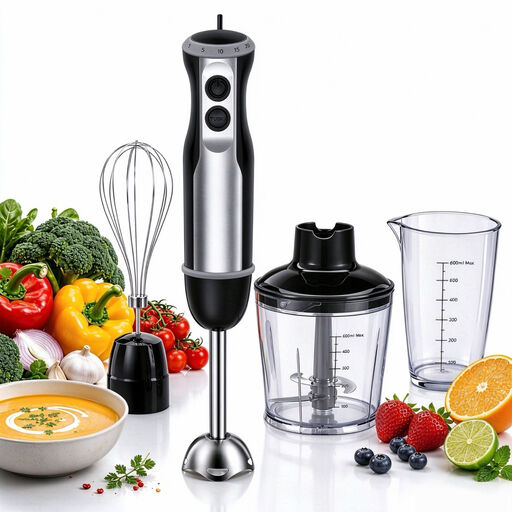 No image available
Stick blender with 6 speeds and turbo function
For blending in a suitable container; the multiple speed settings may be useful if you want to adjust the consistency as you blend.
The product name lists six speeds and a turbo function.
Joybuy
 No image available
Philips 3000 Series Mini Blender HR2510/90, 0.6 l
The mini blender is suited to smaller measured portions; check that the stated capacity is right for the amount you need to prepare each time.
The product name lists 0.6 l and 350 W. The product description states that it’s for indoor domestic use only and excludes commercial use; this product therefore isn’t suitable for a business workshop under those terms of use.
Joybuy
Frequently asked questions
Can I make cucumber soup with a stick blender?
Yes. The Netherlands Nutrition Centre’s cold cucumber soup recipe recommends blending the soup with a stick blender or food processor, then chilling it. If you’re using a different method, follow the relevant recipe and the appliance manual.
How can I keep equipment clean during back-to-back workshop sessions?
Clean the parts that have come into contact with food according to the manual before using them again. The NVWA requires food to be prepared and stored hygienically; food businesses must follow the relevant HACCP rules.
What should I check about the warranty when buying?
Check which jug, blender foot and accessories are included with the exact version. For a consumer purchase, the seller is responsible for providing a product that meets the required standards; the Dutch government states that the Netherlands has no fixed statutory warranty period.
Does a cookery workshop need a food safety plan, and must it declare allergens?
If you prepare, process or sell food as a food business, the NVWA says you must work with an HACCP food safety plan or the relevant hygiene code. If you sell or supply unpackaged soup to customers as a business, you must also provide information about any allergens present. Whether these requirements apply to a particular private workshop isn’t determined simply by calling it a ‘workshop’.


