
Fan of chunky raita
If you want to taste the cucumber, compare grating and stirring with blending. Albert Heijn Allerhande’s raita recipe uses coarsely grated cucumber.


You don’t need a hand blender to make cucumber raita with recognisable pieces of cucumber: grate the cucumber and stir it into the yoghurt. If you also want to blend dips or sauces, choose a hand blender with a detachable blending attachment that’s easy to clean. Only opt for a chopper or whisk if you’ll use those extra functions too.
If you want to taste the cucumber, compare grating and stirring with blending. Albert Heijn Allerhande’s raita recipe uses coarsely grated cucumber.
If you want to use your hand blender for more than one recipe, look for a detachable blending attachment and consider how easy it is to clean. Bosch lists a detachable attachment for the MSM64110.
If you also want to chop herbs or onions, or whisk ingredients, check which attachments come with the model. The Consumentenbond describes a chopper for tasks such as chopping onions and herbs, and a whisk for whisking.
Choose this if: you mainly make raita with recognisable pieces of coarsely grated cucumber.
Bear in mind: you’ll need to grate and chop the ingredients yourself.
Choose this if: you regularly blend soft ingredients, dips or sauces as well as making raita.
Bear in mind: a blending attachment blends or purées; you’ll need a grater for chunky cucumber.
Choose this if: you also regularly want to chop or whisk ingredients.
Bear in mind: extra parts take up storage space and need cleaning after use.
Albert Heijn Allerhande’s recipe uses coarsely grated cucumber in its raita; the Consumentenbond distinguishes blending, chopping and whisking as separate tasks.
| What to consider | What to look for | Who should prioritise this? |
|---|---|---|
| Texture of the raita | Coarsely grate the cucumber for recognisable pieces. If you’re considering a set, check whether it actually includes a grating attachment. | If I want to taste pieces of cucumber, I’d rather choose a grater than a blender; around 33% of consumers say texture is their main concern when buying. |
| Unnecessary spending | Consider whether you’ll use the hand blender for other recipes too, and check which parts come with the model. | If I mainly make raita, I want to know whether I really need an appliance; around 27% of consumers prioritise avoiding unnecessary spending. |
| Cleaning and storage | Check whether each model has a detachable blending attachment and which parts the instruction manual says can be cleaned. | In a small kitchen, I want to avoid having lots of separate parts to wash and store after cooking; around 27% of consumers say this is their main concern when buying. |
| Other cooking tasks | Check whether the model you choose includes the attachments you need for chopping or whisking. | If I also want to chop herbs or onions, or whisk ingredients, I need suitable attachments; around 13% of consumers prioritise these extra cooking tasks. |
Albert Heijn Allerhande’s raita recipe coarsely grates the cucumber and stirs it into the yoghurt; a hand blender isn’t essential for this.
First, decide whether you’ll also use a hand blender regularly for dips, sauces or other dishes.
The Consumentenbond describes a chopper for chopping, while the raita recipe calls for grated cucumber. These are different ways of preparing ingredients.
Think about the texture you want and check which attachments are actually included with each model.
Check the specifications for the exact model. The Dutch Government also distinguishes between a manufacturer’s warranty and your statutory rights if a product doesn’t meet expectations.
Compare wattages only for the correct model, and consider the manufacturer’s warranty separately from your statutory rights.
The MSM64110 and MSM67160 illustrate the difference between a hand blender with a measuring beaker and a set with extra attachments.
The Turbomix HB121838 is worth considering if you mainly want to blend ingredients.
The MultiQuick 3 MQ30001M is worth considering if you’re comparing a model with two speeds and a beaker.
The ProMix HR2520/00 is an option for simple blending and puréeing tasks.
These Joybuy products are hand blenders and sets for blending or puréeing as well as making raita; for recognisable pieces of cucumber, grating is still the right approach.
 Image unavailable
Ideal if you want to blend soups or sauces as well as make raita.
The description lists a detachable blending shaft, chopper and whisk. For chunky cucumber in raita, grate the cucumber separately.
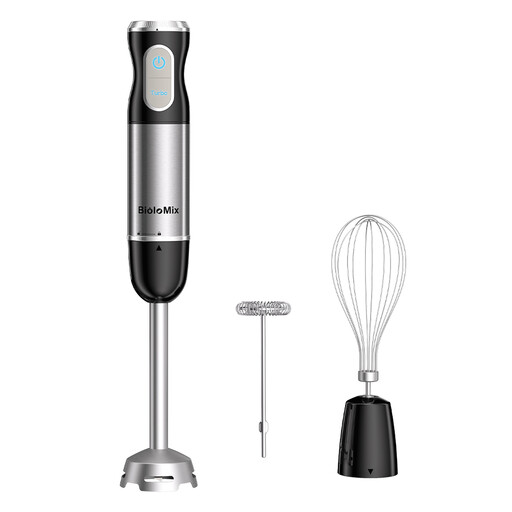 Image unavailable
An option if you want to blend soft ingredients for soups or smoothies as well as making raita.
The product name describes a detachable design, and the description mentions blending and puréeing. You’ll need a grater for a chunky cucumber texture.
 Image unavailable
Ideal if you want to chop ingredients to different consistencies as well as blend them.
The product description lists a chopper with fine, medium and coarse settings, and dishwasher-safe attachments. The chopper won’t replace a coarse grater.
 Image unavailable
A set to consider if you want to blend, chop or whisk as well as make raita.
The product name lists 15,000 rpm, a 700 ml beaker and a 500 ml chopper. According to the description, you can use the appliance for a maximum of one minute at a time, followed by a one-minute rest.
 Image unavailable
Ideal if you want to blend and purée ingredients for soups or sauces as well as make raita.
The product name lists 800 W and variable speed. The description mentions detachable parts and dishwasher cleaning; check the instruction manual for guidance on cleaning each part.
No, not if you want the chunky texture in Albert Heijn Allerhande’s recipe: grate the cucumber and mix it with yoghurt and herbs. A hand blender is for blending or puréeing, not for the cucumber preparation described in the recipe.
Choose a blending attachment for blending and puréeing; only opt for a chopper or whisk if you also want to chop or whisk. Check which parts are included with each model.
Check whether the blending attachment is detachable, and follow the instruction manual for your chosen model for cleaning and dishwasher-safe parts. A detachable attachment can be cleaned separately from the motor unit; don’t assume the whole motor unit is dishwasher-safe.
The Voedingscentrum advises keeping leftovers chilled in a sealed container, leaving them out of the fridge for no longer than 2 hours and storing them in the fridge for up to 2 days. The Voedingscentrum recommends setting your fridge to 4 °C.
No. According to the Dutch Government, the Netherlands has no fixed statutory warranty period; you’re entitled to a product that meets the expectations you’re entitled to have of it. If a product is faulty, the retailer is your point of contact, even if a manufacturer’s warranty applies.