
Vandaag of morgen in huis

Kwaliteit gegarandeerd
Download de app
Categorieën

A shelving unit might seem like a simple purchase, but the wrong choice can lead to frustration. A unit that wobbles, doesn't fit its intended space, or proves unexpectedly difficult to assemble is a purchase you'll regret. This article provides an objective overview of key selection criteria and presents a curated selection of products based on their specifications, enabling you to make an informed decision.
Before purchasing a shelving unit, it's wise to consider a few practical factors. This checklist will help you filter your options and find the unit that best suits your needs.
Accurately measure the available space (width, depth, and height). Factor in obstacles like baseboards, power outlets, and the swing clearance for doors or windows. An open-back shelf can make a space feel larger, but an oversized model will make a room feel cramped.
The material determines both the look and durability of the unit.
Consider the primary purpose of the unit. Will it serve as a storage rack for books and accessories against a wall? Or do you intend to use the shelving unit as a room divider to partition a larger space? In the latter case, it's crucial that the unit is finished on all sides and is stable enough to be freestanding.
Check the maximum load capacity per shelf. This is especially important if you plan to store heavy items like books, binders, or dinnerware. Products sold within the EU must meet safety standards. Look for information on anti-tip hardware, especially for households with children.
Most shelving units are delivered flat-packed for self-assembly. Check the estimated assembly time and the recommended number of people for the job. This will help you avoid any surprises upon delivery.
Below is a selection of three shelving units, analysed based on their product parameters and specifications.
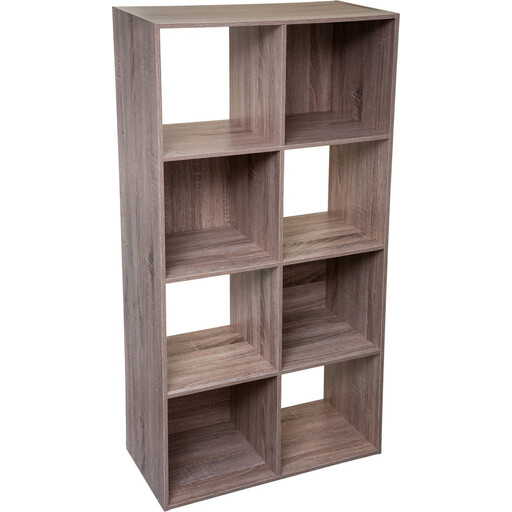
Why This Product This open storage unit from 5five is a practical and customisable solution. It comes with four back panels that you can place as desired, allowing you to alternate between an open and a partially enclosed look. The compartments are compatible with the brand's 'mix'n modul' storage boxes.
Benefits
Who is it for? This model is ideal for those seeking a functional and affordable storage rack with customisation options. It's a great choice for a living room, children's room, or home office, especially if you plan to use storage boxes.
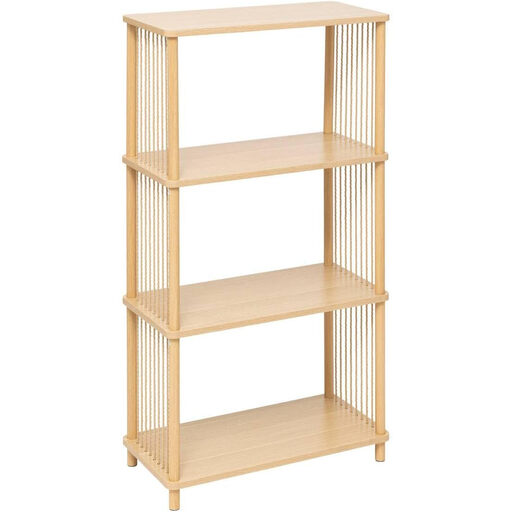
Why This Product The Kord shelving unit combines a minimalist design with industrial elements. Its steel frame and MDF shelves with a light wood-look melamine veneer create an airy, modern aesthetic. Thanks to its open design and slim profile, this unit fits well in smaller spaces.
Benefits
Who is it for? This industrial bookcase is a great option for anyone looking for a stylish, compact unit to display decor, plants, or a limited number of books. The maximum load capacity of 10 kg makes it less suitable for heavy archives.
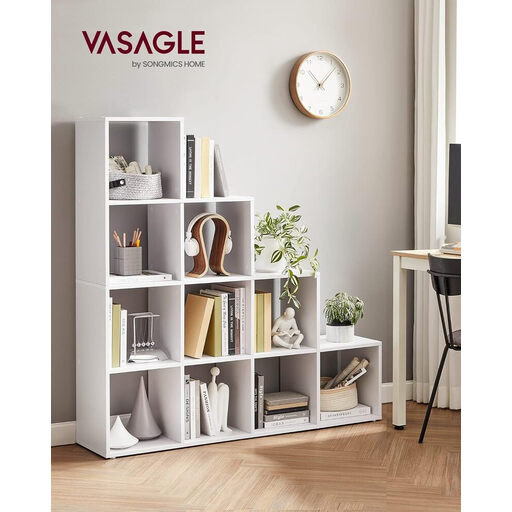
Why This Product This bookcase from VASAGLE stands out with its playful staircase design and its functionality as a room divider. With 10 open compartments accessible from both sides, it offers ample storage and creates a sense of space. The construction is engineered for stability and a high load capacity.
Benefits
Who is it for? Ideal for homeowners or renters who want to divide a large space or make a statement with a unique storage piece. Its high load-bearing capacity makes it an excellent choice for storing heavy books or binders.
If you can't find the perfect dimensions for your nook or wall in standard collections, an alternative is to create your own storage system. With a set of individual wooden shelves and brackets, you can build a wall-mounted solution that is perfectly tailored to your space and needs. This gives you maximum flexibility in both size and layout.
1. How much weight can a shelving unit support? The load capacity varies significantly depending on the model and material. It is typically specified as 'maximum load per shelf' or 'total load capacity'. A particleboard unit often has a lower capacity (e.g., 5-10 kg per shelf) than a unit with a steel frame or one made of solid wood (15 kg or more per shelf). Always check the product specifications.
2. Can any shelving unit be used as a room divider? Not every open-back shelf is suitable for use as a room divider. A suitable unit must be stable enough to be freestanding and should ideally be finished neatly on all sides. Models with a distinct front and back (for example, those with a thin back panel) are less suitable. Pay attention to the product description or choose a model explicitly designated as a room divider.
3. What is the difference between a shelving unit and a bookcase? The terms are often used interchangeably. A bookcase is traditionally designed for storing books, with shelves that span the full width. A shelving unit (or cube storage) features a grid-like layout with both horizontal and vertical dividers, creating square or rectangular compartments. This makes a shelving unit more versatile for storing a variety of objects.