
Anyone making generously filled rolls
You’re looking for a roll whose size, crust and crumb suit your filling. A rustic or multigrain option can be a good starting point, but judge the roll itself rather than relying on its name.


If you want a roll that can take a generous filling, don’t rely on terms such as ‘thick cut’ or ‘rustic’ alone. They won’t tell you how big the roll is or how much filling it can hold. Check its size and crumb, then choose between a fresh roll to serve straight away, bake-at-home rolls to prepare just before eating, or frozen rolls to keep in the freezer. Whichever option you choose, check the preparation instructions and the label.
You’re looking for a roll whose size, crust and crumb suit your filling. A rustic or multigrain option can be a good starting point, but judge the roll itself rather than relying on its name.
You want to prepare the rolls close to serving time without clashing with the rest of your dinner preparations. For bake-at-home and frozen options, the packet instructions will help you plan.
You check the ingredients, allergens and nutritional information, such as fibre and salt per 100 g. If iodine matters to you, check whether the product mentions baker’s salt or iodised salt too.
For a dinner for two, first decide when you want to serve the rolls. Then compare their size, the information on the label and how many you need.
| What to consider | What to check | Most relevant for |
|---|---|---|
| A base for generous fillings | Look at the roll’s cross-section and crumb; don’t assume that ‘rustic’ or ‘multigrain’ means it can hold more. | If I want to fill a roll generously, I look for a size that suits my filling. For around 30% of consumers, a sturdy base is the priority. |
| Serving warm | Check the preparation method and timings on the packet, and allow for defrosting if you’re using frozen rolls. | I want to serve warm rolls when dinner is ready, without leaving the timing to chance; for around 30% of consumers, planning when to serve them is a priority. |
| Ingredients and nutritional information | Check the allergen information and compare fibre and salt per 100 g; look for baker’s salt or iodised salt if relevant. | If I need to avoid an ingredient or want to compare nutritional information, I check the exact product variant. For around 20% of consumers, checking the label comes first. |
| Quantity and storage | Compare the number of rolls in each pack and read the storage instructions, especially after defrosting. | For two people, I want to choose how many rolls to prepare without creating unnecessary leftovers. For around 20% of consumers, getting the quantity right matters most. |
Those terms alone don’t tell you the size of the roll, the thickness of its slices or how much filling it can hold. Dirk describes its rustic multigrain roll as sturdy, but that is the retailer’s product description.
Look at the roll yourself if possible, and check any size or weight information for the variant you’re considering.
Preparation times and temperatures vary from product to product. Jumbo recommends baking its white rolls for 10–12 minutes at 200 °C; PLUS recommends 6–8 minutes at 220 °C for its white Korenlanders rolls.
Follow the instructions on the packet you buy, and factor in the oven space needed for your main course.
Ingredients and allergens vary between products. According to the Netherlands Nutrition Centre, there is no requirement to bake bread using baker’s salt.
Check the label of the specific product for allergens and, if relevant to you, look for a mention of baker’s salt or iodised salt.
Jumbo states that its white frozen rolls must not be refrozen after defrosting and should be prepared and eaten within 24 hours.
Only defrost the number you plan to use, and follow the storage instructions on your packet.
Worth considering if you want to compare an individual wholemeal roll with other options for dinner.
Offers, among other things, white bake-at-home rolls and white frozen rolls, giving you options for different serving times.
Worth considering for a white roll from its in-store bakery range, or white rolls to bake at home.
Worth considering if you’re looking for an individual white roll for a dinner for two.
Worth considering for packaged bake-at-home rolls, including white and multigrain options.
Worth considering if you want to look at a rustic multigrain roll or a white roll.
This white rustic roll is one option to consider if you’re looking for rolls to fill for a snack. Check its size and preparation instructions before planning when to serve it.
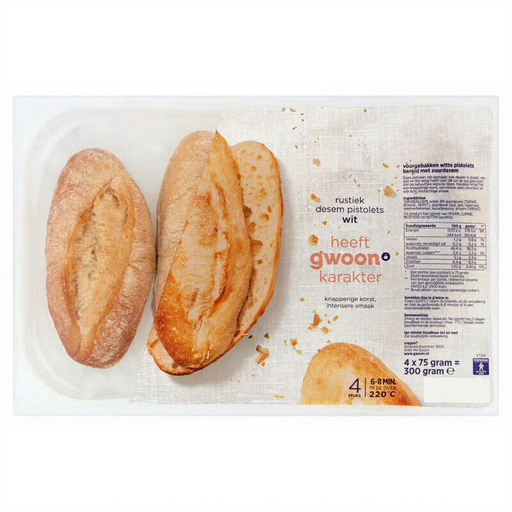 Image unavailable
A white rustic roll to consider for filled rolls; check its size if you plan to use plenty of filling.
Four rolls per pack. Check the packet for preparation instructions if you want to serve them warm.
No. According to the Netherlands Nutrition Centre, there is no requirement to bake bread using baker’s salt. If iodine matters to you, check the ingredients of the rolls you buy for ‘baker’s salt’ or ‘iodised salt’.
Read the allergen information for the exact variant rather than relying on the general name ‘roll’. The white rolls reviewed from PLUS contain wheat and spelt, and may contain sesame, mustard and lupin, among other allergens. According to the Netherlands Food and Consumer Product Safety Authority, any allergens that must be declared have to be listed on the label.
Plan the preparation according to the instructions on the packet of the rolls you choose. Jumbo recommends baking its white rolls for 10–12 minutes at 200 °C; PLUS recommends baking its white Korenlanders rolls for 6–8 minutes at 220 °C, or cooking them in an air fryer for 4 minutes at 200 °C.
Not with Jumbo White Frozen Rolls: Jumbo says they must not be refrozen after defrosting and should be prepared and eaten within 24 hours. For other variants, follow the instructions on the packet.