
Hosts with guests who have different preferences
If one guest prefers white bread and another prefers wholemeal, you can serve both types separately. That way, neither has to be the default choice for everyone.


For Friday afternoon drinks with guests who have different preferences, serving white and wholemeal crusty rolls side by side is a practical choice. Everyone can choose for themselves, while the wholemeal option offers a different nutritional profile. Only serve wholemeal rolls exclusively if that suits your group. For part-baked rolls, check the cooking time, and if anyone has an allergy, check the latest information for the product you buy.
If one guest prefers white bread and another prefers wholemeal, you can serve both types separately. That way, neither has to be the default choice for everyone.
A dark colour or the name ‘multigrain’ alone doesn’t tell you whether a crusty roll is wholemeal. Check the product description, ingredients and fibre content per 100 g.
If you’d like to serve the rolls warm, part-baked rolls are an option, provided you have a suitable oven or air fryer and can fit the cooking time into your plans.
First decide whether you want to offer both white and wholemeal rolls. Then choose between ready-to-serve rolls and those that need baking for each type.
| What to consider | What to look for | Who it matters to |
|---|---|---|
| Choosing between white and wholemeal | Include both types separately in your plans and label or place them clearly apart. | If guests have different bread preferences, I don’t want one type to be their only option. This is the most important factor for around 33% of consumers. |
| Wholemeal and fibre | Check that ‘wholemeal’ appears in the product description and compare the fibre content per 100 g. | If wholemeal is the deciding factor for me, I want to be able to tell from the ingredients, not just the colour. This is the main buying concern for around 25% of consumers. |
| When you’ll serve them | Check whether the rolls need baking, and look at the time, temperature and equipment available. | If I want to serve the rolls warm, baking them needs to fit into my plans. Around 25% of consumers put this first. |
| Allergen information | Check the current packaging or, for unwrapped rolls, ask for allergen information before buying. | If I need to cater for an allergy, I want information about the exact rolls I’m serving. This is the main concern for around 17% of consumers. |
The name ‘multigrain’ alone doesn’t confirm that a crusty roll is wholemeal. PLUS describes its multigrain roll as a wholemeal multigrain roll, but that doesn’t automatically apply to other products.
Look for ‘wholemeal’ on the packaging, and compare the ingredients and fibre content per 100 g.
Part-baked rolls take time to prepare and need space in the oven or air fryer. If you need to bake several batches, the first rolls may cool down before everything is ready to serve.
Check the instructions and the number of rolls per pack, and plan the baking around serving time.
Ingredients and information on packaging can change. The product examples mentioned contain wheat; other allergens vary by product.
Check the current packaging of the rolls you buy. For unwrapped rolls, ask about allergen information before purchasing.
Albert Heijn provides product information for both a white wheat roll and a wholemeal roll.
Jumbo lists several types of crusty rolls in its range overview.
PLUS provides product information for white part-baked rolls and wholemeal multigrain part-baked rolls.
Lidl lists a white crusty roll among the rolls baked in store.
ALDI lists a white crusty roll and sells baked rolls in stores with an in-store bakery.
These white crusty rolls are a good fit for the white option on a mixed platter. Add wholemeal crusty rolls separately if you want to cater for both preferences.
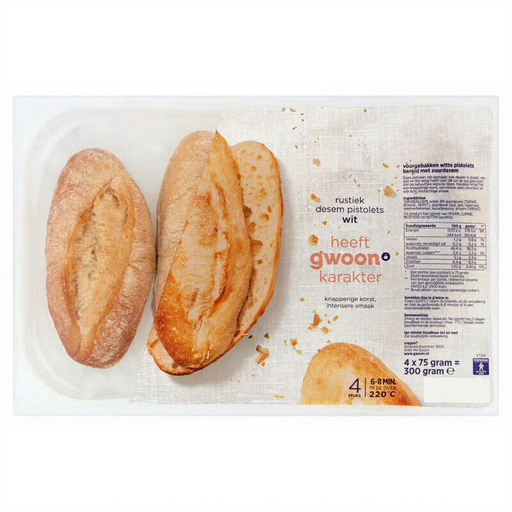 Image unavailable
A white option for guests who prefer white crusty rolls; this pack contains 4.
Check the packaging to see whether the rolls need baking and which allergen information applies to this product.
When guests have different preferences, they can choose the type of bread they like. Keep the white and wholemeal rolls separate so it’s clear which is which.
It varies by product. PLUS says to bake its white and wholemeal multigrain part-baked rolls for 8–10 minutes in an oven at 220 °C, or for 4 minutes in a preheated air fryer at 200 °C. Follow the instructions on the packaging of the variety you buy.
Ask the seller for allergen information if it isn’t clearly available for unwrapped rolls. For pre-packed products, the information is on the label, according to the Netherlands Food and Consumer Product Safety Authority.
No, don’t assume that it does. According to the Netherlands Nutrition Centre, bakers aren’t required to use baker’s salt. For pre-packed rolls, check the ingredients; for unwrapped rolls, ask which type of salt has been used.