Who are these rolls suitable for?

People working from home who want to make lunch a little special

They’re looking for a roll made with ingredients such as sourdough or spelt, or one with a rustic finish, and don’t mind baking it at home first. The ranges at PLUS and Jumbo include these options alongside standard rolls.

People who regularly have rolls for lunch

They want to check the wholemeal flour and fibre content rather than judging by a premium product name or the colour of the roll alone. Albert Heijn, for example, provides this information for its wholemeal roll.

People working from home who plan their lunches ahead

They want to have rolls in the house for a short or unexpected break. The choice comes down to whether the rolls are freshly baked, bake-at-home or frozen, as well as the relevant storage and preparation instructions.

What should you look for when choosing?

First, decide what matters most for your work-from-home lunch: a different flavour and crust, convenience, nutritional information, or a specific dietary or allergen requirement. Then compare the packaging of rolls that meet your needs.

What to considerWhat to look forWho is this important for?
Flavour and crust Check whether it’s a sourdough, spelt or rustic variety, and read how to prepare it. If I want to make an ordinary lunch with a filled roll feel a little special, I start by choosing the type of roll and the crust I’m after. Around 31% of consumers put this lunch experience first.
Speed and keeping a supply at home Check whether the rolls are freshly baked, bake-at-home or frozen, and read the preparation and storage instructions. During a short work break, I want to know whether I can have lunch straight away or need to bake and defrost the rolls first. For around 31% of consumers, this practical convenience comes first.
Wholemeal flour and fibre Read the ingredients list and compare fibre and salt per 100 g; multigrain doesn’t automatically mean wholemeal. If you often have rolls for lunch, you may want to choose based on wholemeal flour and fibre rather than a premium name. This is the main consideration for around 23% of consumers.
Diet and allergens If needed, look for an explicit gluten-free label and read the full allergen information on the current packaging. If I need to avoid a particular ingredient, suitability matters more than the crust or preparation time. Around 15% of consumers put this check first.

Common mistakes

  • Assuming sourdough or multigrain means wholemeal

    These names alone don’t tell you how much wholemeal flour or fibre a roll contains. For example, Albert Heijn states that its wholemeal roll is made with 100% wholemeal flour, while PLUS lists 56% wholemeal wheat flour for one of its multigrain rolls.

    If these qualities will determine your choice, compare the ingredients list and the fibre per 100 g.

  • Assuming a roll contains iodine based on its name

    The product name doesn’t tell you what type of salt was used in an individual roll.

    If it matters to you, check the ingredients list on the current packaging to see whether it mentions baker’s salt or iodised salt.

  • Defrosting frozen rolls without planning when you’ll have lunch

    Jumbo says its frozen rolls must be prepared and eaten within 24 hours of defrosting. According to the product information, they shouldn’t be refrozen.

    Only defrost as many rolls as you’ll use within that time, and follow the instructions on the packaging.

  • Assuming gluten-free means free from other allergens

    A gluten-free label doesn’t tell you about all the other ingredients or warnings. Albert Heijn states that its gluten-free white rolls may contain egg, milk, soya, almond and hazelnut, among other ingredients.

    If you have an allergy, read the full, current ingredients and allergen information as well.

Brands to consider

Albert Heijn

Its range includes a wholemeal roll and a separate gluten-free white roll.

  • For its AH wholemeal roll, Albert Heijn states that it contains 100% wholemeal flour and 7,1 g of fibre per 100 g.
  • Check the packaging again when you buy: ingredients and allergen information can change.

Jumbo

Its range includes standard rolls, multigrain sourdough rolls and frozen rolls.

  • The different storage options let you choose between rolls that are ready to eat and keeping a supply at home.
  • According to the product information, Jumbo Frozen White Rolls must be prepared and eaten within 24 hours of defrosting.

PLUS

Its range includes Korenlanders sourdough rolls and multigrain rolls.

  • For the white Korenlanders sourdough rolls reviewed, PLUS provides preparation instructions for both an oven and an air fryer.
  • Sourdough and multigrain don’t tell you on their own how much wholemeal flour or fibre an individual variety contains.

Dirk

Its range includes rustic multigrain bake-at-home rolls and a separate brown wheat roll.

  • The 1 de Beste rustic multigrain rolls are listed in packs of four; the brown wheat roll is sold individually and weighs 80 g.
  • If you’re choosing based on ingredients or allergens, check the information on the packaging.

Lidl

It lists a freshly baked white roll for anyone who’d rather not bake at home.

  • The white roll listed is freshly baked in store.
  • Lidl says its fresh range can vary by store, so check which varieties are available locally.

Rolls on Joybuy

If you’re after a rustic roll for your work-from-home lunch, this pack is worth a look. Compare the preparation and allergen information on the packaging with what you need for your lunch.
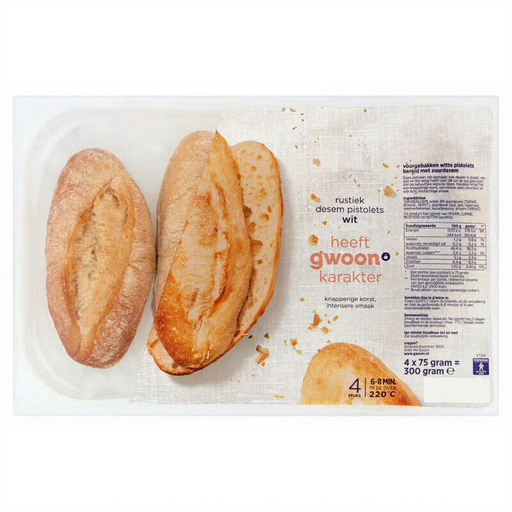
g'woon white rustic rolls, 4 pack

g'woon white rustic rolls, 4 pack

An option if you’re looking for a rustic roll for your work-from-home lunch.

The ingredients information lists wheat and spelt; the allergen information also mentions lupin, mustard, nuts and sesame. Check the current packaging, including for preparation instructions.

View on Joybuy

Frequently asked questions

Are sourdough or rustic rolls automatically wholemeal?

No. Those names don’t tell you how much wholemeal flour the rolls contain. Read the ingredients list and, if fibre matters to you, compare the amount per 100 g.

Can I cook bake-at-home rolls in an air fryer?

Only do so if the instructions for those particular rolls say you can. For the Korenlanders sourdough rolls reviewed, PLUS recommends a preheated air fryer at 200 °C for 4 minutes. For other varieties, follow their own packaging instructions.

How should I plan frozen rolls for a short lunch break?

Allow time for defrosting and preparation, and only take out of the freezer what you’ll use in time. Jumbo says its frozen rolls must be prepared and eaten within 24 hours of defrosting and must not be refrozen.

Is a gluten-free roll also free from other allergens?

Not automatically. Albert Heijn states that its gluten-free white rolls may contain egg, milk, soya, almond and hazelnut. If you have an allergy, check the current packaging, including any ‘may contain’ warnings.

Does every roll contain iodised salt?

Don’t assume so based on the product name. For an individual roll, check the ingredients list for terms such as ‘baker’s salt’ or ‘iodised salt’.
