
For anyone serving a roll alongside cake
You want to be able to fill an individual roll and serve it with coffee. Albert Heijn lists a single roll, while Dirk offers a pack of four. Check the product format if you want to cut your own thick halves.


If you want to serve substantial filled halves alongside coffee and cake, choose a roll you can cut open yourself: the word ‘roll’ alone tells you nothing about how thickly it is sliced. A fresh roll is ready to serve straight away, while a part-baked roll needs some preparation. If you prefer extra fibre or need to avoid gluten, check the ingredients and allergen information for the specific variety.
You want to be able to fill an individual roll and serve it with coffee. Albert Heijn lists a single roll, while Dirk offers a pack of four. Check the product format if you want to cut your own thick halves.
You compare the ingredients and fibre per 100 g, rather than relying on names such as multigrain or rustic. PLUS’s product information states that its multigrain rolls contain 56% wholemeal wheat flour and 7 g of fibre per 100 g.
For example, you may need a product explicitly labelled gluten-free or want to know which allergens a roll contains. Check the current packaging: the bread type alone is not enough.
First decide whether you want to serve the rolls straight away or bake them at home. Then compare the product format, ingredients and preparation instructions with what matters for your coffee break.
| What to look for | What to check when buying | Who it matters to |
|---|---|---|
| A roll you can fill | Check whether you’re buying individual rolls or a pack, and whether you want to cut them open yourself. | If I want to serve filled halves alongside cake, I need to be able to assess the product format. For around 40% of consumers, a roll that’s sturdy enough to fill is the top priority. |
| Bread type and fibre | Compare the ingredients and fibre per 100 g; don’t judge by the word ‘multigrain’ alone. | If you buy rolls regularly and want to keep an eye on fibre, the nutritional information is more useful than a rustic-sounding name. Around 30% of consumers give bread type and fibre top priority. |
| Preparation | Check whether baking is required and follow the pack instructions for time, temperature and equipment. | I want to be able to serve warm rolls just before my coffee break, but I need to fit the preparation in. Ease of preparation is the top priority for around 20% of consumers. |
| Ingredients and allergens | Read the current allergen information; if you need a gluten-free product, choose one that is explicitly labelled as such. | If I need to take a dietary requirement or allergen into account, that comes before choosing white or multigrain. For around 10% of consumers, this is their first priority when buying. |
A crusty roll is sold as an individual roll; its name doesn’t guarantee a particular slice thickness. If you’re expecting filled halves, you may find the product comes in a different format than you had in mind.
Check the description and product photo. If you want to decide how thickly to cut it, choose a roll you can open yourself.
A bread type or sourdough ingredient doesn’t make a roll gluten-free. The multigrain and spelt varieties described contain gluten-containing grains.
If you need a gluten-free product, choose one that is explicitly labelled as gluten-free and read the current allergen information.
According to the Netherlands Nutrition Centre, using baker’s salt when baking is not compulsory. So you can’t tell whether it’s included from the word ‘roll’ alone.
Check the label to see whether baker’s salt or iodised salt is listed among the ingredients.
The word ‘rustic’ doesn’t tell you how much wholemeal flour or fibre a particular roll contains.
Compare the ingredients and nutritional information per 100 g for the products you’re considering.
Albert Heijn describes its 70 g white wheat roll as freshly baked in store.
Jumbo’s roll range includes several types of bread, including white, seeded and spelt.
Lidl describes its 700 g pack of white rolls as suitable for baking at home.
ALDI lists a white roll sold individually.
PLUS lists multigrain rolls, among other options, as well as a separate gluten-free white variety.
Dirk lists white and rustic white part-baked rolls in packs of four.
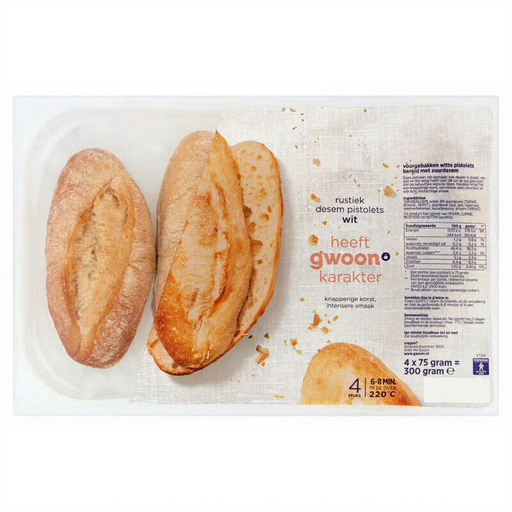
This pack of four white rolls is a good fit if you’re serving several rolls alongside coffee and cake. Check the product format and preparation instructions before your visit.
 No image available
A pack for anyone wanting to serve several individual rolls with coffee. Check whether they need baking and how you’d like to cut them open. If you have dietary requirements or need to avoid particular allergens, check the current packaging.
No. According to the Netherlands Nutrition Centre, using baker’s salt when baking is not compulsory. Check the label to see whether baker’s salt or iodised salt is listed among the ingredients.
Compare the ingredients and fibre per 100 g for the specific rolls. The Netherlands Nutrition Centre recommends replacing white bread with wholemeal or brown bread as often as possible; the word ‘multigrain’ alone doesn’t tell you how much wholemeal flour a product contains.
Yes, if the packaging includes air fryer instructions. PLUS gives instructions for its multigrain rolls and Korenlanders multigrain sourdough rolls to cook at 200 °C for 4 minutes; for other products, follow the instructions on their own packaging.
Not automatically: the multigrain and spelt varieties described contain gluten-containing grains. If you need a gluten-free product, choose a roll explicitly labelled as gluten-free and check the current allergen information.