
Fussy breakfast eaters who want to eat less white bread
If you’re used to the taste of a white roll, you could try a brown or multigrain one for a savoury breakfast. Check the label if the amount of wholemeal flour matters to you.


To be sure your roll is made with wholemeal flour, choose one with ‘wholemeal’ in the name: according to the Voedingscentrum, this means it is made with 100% wholemeal flour. A brown or multigrain roll may be a good option if you want to make a gradual change from white bread, but check the ingredients and fibre per 100 g; colour and the word ‘multigrain’ alone don’t tell you enough. If you’re having savoury fillings, check the salt content of both the roll and the filling.
If you’re used to the taste of a white roll, you could try a brown or multigrain one for a savoury breakfast. Check the label if the amount of wholemeal flour matters to you.
If wholemeal flour or fibre content is a priority, the product name, ingredients and nutritional information per 100 g are more useful than the colour of the roll alone.
A bake-at-home roll is a good choice if you want a warm roll and have the time and equipment to follow the instructions on the packaging.
First, decide what matters most for your savoury breakfast: a familiar taste, clearly labelled wholemeal flour, baking at home or being able to buy a roll when you need one.
| What to consider | What to check | Who it matters to |
|---|---|---|
| Moving from white to more wholemeal flour | For brown and multigrain rolls, check the ingredients and compare fibre per 100 g; the name alone doesn’t confirm that they’re made entirely with wholemeal flour. | If I’m used to the taste of white bread, I’d like to try a brown or multigrain roll without assuming it’s wholemeal. This gradual change is a priority for around 36% of consumers. |
| Clearly labelled wholemeal flour and fibre | Look for ‘wholemeal’ in the product name and compare fibre on the same basis, per 100 g. | If I want to choose mainly based on wholemeal flour and fibre, I need a claim I can check on the packaging. This matters most to around 29% of consumers. |
| Baking at home | Check the storage instructions, preparation time and whether the instructions suit your oven or air fryer. | If I want a warm roll in the morning, I need to know whether I can prepare it in time using the equipment I have. Around 21% of consumers prioritise the convenience of baking at home. |
| Availability and how it’s sold | Decide whether you want an individual or packaged roll, and check the current range at your chosen shop. | If I only need a few rolls, I want to be able to buy the variety I’m after when I’m preparing breakfast. This is the main concern for around 14% of consumers. |
According to the Voedingscentrum, brown bread is made with a combination of wholemeal flour and white flour. ‘Multigrain’ on its own doesn’t mean a roll is entirely wholemeal either.
Look for ‘wholemeal’ in the name. Otherwise, compare the ingredients and fibre per 100 g.
The filling also contributes to a savoury breakfast, and both the roll and the filling can contain salt.
Check the filling’s nutritional information too, and consider the portion you use.
Preparation and storage instructions vary by product. For example, a frozen roll requires different planning from one bought loose.
Before buying, check the preparation and storage instructions on the packaging you’ve chosen.
Product ranges and recipes can change, even if you’ve bought a particular roll before.
Check the current range when you buy, and read the label on the pack you take home.
Albert Heijn lists packs of four crusty rolls and also lists a wholemeal sourdough roll in its range.
Jumbo lists, among other products, white, multiseed and brown frozen rolls.
PLUS lists white and multigrain bake-at-home rolls, with ingredients and nutritional information provided.
Dirk lists individual white and brown rolls, including an 80 g brown wheat roll.
ALDI lists an individual white roll.
At Lidl, you can look for white and wholemeal rolls for a savoury breakfast.
This white roll is an option if you’d prefer to stick with a familiar white variety for a savoury filling. If you’re specifically looking for a brown, multigrain or wholemeal roll, check that feature separately on another product.
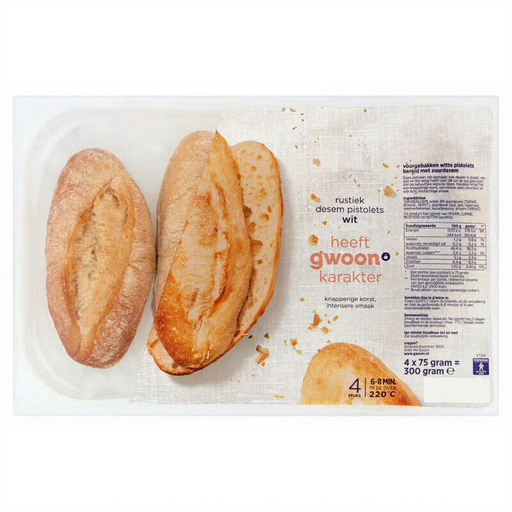 Image unavailable
For anyone who wants a white roll with a savoury breakfast; the pack contains four.
If you want to compare wholemeal flour or fibre, first check the ingredients and nutritional information on the current packaging. Also check the allergen information if it’s relevant to your choice.
No. According to the Voedingscentrum, ‘wholemeal’ means bread made with 100% wholemeal flour; ‘multigrain’ doesn’t mean that. According to PLUS, its multigrain rolls mentioned here contain 56% wholemeal wheat flour. Check the label of the variety you buy.
A brown or multigrain roll can be a stepping stone if you’re used to white rolls. If you want to be sure the roll is made with wholemeal flour, look for ‘wholemeal’ in the product name and check the fibre per 100 g too. Factor in your filling, especially if you’re watching your salt intake.
It varies by product, so check the ingredients on the current label. The white and multigrain rolls mentioned from PLUS, and Albert Heijn’s wholemeal sourdough roll, list iodised salt. That doesn’t mean every roll contains the same type of salt.
Follow the instructions on the packaging you’ve chosen. PLUS recommends four minutes in a preheated air fryer at 200°C for its multigrain bake-at-home rolls; this instruction won’t necessarily apply to other rolls.
Read the allergen information on the packaging for the exact variety you’re buying. Don’t rely on the words ‘white’, ‘brown’ or ‘multigrain’ alone: ingredients and information about possible allergens can vary from product to product.