
Office organisers planning an aniseed-themed spread
You want to offer an aniseed topping for crispbread, bread or yoghurt, or use muisjes as decoration. Albert Heijn and Jumbo describe crushed muisjes as sugar-coated aniseed seeds, not biscuits.


Choose crushed muisjes for an office biscuit tin if you want to offer a loose aniseed topping for crispbread, bread or yoghurt. If colleagues want to take something straight from the tin, this product format is less suitable. If it will be shared, check the ingredients and nutritional information on the label too.
You want to offer an aniseed topping for crispbread, bread or yoghurt, or use muisjes as decoration. Albert Heijn and Jumbo describe crushed muisjes as sugar-coated aniseed seeds, not biscuits.
You want to work out how many small topping portions a pack will provide, and whether colleagues will use them. Albert Heijn lists a 6 g serving and 45 servings per pack for De Ruijter Gestampte Muisjes 270 g.
You want colleagues to be able to check the ingredients and allergens before using what’s in the tin. The product details for the crushed variety list wheat and cereals containing gluten; Jumbo also lists 79 g of sugars per 100 g.
The format determines how you use it. First decide whether you want to offer a fine topping, aniseed sprinkles or whole muisjes, then consider how they’ll fit into your office supplies.
Choose these if: you’re looking for a finely crushed aniseed topping for crispbread, bread or decoration.
Trade-off: this loose topping needs a suitable way to serve it and won’t replace a biscuit you can hand out on its own.
Choose these if: an aniseed flavour matters, but the crushed format doesn’t.
Trade-off: According to Albert Heijn, De Ruijter Anijshagel is sugar sprinkles with an aniseed flavour, not crushed muisjes.
Choose these if: the whole format or a blue-and-white theme suits the occasion.
Trade-off: whole muisjes are still loose sprinkles and don’t have the fine texture of crushed muisjes.
| What to consider | What to check when buying | Who it matters to |
|---|---|---|
| How they’ll be used in the tin | Check whether crispbread, bread or another base will be served with the loose muisjes. | If you want to put something out that colleagues can take straight from the tin, loose topping without anything to sprinkle it on isn’t the right choice. Around 46% of consumers prioritise something that’s ready to hand out. |
| Amount you can use | Compare the pack size with expected use; Albert Heijn lists 45 topping portions of 6 g for the crushed variety. | If you’re stocking a shared cupboard, you’ll want to know whether small portions will actually be used before a pack is left sitting there. Around 27% of consumers prioritise the amount they can use. |
| Ingredients and sugars | Check the label for wheat, cereals containing gluten and nutritional information per 100 g. | If colleagues are helping themselves, you’ll want to check the ingredients and sugars. This product information matters most to around 27% of consumers. |
Albert Heijn and Jumbo describe them as sugar-coated aniseed seeds. Without crispbread, bread or another way to use them, a tin of loose sprinkles might not be what colleagues expect.
Decide before buying whether you want to offer a topping. If the tin is meant to hold a treat people can take straight away, look for something ready to hand out.
The 45 portions of 6 g listed by Albert Heijn for the 270 g pack are small topping portions, not necessarily 45 complete treats.
Choose an amount based on how often the muisjes will actually be used as a topping.
According to the product details, De Ruijter Gestampte Muisjes 270 g contains wheat and cereals containing gluten. Jumbo lists 79 g of sugars per 100 g.
Check the packaging before buying, and keep the ingredients and allergen information available if you transfer the muisjes to another tin.
Albert Heijn and Jumbo list De Ruijter Gestampte Muisjes 270 g; their product pages also show other aniseed-flavoured formats.
These whole blue-and-white muisjes are a good choice for an aniseed topping or office decoration when the format matters; they aren’t the crushed variety discussed in the main question.
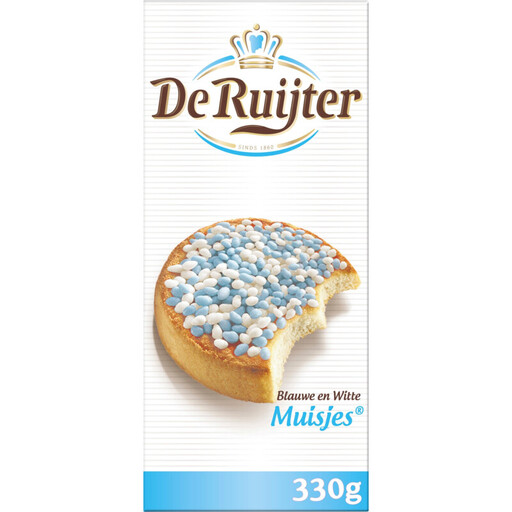 Image unavailable
Worth considering if you want to offer whole blue-and-white muisjes as a topping or decoration, rather than crushed muisjes.
The pack contains 330 g. Jumbo lists wheat, cereals containing gluten and 79 g of sugars per 100 g for De Ruijter Blue & White Muisjes 330 g; check the label if they’ll be shared.
No. Don’t offer the 270 g variety as gluten-free: the product details from Albert Heijn and Jumbo list wheat starch, wheat and cereals containing gluten. Check the label when you buy it for the latest ingredient information.
Keep them dry and follow the best-before information on the packaging. If you use a clean, airtight tin, keep the original product information with the supplies.
Albert Heijn lists 45 portions of 6 g for De Ruijter Gestampte Muisjes 270 g. These are topping portions, not complete office treats.
Keep the original packaging by the tin or place the ingredients and allergen information clearly beside it. That way, colleagues can check the information before using the muisjes.