
Festival organisers setting up a topping station
For anyone looking to finish rusks, cupcakes or other treats with a dry aniseed topping, and who needs to be able to give visitors information about the ingredients.


Choose crushed aniseed sprinkles if you want a festival treat topped with the distinctive texture of crushed, sugared aniseed, and need a topping that can be transported and served dry. Fine aniseed sprinkles are an alternative, but they are not an exact substitute. The products reviewed contain wheat, so check the current packaging before serving and make sure visitors can access the allergen information.
For anyone looking to finish rusks, cupcakes or other treats with a dry aniseed topping, and who needs to be able to give visitors information about the ingredients.
For anyone after a sprinkle-on topping for several uses, rather than an individually wrapped snack. According to the Netherlands Nutrition Centre, you can keep opened crushed aniseed sprinkles in a kitchen cupboard for up to a year, provided the pack is sealed properly and stored in a dry place.
For anyone who needs to check the ingredients before serving: the crushed aniseed sprinkles and aniseed sprinkles reviewed list wheat and cereals containing gluten. The packaging for the specific batch you choose is the one to check.
First decide whether you want the coarser texture of crushed aniseed sprinkles or a finer aniseed topping. Then check that you can serve it dry and have the ingredient information to hand.
| What to consider | What to check when buying | Who should pay particular attention? |
|---|---|---|
| Using it as a topping | Choose the product form you want and check that you have a base product and a dry place to serve it. Check the event’s rules on bringing in or serving unwrapped food. | If I want to finish rusks or baked goods on the spot, I need a sprinkle-on topping rather than a snack on its own. For around 42% of consumers, practical use comes first. |
| Packaging and using leftovers | Compare the pack size with the amount you expect to use, and check how to keep an opened pack dry and tightly sealed. | I don’t want to throw away an opened pack unnecessarily after the event. For around 33% of consumers, making use of the remaining product is the top priority. |
| Allergen information | Read the label on the current packaging and make allergen information readily available when offering individual portions. | When I offer visitors an unwrapped treat, I need to be able to tell them which allergens it contains. Around 25% of consumers put this check ahead of the other considerations. |
The product information reviewed recommends storing them in a dry place. The Netherlands Nutrition Centre also advises sealing an opened pack well and keeping it dry; according to the storage guide, the freezer is less suitable.
Transport the pack sealed and dry, then close it tightly again after use.
The crushed aniseed sprinkles reviewed come in a 270 g pack; the aniseed sprinkles come in a 300 g pack, but have a finer texture and different ingredients. So the pack weight doesn’t tell you what texture you’ll be serving.
Choose the topping you want first, then match the pack size to your plans.
The De Ruijter Gestampte Muisjes reviewed list wheat and cereals containing gluten. When a treat is offered unwrapped, visitors won’t automatically be able to see the label.
Check the current ingredients list and make information about any allergens available to visitors before they choose or buy.
The brand behind the 270 g Gestampte Muisjes and 300 g Anijsstrooisels reviewed here. The product texture matters when choosing a topping for rusks, yoghurt or baked goods.
A retailer with product information for the 270 g De Ruijter Gestampte Muisjes reviewed here.
A retailer with product information for the 270 g De Ruijter Gestampte Muisjes reviewed here.
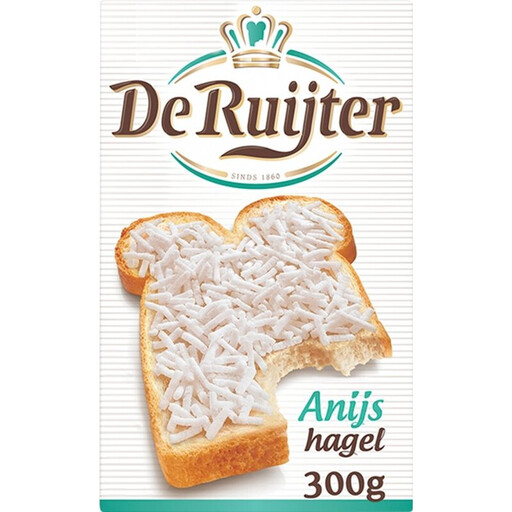
This product is a good fit if you’re looking for a finer aniseed topping for bread, yoghurt or baked goods. It doesn’t have the same texture as crushed aniseed sprinkles.
 No image available
A finer aniseed topping for anyone who doesn’t need the texture of crushed aniseed, for example as a topping for bread, yoghurt or baked goods.
300 g pack. The product information reviewed lists wheat and cereals containing gluten, and 91 g of sugars per 100 g. Check the current packaging if you’re serving it to visitors, and store it in a dry place.
The De Ruijter Gestampte Muisjes reviewed are crushed, sugared aniseed. According to the product information, you can use them on bread or rusks, stir them into yoghurt, or decorate cupcakes and baked goods with them. At a festival, they work as a topping for a treat made with a base product, rather than as an individually wrapped snack.
Seal the pack tightly and store it in a dry kitchen cupboard. The Netherlands Nutrition Centre says opened crushed aniseed sprinkles can be kept for up to a year under these conditions. For an unopened pack, follow the best-before date and storage advice on the packaging.
No. The De Ruijter Gestampte Muisjes 270 g reviewed list wheat and cereals containing gluten. Read the label on the current packaging before buying or serving.
When offering unwrapped food, make sure visitors can get information about any allergens it contains before buying. The Netherlands Food and Consumer Product Safety Authority outlines different ways to provide this information. Check which approach is right for the way you’re offering the food, and refer to the ingredients on the packs you use.