
Consumers comparing fat levels
You want to pick up some crisps when getting chips, and base your choice mainly on the fat per 100 g—not just the claim on the front of the bag.


When choosing crisps to have with chips, don’t rely solely on a ‘less fat’ claim. Compare fat and salt per 100 g, and think about how many crisps you plan to eat. Jumbo lists 9.2 g of fat and 1.5 g of salt per 100 g for Chio Oven Chips Sea Salt; Albert Heijn lists 13 g of fat and 0.85 g of salt per 100 g for Lay’s Oven Baked Natural. So, of these two, the option with less fat contains more salt.
You want to pick up some crisps when getting chips, and base your choice mainly on the fat per 100 g—not just the claim on the front of the bag.
You’re having crisps with chips and possibly a sauce, so you want to know how much salt your chosen crisps add to what you’ll actually eat.
You’re looking for a plain or ridged variety with a relative reduction in fat, but you also want the type of product to suit your preferences.
If you’re considering lower-fat crisps to have with chips, it’s worth thinking about fat, salt, how many crisps you’ll eat and the type of product. Decide which matters most to you, then compare the nutritional information for the specific variety.
| What to consider | What to check when buying | Who it matters to |
|---|---|---|
| Fat per 100 g | Compare fat levels on the same 100 g basis. If a product claims ‘less fat’, check which product it’s being compared with. | When I have crisps with chips, I want to choose mainly by the fat level, not a percentage on the front of the pack. Around 42% of consumers put fat levels first. |
| Salt | Check the salt per 100 g for your chosen flavour, then work out how much that means for the amount you plan to eat. | With chips and sauce, I want to know how much salt the extra crisps add. That’s why salt is the main thing to consider for around 25% of consumers. |
| Quantity | Check the pack size, and use the stated serving size to help with your calculations—not as a fixed amount to eat. | I’m just looking for something crunchy on the side and want to decide how many crisps to have. A suitable portion is the top priority for around 17% of consumers. |
| Product type and texture | Check whether it’s a baked crisp, a ridged crisp or a snack made with ingredients such as lentil flour. | I want the crisps to suit my preference for plain or ridged varieties, even with less fat. Around 16% of consumers give this choice the highest priority. |
A fat-reduction claim compares a product with other crisps. The Netherlands Nutrition Centre defines ‘low fat’ separately as a maximum of 3 g of fat per 100 g; the varieties discussed here list higher fat levels.
Check the fat per 100 g and the product used as the comparison for the reduction claim.
Jumbo lists 9.2 g of fat and 1.5 g of salt per 100 g for Chio Oven Chips Sea Salt. So a lower fat level doesn’t automatically answer your question about salt when you’re having crisps with chips.
Decide which figure matters more to you, then compare both figures on the specific bag.
A nutrition table per serving doesn’t necessarily reflect how much you’ll take from the bag yourself.
Decide how many crisps you plan to eat, then work out the nutritional values for that amount.
Ingredients and nutritional values can change when a recipe is updated. This is particularly important if you’re checking for allergens or a specific nutritional value.
Check the ingredients, allergens and nutritional information on the packaging you’re actually using.
Oven Chips Sea Salt is an oven-baked potato snack for anyone mainly comparing fat per 100 g.
Oven Baked Natural is a plain variety with a relative reduction in fat.
AH Ridged Crisps Plain Less Fat is an option if you’re specifically looking for ridged crisps.
Sea Salt Lentil Crisps are a snack made with lentil flour, rather than a standard potato crisp.
These oven-baked crisps are options if you’re considering a variety with a fat-reduction claim to have with chips. Before choosing, check the salt level and nutritional information for the exact bag too.
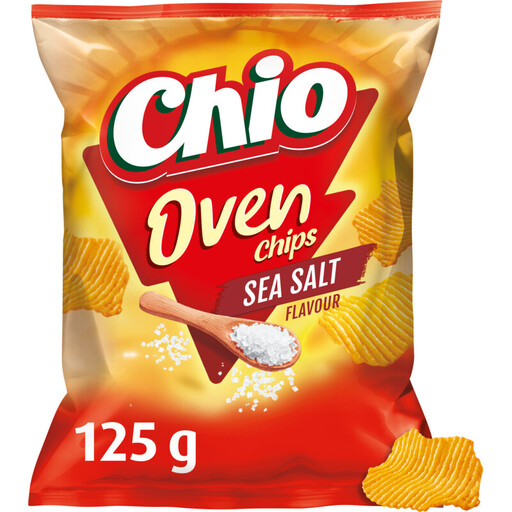 No image available
An option if, when having crisps with chips, you’re mainly comparing fat per 100 g. Jumbo lists 9.2 g of fat and 1.5 g of salt per 100 g for this Sea Salt variety. If you have allergies, check the current packaging.
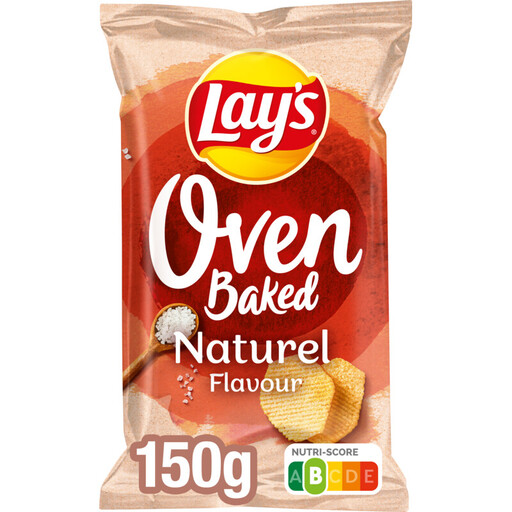 No image available
A plain variety if you’d like oven-baked crisps with chips. Compare the fat and salt levels on the packaging of this bag before weighing them against those of other varieties.
No. ‘Less fat’ compares crisps with another product, while the Netherlands Nutrition Centre defines ‘low fat’ as a maximum of 3 g of fat per 100 g. The four varieties discussed list between 9.2 and 20 g of fat per 100 g, so check the nutritional value rather than relying on the reduction claim alone.
Compare the salt per 100 g for the specific flavour, then work out how much that means for the amount you’ll eat. Albert Heijn lists 0.85 g of salt per 100 g for Lay’s Oven Baked Natural and 0.9 g for AH Ridged Crisps Plain Less Fat; Jumbo lists 1.5 g for Chio Oven Chips Sea Salt. Albert Heijn lists 1.7 g for BioToday Sea Salt Lentil Crisps.
No. Check the ingredients and allergens on the current packaging for the specific bag. A product name doesn’t show all the ingredients, and product information can change when a recipe is updated.
No. For this choice, Nutri-Score doesn’t replace the nutritional information for the specific variety. At the very least, compare fat and salt per 100 g, and take into account how much you plan to eat.