For a shared office snack supply, first agree on a serving size, then compare the energy, saturated fat and salt in crisps per equal amount. A label such as ‘light’ or ‘oven-baked’ doesn’t tell you how many calories your portion contains, so check the nutritional information for the exact flavour and keep the packaging to hand for ingredient and allergen details.
Who is this choice relevant to?
The office snacker who watches portion sizes
You want to help yourself to crisps at work without relying solely on the wording on the front of the bag. Compare the energy content of different products per equal amount, and decide how many crisps to put in a bowl each time.
The colleague who manages the shared snack supply
You want to hand out crisps without letting the tin determine the portion size. Small bags or pre-measured portions make it clearer how much you’re having at each snack break.
The colleague who needs to check ingredients
You want to be able to check which ingredients and allergens the crisps contain, even after they’ve been taken out of the original bag. Keep the label with the snack supply and check each new bag again; the Netherlands Food and Consumer Product Safety Authority stresses the importance of clear allergen information on labels.
What should you look for when choosing?
First, agree how much counts as one portion for the office snack supply. Then compare crisps per 100 g or per the same serving size. Also check that the product information stays available alongside the tin.
| What to consider |
What should you check? |
Who is it important for? |
| Energy per portion |
Compare kcal per 100 g and calculate based on the same portion size, such as 30 g or 40 g. Also check the saturated fat and salt on the label. |
When I have crisps between meals, I want to know how much energy my agreed portion contains. For around 50% of consumers, energy content comes first. |
| How much you take from the tin |
Choose small bags or divide a larger bag into portions in advance; use the stated portion size as a guide. |
With a shared tin, I want to know how much I’m taking in advance, rather than helping myself from an open supply each time. Around 30% of consumers prioritise keeping track of the amount they eat. |
| Product information |
Keep the packaging with the tin and check the ingredients, allergens and any cross-contamination warnings with every new bag. |
When the bag is no longer next to the crisps, I want to be able to see what’s in them before taking any. For around 20% of consumers, access to this information is the top priority. |
Common mistakes with a shared snack supply
-
Assuming ‘less fat’ means ‘far fewer calories’
Fat and energy are different values. The Netherlands Nutrition Centre points out that the difference in calories between light crisps and regular crisps can be small, even when the light crisps contain less fat.
Compare the nutritional values of the flavours you’ve chosen per equal amount. Don’t just look at the claim on the front; check kcal, fat, saturated fat and salt too.
-
Putting a large bag in the tin without agreeing on portions
It then becomes unclear how much each person takes. The Netherlands Nutrition Centre gives 215 kcal for an average 40 g bowl of crisps; a larger amount isn’t the same portion.
Use small bags or prepare portions in advance. Then compare products based on the amount you’ll actually be serving.
-
Throwing away the original packaging straight away
Without the bag, the ingredients, allergens, best-before date and any warnings are no longer readily available alongside the crisps.
Keep the packaging with the tin and check the label again whenever you add a different flavour or a new bag.
Relevant brands and retailers to compare
The nutritional values below apply to the specific products listed, not to every crisp made by the same brand or sold by the same retailer. Before buying, compare the flavour and pack you’re actually choosing.
Lay's
The Oven Baked range is a good starting point if you want to compare oven-baked crisps with regular crisps.
- Jumbo lists 428 kcal per 100 g and 128 kcal per 30 g for Lay's Oven Baked Original.
- These values apply to the Original flavour. Don’t assume they apply to another flavour, even if it’s also called Oven Baked.
Pringles
The tube sizes are worth considering if you want to weigh out how much to put out for the office snack supply at a time.
- Pringles lists Original in 40 g, 70 g and 165 g sizes, with a nutritional value of 158 kcal per 30 g.
- Pringles Original also lists 528 kcal per 100 g. Choosing a smaller pack doesn’t change the nutritional value per 100 g.
Jumbo
The own-brand range offers a specific product to compare the nutritional values of regular crinkle-cut crisps.
- Jumbo lists 528 kcal per 100 g and 158 kcal per 30 g portion for its Original Crinkle-Cut Crisps.
- The nutritional values for this Original flavour don’t tell you anything about other flavours or crisps sold by Jumbo.
Albert Heijn
You can compare the own-brand range with other crisps in the selection using the nutritional information for each product.
- Albert Heijn lists 555 kcal and 1.2 g of salt per 100 g for AH Original Crinkle-Cut Crisps.
- Albert Heijn notes that product information may change. Check the packaging of the flavour you buy.
Lidl
Lidl explains Nutri-Score as additional information to help you compare products within the same category.
- According to Lidl, Nutri-Score is designed to help compare products within a category.
- Nutri-Score doesn’t replace the nutritional information table for a specific bag of crisps; compare energy, fat and salt separately.
Crisps for a shared office snack supply
This Lay's Oven Baked flavour is a good fit for an office snack supply where you want to agree on portions in advance. Compare the nutritional information for Mediterranean Herbs with that of other crisps per equal amount; the values for Oven Baked Original don’t automatically apply to this flavour.
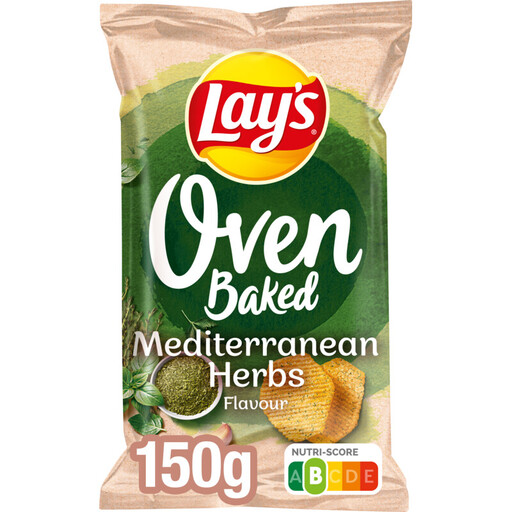 Image unavailable
Lay's Oven Baked Mediterranean Herbs, 150 g
For a shared supply where you measure out a set amount of crisps for each portion.
150 g pack. Before sharing, check the nutritional information, ingredients and allergens for this Mediterranean Herbs flavour, and keep the packaging with the tin.
View at Joybuy
Frequently asked questions
Are oven-baked or light crisps automatically low in calories?
No. Those labels don’t tell you how many calories a portion of the crisps you’ve chosen contains. According to the Netherlands Nutrition Centre, the calorie difference between light crisps and regular crisps can be small. Compare the energy per 100 g and per the same serving size on the packaging.
Which values should I compare besides calories?
At the very least, compare saturated fat and salt per equal amount of crisps, as well as the energy content. Nutri-Score can provide additional information when comparing products in the same category, but it doesn’t replace the nutritional information table.
Can I put crisps from the bag into an office snack tin?
Yes, but keep the original packaging with the tin so colleagues can check the ingredients, allergens, best-before date and any warnings. Check this information again whenever you add a different bag or flavour.
How should I store crisps after opening the bag?
Follow the storage instructions on the packaging you’ve chosen. For example, Albert Heijn recommends storing AH Original Crinkle-Cut Crisps in a sealed tin after opening. Storage instructions don’t change the portion size or nutritional value of the crisps.


