
Back-to-school snackers comparing kcal
You want to take crisps with you, so you compare the energy value per 100 g of specific products. Then you can decide how much of your chosen crisps to eat.


When comparing crisps for the start of term, first check the kcal per 100 g, then decide how much you’ll actually take with you. ‘Lower fat’ doesn’t tell you how much energy your portion provides. Albert Heijn lists 428 kcal per 100 g for Lay’s Oven Baked Naturel and 461 kcal for AH Ribbelchips Naturel Minder Vet, compared with 517 kcal for Lay’s Naturel. Also check the salt content and nutritional information on the packaging for your chosen flavour.
You want to take crisps with you, so you compare the energy value per 100 g of specific products. Then you can decide how much of your chosen crisps to eat.
You want to decide in advance how many crisps to take, rather than eating from a larger bag during your break.
As well as kcal, you compare the salt per 100 g and take the amount in your portion into account.
Start with the nutritional information per 100 g to compare products. Then decide on your portion and check the salt content too: these three questions could lead you to a different choice.
| What to consider | What to check when buying | Who is this important to? |
|---|---|---|
| Energy value | Compare kcal per 100 g for the flavours you’re considering, rather than relying on claims such as ‘oven baked’ or ‘lower fat’. | When choosing crisps for the start of term, I want to know how the energy value of one variety compares with another; around 42% of consumers prioritise a lower energy value. |
| Portion size | Check the pack weight and portion size on the label, and decide in advance how much to take with you. | I don’t want to keep eating from a large bag without realising during my break; around 33% of consumers prioritise portion control. |
| Salt | Compare the salt per 100 g on the packaging for your chosen flavour, and take your portion size into account. | When choosing a savoury snack, I also want to know how much salt the crisps contain; around 25% of consumers put this first when making their choice. |
Fat and energy value are different measures. Albert Heijn lists 428 kcal per 100 g for Lay’s Oven Baked Naturel and 517 kcal for Lay’s Naturel; a claim about fat doesn’t tell you the difference in kcal.
Use the energy value per 100 g to compare the products you’re considering.
The amount you eat determines how much of the stated nutritional value you consume. Voedingscentrum gives an average 40 g bowl of plain crisps an energy value of 216 kcal; the value for a specific product may differ.
Put the amount you want to take with you into a container in advance, then use the nutritional information for those crisps to assess your portion.
Even crisps you compare by kcal can vary in salt content. Albert Heijn lists 0.85 g of salt per 100 g for Lay’s Oven Baked Naturel and 1.1 g for Lay’s Naturel.
Check both the energy value and salt content on each pack, ideally for the same quantity of crisps.
The Oven Baked range is worth considering if you want to compare the nutritional value of an oven-baked variety with regular plain crisps.
AH Ribbelchips Naturel Minder Vet is an own-brand option you can compare by energy value and salt content.
Jumbo Chips Naturel is a regular plain variety that can serve as a nutritional comparison point.
These products are oven-baked crisps with paprika or sea salt flavour. For the start of term, check the nutritional information on each pack and decide how much you’d like to take with you.
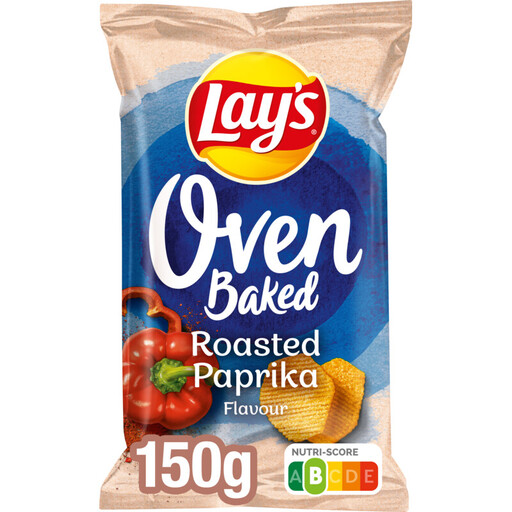 Image unavailable
An option if you’re looking for oven-baked crisps with paprika flavour for your break.
150 g pack. Check the kcal, salt content and portion size on the label for this flavour.
 Image unavailable
An option if you’re looking for oven-baked crisps with sea salt flavour for your break.
125 g pack. Compare the kcal and salt per 100 g with other crisps, and decide in advance how much to take with you.
No. A claim about fat doesn’t tell you how many kcal a product contains. Albert Heijn lists 428 kcal per 100 g for Lay’s Oven Baked Naturel and 517 kcal for Lay’s Naturel; check the energy value for the specific flavour you’re considering.
Of the products mentioned here, Albert Heijn lists the lowest energy value for Lay’s Oven Baked Naturel: 428 kcal per 100 g. Albert Heijn gives 461 kcal for AH Ribbelchips Naturel Minder Vet and 517 kcal for Lay’s Naturel; Jumbo lists 528 kcal for Jumbo Chips Naturel.
Use kcal per 100 g to compare products in different pack sizes, then consider how much you actually want to eat. Voedingscentrum gives an average 40 g bowl of plain crisps an energy value of 216 kcal; for a specific product, use the nutritional information on its own packaging.
A lower energy value per 100 g doesn’t, by itself, determine how often you should eat crisps. Voedingscentrum points out that many snacks are high in calories or salt, so check the portion size and salt content of the crisps you choose as well as their kcal.