
If you’re focused on wholegrains and fibre
If crispbread is a regular feature on your table, you’ll want to consider the grains, fibre and salt content together. Compare the nutritional information per 100 g before looking at portion size.


Choose a wholegrain crispbread and check that it is labelled as wholegrain. Then compare the fibre and salt content per 100 g. If you need to avoid gluten or other allergens, check the ingredients and allergen information first; a gluten-free option may still contain sesame, for example. Consider the size of each slice for the occasion you have in mind, too, and don’t assume it provides the same amount of iodine as bread without checking.
If crispbread is a regular feature on your table, you’ll want to consider the grains, fibre and salt content together. Compare the nutritional information per 100 g before looking at portion size.
If you need to avoid gluten, milk or sesame, the information on the specific pack matters. A gluten-free label doesn’t, by itself, tell you whether the product contains sesame.
For a topped slice, a thin, mild or more substantial texture can make all the difference. Check the weight per slice if you’re comparing nutritional values per piece.
First, check whether there are any ingredients you need to avoid. Then compare the nutritional information or portion size, depending on what matters most for the occasion.
| What to look for | What to check when buying | Who it matters to |
|---|---|---|
| Wholegrains and fibre | Look for a wholegrain label and compare both fibre and salt per 100 g. According to the Netherlands Nutrition Centre, crackers can only be labelled wholegrain if the flour is entirely wholegrain. | If I eat crispbread regularly, I mainly want to know which grain base I’m choosing and how much fibre it contains. Around 50% of consumers prioritise wholegrains and fibre. |
| Allergens | Check the ingredients, allergen information and any warnings about traces on the current pack. Check separately for gluten-containing cereals, milk and sesame. | If I need to avoid an ingredient, that determines which option I can choose, even if the front says gluten-free. For around 33% of consumers, allergen suitability is the main concern. |
| Portion size and texture | Check the weight per slice alongside the nutritional value per piece, and choose a texture that suits the occasion. | For a snack with toppings, I want to know whether a thin or substantial slice will work well and how much I’ll actually eat. Portion size and texture are the top priorities for around 17% of consumers. |
The fibre content doesn’t tell you how much salt an option contains. Wasa lists 20 g of fibre and 1.25 g of salt per 100 g for Wasa Wholegrain; Albert Heijn lists 12 g of fibre and 0.7 g of salt per 100 g for AH Wholegrain Crispbread.
Compare both figures per 100 g, and also check the wholegrain labelling and ingredients.
The Wasa Gluten- & Lactose-Free option described by Jumbo contains sesame seeds. Wasa’s Lightweight option, on the other hand, contains milk ingredients.
Check the current allergen information and any warnings about traces for every option, even if the label on the front seems to meet your needs.
If slices weigh different amounts, the value per piece doesn’t tell you the same thing about their composition.
Use the figures per 100 g to compare products, and the figures per piece to check the portion you plan to eat.
The Netherlands Nutrition Centre identifies bread made with iodised baker’s salt as an important source of iodine in the Netherlands. The crispbread category doesn’t tell you whether a particular pack provides a similar amount.
If you eat crispbread instead of bread and iodine is a consideration, check the information for the specific product rather than making assumptions based on the category.
The range includes wholegrain rye crispbread, a lightweight option and a substantial rustic variety.
AH Wholegrain Crispbread is a supermarket own-brand option sold in a 375 g pack.
ALDI describes Goud Gebakken Wholegrain Crispbread as a pack of 25 pieces weighing 375 g.
These Joybuy products are worth considering if you’re looking for thin or substantial slices, a wholegrain label or a pack for several occasions. Compare the current nutritional and allergen information for each product; the options listed aren’t interchangeable if you need to avoid certain ingredients.
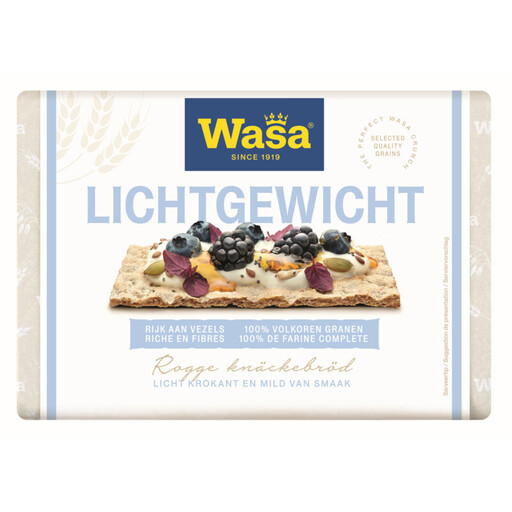 Image unavailable
An option to consider if you’re looking for a lighter slice to top. Wasa lists wholegrain rye flour and milk ingredients for Lightweight; check the current pack if you need to avoid gluten or milk.
 Image unavailable
An option to compare if wholegrain crispbread is your starting point. The pack contains 265 g; check the fibre, salt and ingredients on the label before making your choice.
 Image unavailable
If you’re comparing products based on fibre, this is one to set alongside other options. The pack contains 300 g; check the fibre per 100 g, the types of flour used and the salt content before choosing.
 Image unavailable
A 375 g pack to consider if you’re buying crispbread for several occasions. If flour made entirely from wholegrains is essential to you, check the types of flour on the label, and read the allergen information separately.
 Image unavailable
An option to consider if you want a substantial slice for toppings; Wasa describes its Rustic crispbread as substantial. This pack contains 215 g. If fibre is your main criterion, compare the nutritional information per 100 g.
No. According to the Netherlands Nutrition Centre, a cracker can only be called wholegrain if the flour used is entirely wholegrain. So don’t rely on the colour or a label such as ‘multigrain’; check the product name and ingredients instead.
Not if the crispbread contains rye: rye is a gluten-containing cereal. Choose a product explicitly labelled gluten-free, and check the other allergens on the pack too. The gluten-free Wasa sesame option described by Jumbo, for example, contains sesame.
Don’t assume that it does. The Netherlands Nutrition Centre identifies bread made with iodised baker’s salt as an important source of iodine in the Netherlands, but that doesn’t apply to every crispbread. Check the information for the specific product if iodine is a factor in your choice.