
Families who like generously topped bites
They’re looking for a crunchy base that’s easy to serve with their planned toppings. Wasa describes Rustic as sturdy, but how much topping a slice can hold in practice also depends on what you put on it.


For generously topped bites, crispbread described as sturdy is the obvious choice; Wasa describes Rustic as this kind of option. Choose thin crispbread if you’re after a lighter bite, but don’t assume it can hold the same amount of topping. ‘Thick cut’ isn’t a standard measure of thickness: compare the product description and the label, and, if necessary, try your planned topping on one slice first.
They’re looking for a crunchy base that’s easy to serve with their planned toppings. Wasa describes Rustic as sturdy, but how much topping a slice can hold in practice also depends on what you put on it.
They don’t want to judge by thickness alone. The Netherlands Nutrition Centre points out that wholegrain products contain more fibre than products made with refined flour; compare the nutritional values per 100 g on individual packs.
They need to check the ingredients of the exact product for everyone at the table. The Netherlands Food and Consumer Product Safety Authority highlights the importance of the allergen information on the label; don’t rely on the product name or brand alone.
First decide how much topping you want to serve and what kind. Then compare wholegrain status, nutritional information and ingredients on packs that suit the way you plan to serve them.
| What to consider | What to check when buying | Who it matters to |
|---|---|---|
| Sturdiness for generous toppings | Read how the manufacturer describes the product and try your planned topping on one slice first. | If I want to add plenty of topping, the bite needs to be easy to pick up. For around 33% of consumers, a sturdy base comes first. |
| Wholegrains and fibre | Check whether the product is wholegrain and compare fibre per 100 g in the nutrition table. | A thick slice isn’t enough to sway me; I also want to know which grain product I’m serving. Around 27% of consumers prioritise wholegrains and fibre. |
| Ingredients and allergens | Read the ingredients list and allergen information for the exact product, including any warnings about traces. | When not everyone at the table can eat the same things, I want to be able to decide in advance which pack is suitable. This is the main consideration for around 20% of consumers. |
| Practicality when serving | Check the pack size and product shape; check current availability when you buy. | I want enough slices for the meal and a product I can buy without any extra hassle. For around 20% of consumers, convenience matters most. |
A description such as ‘sturdy’ tells you how a product is positioned, but it isn’t a standardised measure of thickness or how much it can hold.
Compare the product shape and description. If you’re using a new or moist topping, try serving it on one slice first.
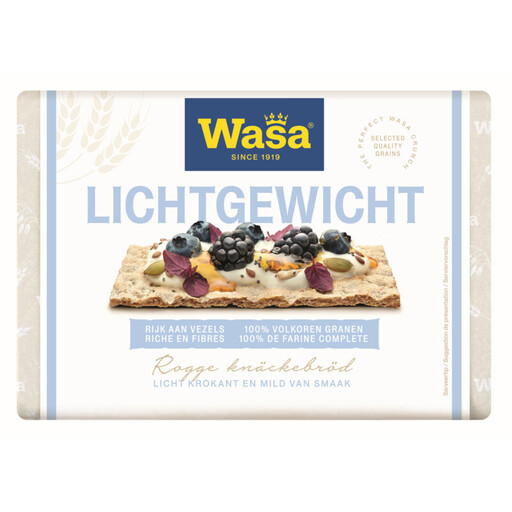
Ingredients vary between products. Wasa lists milk ingredients for Lightweight, among other things, and warns that traces of sesame may be present.
Check the current label for every product you choose. For unpackaged products, ask for the allergen information.
A Dutch product or a reference to baker’s salt doesn’t prove that the crispbread you’ve chosen contains iodised salt. According to Brood.net, using iodised baker’s salt isn’t a legal requirement.
Check the ingredients on the individual pack if the type of salt used is important to your choice.
These brands offer useful starting points for comparing product styles and labels; features vary between products.
Wasa describes both a sturdy rye crispbread, Rustic, and a thin option, Thin Rye Wholegrain.
Leksands describes its product as classic rye crispbread; Albert Heijn lists Leksands Knäcke original in its crispbread range.
Albert Heijn’s crispbread range includes AH Sesame Crispbread alongside branded products.
Jumbo includes its own wholegrain crispbread in its range.
These crispbreads give you different options for topped bites, from distinctly sturdy or light styles to wholegrain varieties. Compare the exact pack and, if you’re using generous or moist toppings, try one slice first.
 No image available
An option to consider if you’re looking for a sturdy base for generous toppings; try your planned topping on one slice first. If you have allergies, check the current label, including for rye, milk and sesame.
 No image available
An option to compare if you’re after a light, thin bite rather than a distinctly sturdy base. Try heavy or moist toppings beforehand, and check the label for rye, milk and sesame, among other things.
 No image available
A rye option to consider for topped bites; assess the product style and try your topping before relying on it to be sturdy. If you have allergies, check the label for rye, barley, milk and sesame, among other things.
 No image available
For anyone who wants to compare a wholegrain option with the distinctly sturdy and thin varieties. Check separately whether the slices suit your toppings, and read the current label carefully if allergens are a consideration at the table.
 No image available
A wholegrain option to include in your comparison if the type of grain matters to you too. Check the product style for generous toppings, and if you have allergies, read the label for wheat, rye, barley, sesame and lupin, among other things.
No, thickness and wholegrain status are different features. Check the ingredients and compare fibre per 100 g in the nutrition table; according to Wasa, both Rustic and Thin Rye Wholegrain contain fibre: 20 g and 21 g per 100 g respectively.
Check the ingredients and allergen information on every pack you plan to serve. Look out for the gluten-containing grains listed and for ingredients or warnings relevant to your guests, such as milk or sesame; the Netherlands Food and Consumer Product Safety Authority says that mandatory allergen information must be clearly shown on the label.
No, don’t assume this applies to every pack. According to Brood.net, using iodised baker’s salt isn’t a legal requirement; check the ingredients list if the type of salt used matters to your choice.
For wet or creamy toppings, you can top the slices just before serving. Try one slice beforehand to see whether it’s still easy to pick up. Store the remaining slices according to the instructions on the pack.