
Hosting a full Sunday table
You want enough crispbread for everyone. The net weight and any stated number of servings can help you work out how many packs you’ll need.


Choose a 375 g pack if you’re serving crispbread to several people or want to keep some in stock. If you expect to use less, a 260–265 g pack may be a better fit. Then compare the nutritional information per 100 g, and check the ingredients and allergens on the pack you’re serving.
You want enough crispbread for everyone. The net weight and any stated number of servings can help you work out how many packs you’ll need.
You compare the grains in the ingredients list and check the fibre and salt per 100 g, rather than relying on the wording on the front of the pack.
If a guest needs to avoid certain ingredients, check the ingredients and allergen information on the exact pack before serving it.
First, work out how much crispbread you expect to serve. Then compare the nutritional information, check for any dietary restrictions and choose a variety that goes well with your toppings.
| What to consider | What to check | Who it matters to |
|---|---|---|
| Quantity | Compare the net weight, any stated number of servings and the storage instructions after opening. | If I’m serving several people, I want enough to put on the table without having lots left over. Having enough is the top priority for around 36% of consumers. |
| Wholegrain, fibre and salt | Read the ingredients and compare fibre and salt per 100 g. The Netherlands Nutrition Centre recommends comparing labels on this basis. | I want to know which grains I’m serving and how the nutritional values compare, even when packs list different serving sizes. Around 29% of consumers prioritise this comparison. |
| Allergens | Check the ingredients, highlighted allergens and any ‘may contain’ information on the exact pack. | If a guest needs to avoid certain ingredients, I don’t want to choose based on the product name alone. This check comes first for around 21% of consumers. |
| Flavour and toppings | Check the ingredients and choose a variety that goes with the toppings you plan to serve. | I’m looking for crispbread that complements what’s on the table, without a strong flavour that not everyone will enjoy. This is the main consideration for around 14% of consumers. |
The label doesn’t tell you how much crispbread you’ll get. A larger box is only practical if you expect to use what’s inside.
Compare the net weight and any stated number of servings with the number of people you’re serving. Also read the storage instructions for after opening.
Fibre and salt levels can vary between products. A claim on the front of the pack doesn’t let you compare those values side by side.
Compare both values per 100 g in the nutritional information, and check which grains are listed in the ingredients.
The varieties reviewed include grains containing gluten or sesame. The product category alone doesn’t tell you whether something is suitable for someone with an allergy or coeliac disease.
Check the exact pack, including any ‘may contain’ information, before serving crispbread to a guest with a dietary restriction.
General information about baker’s salt doesn’t tell you which type of salt was used in a specific crispbread or how much iodine that product contains.
So don’t treat iodine as a product feature unless you have information about the exact pack.
Among the products reviewed, Wasa offers rye and wholegrain crispbread in a range of pack sizes.
Bolletje has several crispbread varieties, including a wholegrain High Fibre option and a separate Protein variety.
Jumbo’s wholegrain crispbread is an example of a larger everyday pack.
Albert Heijn’s range includes its own-label crispbread alongside products from other brands.
Ryvita Original Crispbread is a rye option for anyone who wants to compare the ingredients of a specific product.
These packs offer different quantities of crispbread for serving or keeping in stock. As well as checking the weight per pack, work out how much you need and always check the exact product if you have dietary restrictions.
 No image available
A 375 g pack to compare with the amount you need for your Sunday table. If the number of pieces or allergens affects your choice, check the pack.
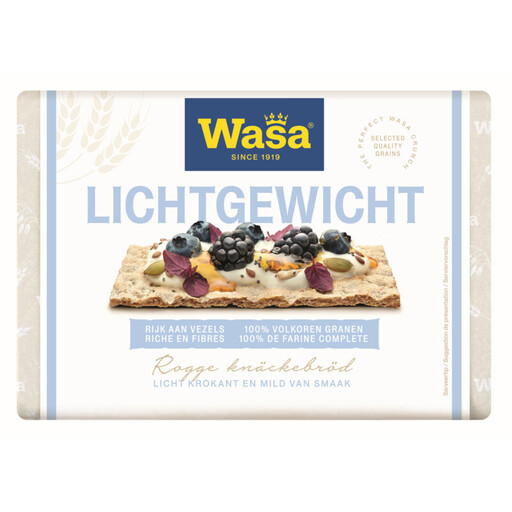 No image available
The 300 g pack is a mid-sized option if you’re still working out how much you need. Compare the nutritional information and check the number of pieces on the pack.
 No image available
A 300 g pack for anyone who wants to compare fibre as well as quantity. Read the nutritional information per 100 g and, if you have dietary restrictions, check the ingredients on this pack.
 No image available
The 265 g pack may suit you if you want to buy less crispbread. Check how many pieces it contains, and read the label for this variety before comparing its nutritional values or allergens with another pack.
 No image available
A 260 g pack to consider if you want to serve a smaller amount. Compare the nutritional information for this product and check the number of pieces if you’re planning for several people.
A 375 g pack is a better fit if you’re serving several people or want to keep some in stock; a smaller pack may suit you if you use less. Jumbo lists 25 servings for its 375 g wholegrain pack, but work out how much you actually need for your table and follow the storage instructions after opening.
Start by comparing crispbread per 100 g, so different serving sizes don’t skew the comparison. The Netherlands Nutrition Centre recommends comparing labels on this basis; then consider how much you’ll serve.
No: crispbread can contain grains that contain gluten. For example, Jumbo lists rye in Wasa Wholegrain 260 g. If a guest needs to avoid gluten, check the explicit gluten-free claim and allergen information on the exact product.
Read the ingredients list and any information about the possible presence of allergens on the pack you’re serving. The Netherlands Food and Consumer Product Safety Authority explains that allergens present in prepacked foods must be clearly distinguished on the label. Don’t rely on the name of a crispbread variety alone.
No, you can’t infer that for every pack from a general reference to baker’s salt. Check the ingredients of the specific crispbread, and don’t assume it contains iodine unless you have product-specific information.