
If you’re mainly comparing sugars
You’re looking for crispbread to serve with savoury toppings at a Sunday roast, and give the ‘of which sugars’ figure per 100 g more weight than terms such as ‘wholegrain’ or ‘low carb’.


To make a sugar-conscious choice, first compare ‘of which sugars’ per 100 g, rather than relying on terms such as ‘wholegrain’ or ‘low carb’. Then choose a crispbread that goes with your savoury toppings and check the fibre, salt, ingredients and allergens on the pack. Fewer carbohydrates do not automatically mean fewer sugars.
You’re looking for crispbread to serve with savoury toppings at a Sunday roast, and give the ‘of which sugars’ figure per 100 g more weight than terms such as ‘wholegrain’ or ‘low carb’.
You look first at carbohydrates per 100 g. For a variety with seeds, you also want to check the separate figures for sugars and fat, as well as the allergens.
You want a crunchy base for savoury toppings and compare wholegrain ingredients and fibre. Sugars, salt and the other ingredients are also worth checking separately.
If sugars are your main priority, start with the nutrition information per 100 g. Then decide whether wholegrain ingredients, carbohydrates or the product’s composition matter for the way you plan to serve it.
| What to look for | What to check when buying | Who it matters to |
|---|---|---|
| Sugars | Compare ‘of which sugars’ per 100 g on packs of similar crispbread. | When serving savoury toppings, I want to know how much sugar the base itself contains. For around 36% of consumers, the sugar figure is the deciding factor. |
| Wholegrain and fibre | Check the wholegrain ingredients and compare fibre per 100 g; read the sugar figure separately. | When I’m looking for a wholegrain base for toppings, I don’t want to judge by colour. Wholegrain ingredients and fibre come first for around 29% of consumers. |
| Carbohydrates | Read carbohydrates and ‘of which sugars’ as separate figures per 100 g. | If carbohydrates are my main priority, I want to assess a variety on that basis without assuming it has less sugar. For around 21% of consumers, this distinction is key. |
| Ingredients | Check the current label for allergens and, if it matters to you, baking salt. | When serving guests with different dietary needs, I want to know which grains and seeds the crispbread contains. For around 14% of consumers, checking the ingredients is most important. |
Carbohydrates and sugars are different figures. Albert Heijn lists 3.3 g of sugars per 100 g for TastyBasics Low carb crispbread with poppy seeds and sesame, compared with 3.0 g for AH Knäckebröd goudbruin.
Compare the sugar figure directly; use the carbohydrate figure if carbohydrates are a separate priority for you.
Albert Heijn lists both 12 g of fibre and 3.4 g of sugars per 100 g for AH Knäckebröd volkoren. So the fibre figure doesn’t tell you what’s shown on the sugar line.
Compare both figures separately when choosing a wholegrain variety for savoury toppings.
According to the Voedingscentrum, baking salt contains iodine, but bakers aren’t required to use it. So don’t assume that every crispbread contains baking salt.
If baking salt matters to your choice, check the ingredients list for the specific product.
The crispbread varieties considered differ in their grains, seeds and allergens. Toppings also have their own ingredients lists and nutrition information.
Check the crispbread and topping separately, and serve toppings on the side if you’re catering for guests with different needs.
Albert Heijn’s product information lets you compare AH Knäckebröd goudbruin with AH Knäckebröd volkoren.
TastyBasics Low carb crispbread with poppy seeds and sesame is worth considering if carbohydrates are your main priority.
Ryvita describes Original and Multigrain on its UK manufacturer’s website; the figures given relate to that product information.
Albert Heijn lists Leksands Knäcke original in its online range.
These crispbread varieties are worth considering as a crunchy base for savoury toppings. Compare the nutrition information and ingredients on the relevant pack before choosing.
 Image unavailable
A rye variety to consider with savoury toppings. Compare the sugar figure on the pack and check the allergen information: the product information lists rye and barley; sesame and milk may be present.
 Image unavailable
Worth considering if fibre is a selection criterion alongside sugars; compare both figures separately on the label. The product information lists sesame and cereals containing gluten; milk may be present.
 Image unavailable
A wholegrain variety to compare as a base for savoury toppings; check the sugar and fibre figures separately. The product information lists wheat, rye, barley and sesame; lupin may be present.
 Image unavailable
A wholemeal crispbread to consider for toppings; compare its sugar figure with those of other varieties. Check the current allergen information carefully: the product information lists wheat, rye, barley, sesame, egg, milk and lupin, among other ingredients; soya may be present.
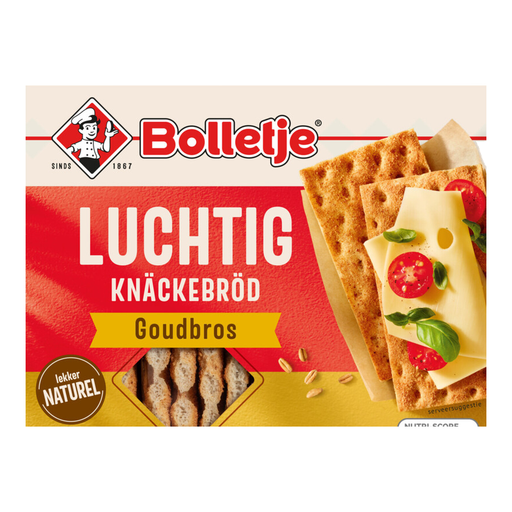 Image unavailable
A variety to consider as a crunchy base for toppings; don’t assume it has less sugar because it says ‘Light’—check ‘of which sugars’ on the pack. The product information lists wheat and sesame; lupin may be present.
According to EUR-Lex, the EU nutrition claim ‘low in sugars’ can only be used for a solid food if it contains no more than 5 g of sugars per 100 g. Even if the claim isn’t on the product, you can still compare the ‘of which sugars’ figure per 100 g.
No. A lower carbohydrate figure doesn’t automatically mean a lower sugar figure. Per 100 g, Albert Heijn lists 33 g of carbohydrates and 3.3 g of sugars for TastyBasics Low carb crispbread, compared with 77 g of carbohydrates and 3.0 g of sugars for AH Knäckebröd goudbruin.
No, you can’t assume that. According to the Voedingscentrum, baking salt contains iodine, but its use isn’t compulsory. For packaged crispbread, check the ingredients list for the specific product.
Check the label for both the variety you’ve chosen and the toppings. The crispbread products described differ in the grains, soya and sesame they contain; information about possible allergens may also vary from product to product.