When comparing crispbread to enjoy with coffee, first check the ‘of which sugars’ figure per 100 g, then consider how much you actually eat. Values vary between varieties, and the amount per piece depends on its weight. In a hotel room, it’s also worth considering how to store it somewhere dry, what you’ll have on top, and any gluten or allergen requirements. Check these details on the packaging rather than relying on a claim on the front alone.
Who might find this choice relevant?
A coffee drinker keeping an eye on sugar
You want something crunchy to enjoy with your coffee, so you compare the sugar content per 100 g and per piece you eat. The Netherlands Nutrition Centre gives an average of 0.3 g of sugar per 10 g piece of wholegrain crispbread; the value for your product may differ.
A hotel guest without a fridge
You’re looking for something you can keep somewhere dry and reseal properly once opened. If you’re taking a topping with you, check how it needs to be stored too.
A guest who needs to avoid gluten or allergens
A claim such as ‘gluten-free’ doesn’t answer every allergen-related question. Read the ingredients and allergen information on the current packaging of the product you want to eat.
What should you look for when choosing?
Start by comparing the sugar content on a like-for-like basis. Then decide what matters most for your coffee break: a pack that’s easy to store, a wholegrain base or checking for a specific allergen.
| What to consider |
What to check before buying |
Who it matters to |
| Sugar |
Compare the ‘of which sugars’ figure per 100 g and consider how many pieces you eat. Check the ingredients list too. |
When I have something with my coffee, I want to know how much sugar is in my own portion, not just what’s listed for one piece. Around 31% of consumers prioritise comparing sugar content. |
| Storage and toppings |
Read the storage instructions and check whether you can reseal the pack properly after opening. Check separately how to store any toppings. |
In a hotel room, I want the crispbread to stay crunchy for my next coffee break. For around 25% of consumers, practical storage is their first concern. |
| Wholegrain and fibre |
Check the ‘wholegrain’ claim and compare fibre per 100 g alongside sugar and salt. |
If I choose crispbread regularly, I want to know what type of grain it’s made from and how much fibre the variety contains. This is a priority for around 25% of consumers. |
| Gluten and allergens |
Read the ingredients and allergen information on the current packaging, even for a gluten-free variety. |
If I need to avoid a specific allergen, the packaging determines whether this product is suitable for me. Around 19% of consumers put this check first. |
Common mistakes
-
Relying on ‘less sugar’ as your only comparison
Without comparing products per 100 g, you can’t tell how two varieties measure up for the same quantity. The amount of sugar in your coffee break also depends on how much you eat.
Read the nutritional information per 100 g, then consider your portion; use the ingredients list for extra information.
-
Looking only at ‘wholegrain’ or ‘high in fibre’
A wholegrain base or stated fibre content won’t also tell you how much sugar and salt the variety contains, or which allergens it includes.
Compare all this information on the packaging of the variety you want to buy.
-
Assuming ‘gluten-free’ means ‘free from all allergens’
A gluten-free product may contain ingredients that matter to someone with a different allergy. For example, the gluten-free variety described by Albert Heijn lists sesame.
Read the full ingredients and allergen information, even if ‘gluten-free’ appears on the front.
-
Assuming all crispbread contains iodised baker’s salt
Overheid.nl describes an agreement that encourages the use of iodised baker’s salt in bread and bread substitutes. This doesn’t tell you which type of salt is used in a specific pack of crispbread.
Check the ingredients list if the type of salt used matters to you.
Brands compared
Wasa
Wasa makes crispbread varieties with different nutritional profiles, so compare the information on each individual pack.
- The product information for the sourdough rye variety lists 0.3 g of sugar and 19 g of fibre per 100 g; for the high-fibre variety, the figures are 2.0 g of sugar and 26 g of fibre per 100 g.
- Values and allergens vary by variety. Wasa Lichtgewicht lists milk as an ingredient and contains 3.5 g of sugar per 100 g.
Albert Heijn
The own-brand wholegrain and gluten-free varieties offer different points of comparison for their ingredients and nutritional profiles.
- For AH Knäckebröd volkoren, Albert Heijn lists 3.4 g of sugar, 12 g of fibre and 0.7 g of salt per 100 g.
- The gluten-free high-fibre variety lists oats and contains 2.4 g of salt per 100 g. If you have an allergy, check the other ingredients and allergens too.
Ryvita
Ryvita publishes information about rye crispbread that can help you compare product formulations.
- According to Ryvita’s UK product information, Original Crispbread contains 0.3 g of sugar per piece and includes wholegrain rye and rye flour.
- When buying in the Netherlands, use the nutritional and allergen information on the Dutch packaging. The UK value per piece isn’t directly comparable with a value per 100 g.
Crispbread to enjoy with coffee in your hotel room
These products offer a dry, crunchy option to enjoy with coffee, and can also be used as a base for toppings. To help you choose, compare the nutritional information on the same basis and check the ingredients and storage instructions for your chosen variety.
 Image unavailable
Wasa Rustic Crispbread – 215 g
A crunchy snack to enjoy with coffee. Compare the sugar content per 100 g and check how much your portion weighs before deciding how much to have with each coffee break.
View at Joybuy
 Image unavailable
Wasa Wholegrain Crispbread – 260 g
A wholegrain variety to compare if the type of grain matters to you. Also check the sugar, salt and allergen information on the packaging; ‘wholegrain’ alone doesn’t tell you this.
View at Joybuy
 Image unavailable
Wasa High-Fiber Crackers – 300 g
For anyone who wants to compare fibre as well as sugar. The product information for this variety lists 2.0 g of sugar and 26 g of fibre per 100 g; check the weight of the crackers you eat to work out your portion.
View at Joybuy
 Image unavailable
g'woon Wholemeal Crispbread – 375 g
A wholegrain option to enjoy with coffee or with toppings. Compare the nutritional values per 100 g with other varieties, and read the ingredients and allergen information if you need to avoid anything.
View at Joybuy
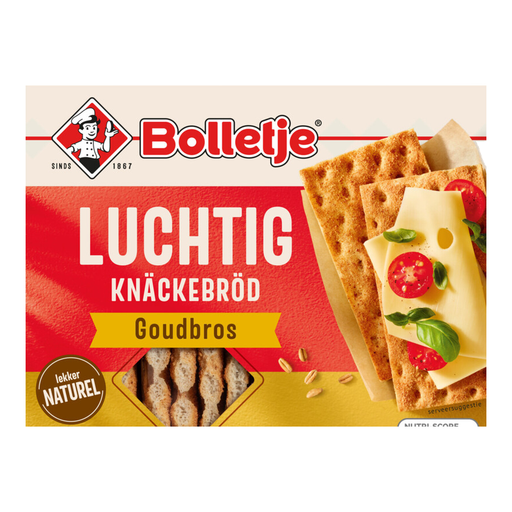 Image unavailable
Bolletje Light Crispbread Golden Crisp – 240 g
A crunchy option for a coffee break in your hotel room. Don’t assume ‘Light’ tells you how much sugar is in a portion: check the nutritional information per 100 g and consider how much you eat.
View at Joybuy
Frequently asked questions
Can you tell how much sugar crispbread contains from the name?
No, check the nutritional information for the variety you’ve chosen. The Netherlands Nutrition Centre gives an average of 0.3 g of sugar per 10 g piece of wholegrain crispbread, but values vary by brand. Compare products per 100 g, then consider your own portion.
How should you store crispbread in a hotel room?
Follow the storage instructions on the packaging. The products described should be kept in a cool, dry place and sealed properly after opening. If there’s no fridge, only take toppings that can be stored without refrigeration according to their own storage instructions.
Is wholegrain crispbread suitable if you need to avoid gluten?
A variety made with rye or wheat isn’t suitable if you need to avoid gluten. Choose a product explicitly labelled gluten-free, and check the other ingredients and allergens on the current packaging too.
Can you assume crispbread contains iodised baker’s salt?
No, don’t assume all varieties use the same type of salt without checking. Overheid.nl describes an agreement that encourages the use of iodised baker’s salt in bread and bread substitutes; check the ingredients list for the product you’re buying.


