
Households that eat crispbread regularly
If you eat crispbread often, you can compare the pack weight with how much you use. Also check whether you can store the contents as recommended after opening.


For a small household, choose a pack of crispbread that suits how often you eat it and that you can keep sealed and dry after opening. Don’t just look at the quantity: check the ingredients, allergens and nutritional information for the specific variety too, especially if wholegrain or gluten content matters to your choice.
If you eat crispbread often, you can compare the pack weight with how much you use. Also check whether you can store the contents as recommended after opening.
If you only eat crispbread now and then, the amount in each pack and how well it can be stored matter more. Albert Heijn recommends keeping its wholegrain crispbread in a sealed tin after opening.
If wholegrain content, fibre, salt or allergens influence your choice, read the information for the specific variety. The ingredients in one crispbread product won’t necessarily be the same as those in another pack from the same brand.
Start with the amount you’ll actually use and how you can store the pack. Then compare the ingredients and nutritional information of the varieties that suit your needs.
| What to consider | What to check | Who is this for? |
|---|---|---|
| Pack size | Compare the weight and, if listed, the number of portions with how often you eat crispbread. | If I eat crispbread regularly, I want to choose an amount that suits how much I use. Pack size is the top priority for around 33% of shoppers. |
| Storage after opening | Read the storage advice and check whether you can keep the contents sealed and dry. | In a small household, I might not get through a whole pack quickly and want to stop it going soft. Reducing waste is the top priority for around 25% of shoppers. |
| Wholegrain and fibre | Check the wholegrain description, ingredients and fibre per 100 g; also look at the salt content. | If wholegrain and fibre guide my choice, I want to compare the figures for the specific varieties. This is a key consideration for around 25% of shoppers. |
| Gluten and other label information | Read the allergen declaration and check for an explicit gluten-free claim. Check the salt per 100 g and, if relevant, whether the ingredients include iodised salt. | If I need to avoid gluten or check for specific ingredients, I can’t rely on the brand name. Checking the label is the main concern for around 17% of shoppers. |
If you don’t eat much, crispbread can go soft after opening if it isn’t stored properly.
Choose a pack size that suits how much you use. Albert Heijn recommends storing its wholegrain crispbread in a cool, dark, dry place and keeping it in a sealed tin after opening.
Wasa Volkoren contains rye, which contains gluten. According to Voedingscentrum, bakers aren’t required to use baker’s salt.
Check the allergens for the specific variety, look for an explicit gluten-free claim and, if it matters to your choice, check the ingredients for iodised salt.
Fibre, salt and ingredients vary between varieties. A single claim on the front of the pack doesn’t tell you what the full nutritional information looks like.
Compare fibre and salt per 100 g, and also read the ingredients and allergen information on the pack you want to buy.
The AH range includes, among other products, a 375 g wholegrain crispbread.
Wasa Volkoren is a 260 g crispbread made with wholegrain rye.
ALDI lists a wholegrain crispbread pack containing 25 pieces and weighing 375 g, as well as a 265 g robust variety.
Lidl lists a 264 g crispbread in sunflower seed and pumpkin seed varieties.
Ryvita Dark Rye is a 250 g crispbread variety listed by a specialist retailer.
These Joybuy products come in pack sizes ranging from 125 g to 375 g. First choose an amount that suits how much you use and your storage options, then check the information on the packaging.
 No image available
A 300 g pack to compare with how often you eat crispbread. Check the ingredients, allergens and nutritional information for this variety before choosing.
 No image available
A 265 g pack if you think that amount suits your needs. If wholegrain and fibre matter to your choice, read the ingredients and nutritional information for the specific variety.
 No image available
A 375 g pack to consider if you eat crispbread regularly and can keep it sealed after opening. If the wholemeal description influences your choice, check the ingredients for this variety.
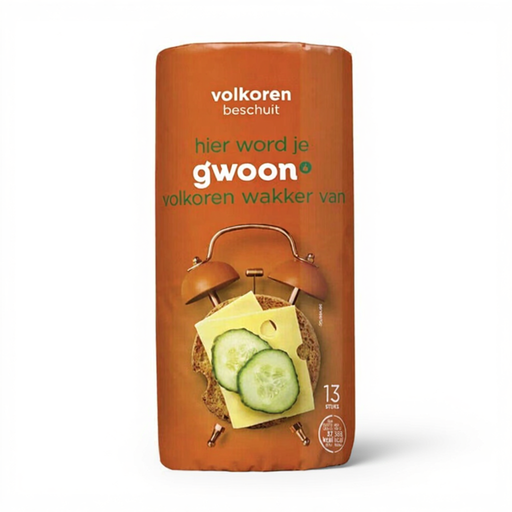 No image available
A 125 g pack to consider if you only eat crispbread now and then. Check the packaging for the ingredients, allergens and the basis used for the nutritional values.
 No image available
A 260 g pack for anyone looking for a Wasa wholegrain variety and able to use that amount. Wasa Volkoren’s product information lists rye; check the label on this pack if you need to avoid gluten.
Don’t use ‘half loaf’ as a measure for a pack of crispbread. Check the stated weight, the number of portions if given, and how you can store the contents after opening.
Store it according to the instructions on the packaging. For AH wholegrain crispbread, Albert Heijn recommends keeping it in a cool, dark, dry place and storing it in a sealed tin after opening.
No, don’t assume this is the case for every product. According to Voedingscentrum, bakers aren’t required to use baker’s salt. If iodised salt matters to your choice, check the ingredients for the specific variety.
Crispbread made with rye isn’t gluten-free: Wasa Volkoren lists rye as a gluten-containing ingredient. If you need to avoid gluten, check for an explicit gluten-free claim and read the allergen information for the product you choose.
According to Voedingscentrum, a cracker can only be called ‘wholegrain’ if it’s made entirely from wholegrain flour. Also compare the nutritional information, including fibre and salt per 100 g, and check the allergens for the specific variety.