What should you look for?
First, decide how you want to top the crispbread and how many nibbles you need. Then use the nutritional information and ingredients list to compare varieties with a suitable shape.
| What to consider |
What to check when buying |
Who should pay particular attention? |
| Size and toppings |
Check the shape and number of pieces; if you’re using a generous or moist topping, try it on one piece first. |
If I want to make nibbles that guests can easily pick up, the pieces need to suit my toppings. An estimated 33% of consumers put ease of handling first. |
| Pack size and planning |
Compare the number of pieces and pack weight with the number of guests and toppings. |
I want enough bases for everyone, without relying on the pack weight alone. An estimated 27% of consumers consider this the main priority. |
| Wholegrain and fibre |
Read the ingredients and compare fibre per 100 g; use per-piece values when checking portions of that specific product. |
If I eat crispbread during the week as well, I want to know what’s in the variety I’ve chosen. An estimated 20% of consumers put this comparison first. |
| Allergens and salt |
Read the allergen information for the exact variety and compare salt per 100 g, bearing your toppings in mind too. |
When I’m hosting guests with different dietary requirements, I want to know what’s on the board before serving. An estimated 20% of consumers give this top priority. |
‘Medium sliced’ isn’t a measurement you can use to work out the size of each piece. Products may be described as thin, light, wholegrain or robust, but those words don’t replace checking the dimensions and number of pieces, or trying a piece with your toppings. For comparing the nutritional values of different products, the Voedingscentrum recommends looking at the figures per 100 g.
Brands and ranges to consider
A brand name doesn’t tell you the nutritional values or size: always compare the specific variety you’re planning to buy.
Wasa (Wasabröd)
Wasa offers wholegrain, thin and high-fibre crispbread varieties, among others. It’s worth comparing the product names with the labels for each individual variety.
- Wasa lists 20 g of fibre per 100 g for its Wholegrain variety.
- Wasa High Fibre has a different ingredients list, including rye, wheat, oats and sesame. Don’t assume details for one variety apply to another.
Albert Heijn
The range includes AH own-brand crispbread and products from other brands, with a variety of shapes and ingredients.
- AH Wholegrain and Golden Brown Crispbread are listed in 375 g packs; seed varieties are also available in 265 g packs.
- When choosing for guests, check the ingredients and nutritional information for the exact product, not just the range name.
Jumbo
Jumbo lists its own Wholegrain and Golden Brown Crispbread, as well as other varieties in the range.
- Jumbo lists both its Wholegrain and Golden Brown varieties in packs of 5 × 5 pieces, weighing 375 g.
- Details for these two packs don’t tell you the number of pieces or ingredients in other Jumbo varieties.
ALDI / Goud Gebakken
The Goud Gebakken range includes wholegrain, sesame and robust crispbread varieties, among others.
- ALDI lists 25 pieces and a weight of 375 g for both its wholegrain and sesame varieties.
- Check the ingredients, allergens and nutritional information on the pack you’ve chosen; the varieties aren’t interchangeable.
Crispbread for drinks and nibbles on Joybuy
These crispbread varieties are worth comparing as a base for drinks-party nibbles. Pack weights are included in the product names; check the packaging and consider your chosen toppings to work out how many nibbles you can make. A product name or description doesn’t prove that every piece can hold a generous topping.
 Image unavailable
g'woon wholegrain crispbread, 375 g
Worth considering if you’re looking for a wholegrain base for topped nibbles. Check the number of pieces and their dimensions before planning your nibbles; if guests have dietary requirements, check the allergen information on the pack too.
View on Joybuy
 Image unavailable
Bolletje wholegrain crispbread, 265 g
A wholegrain variety to consider if you’re looking for crispbread for drinks and other occasions. Check the pack to see how many individual pieces it contains, and read the ingredients before serving it to guests.
View on Joybuy
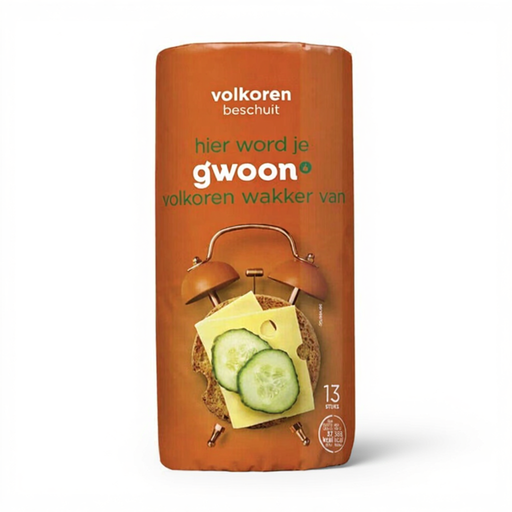 Image unavailable
g'woon wholegrain crispbread, 125 g
A smaller pack to consider if you’re serving a range of toppings. Check the size and number of pieces before planning portions; read the fibre and salt figures per 100 g directly from the nutritional information table.
View on Joybuy
 Image unavailable
Wasa Rustic crispbread, 215 g
Worth a look if you want to compare a different shape for savoury toppings. Try a generous or moist topping on one piece first: the name Rustic doesn’t tell you how much it can hold. Check the allergen information for guests too.
View on Joybuy
 Image unavailable
Wasa wholegrain crispbread, 260 g
A wholegrain variety to consider as a base for topped nibbles. Check the number of pieces and their dimensions when planning for drinks, and read the current packaging if guests need to avoid certain ingredients.
View on Joybuy
Frequently asked questions
What does ‘medium sliced’ mean on crispbread?
Don’t treat ‘medium sliced’ as a standard crispbread size. Check the product shape and number of pieces on the pack, and see whether the size works for your topped nibbles.
Which allergens should I check when serving crispbread to guests?
Read the ingredients list and any ‘may contain’ warning for each specific variety. Depending on the product, look out for cereals containing gluten and sesame, among other allergens. Wasa High Fibre lists rye, wheat, oats and sesame, and warns that it may contain traces of milk. Ask guests with dietary requirements what they need to avoid.
Should I compare nutritional values per piece or per 100 g?
First compare different crispbread products per 100 g, as the Voedingscentrum recommends when comparing products. A per-piece value can then help you check your own portion, as long as it applies to the variety you’ve chosen.
How can I tell whether my crispbread contains iodised baker’s salt?
Check the ingredients list of the product you’re buying rather than assuming all crispbread contains iodised baker’s salt. Brood.net describes the use of iodine-enriched baker’s salt by Dutch bakeries as an industry agreement, not a general requirement to use it in every crispbread product.


