
Office buyers looking for a wholegrain option
You’re looking for crispbread to serve at breaks and lunches, and want to compare the fibre and salt content of different packs.


When choosing supplies for a shared office, don’t rely on the word ‘premium’ alone. Think about what your colleagues need: a wholegrain option for everyday snacking, a distinctive rye variety or a product that meets a specific request for more protein. Compare the grains, fibre, protein, salt and allergens on each pack. Store the crispbread in a dry place and follow the storage advice for your chosen product once opened.
You’re looking for crispbread to serve at breaks and lunches, and want to compare the fibre and salt content of different packs.
You’re after a distinctive rye variety. The ingredients list matters here: not all crispbread is made exclusively with rye.
For some, protein content is a deciding factor; for others, allergen information determines whether a product is suitable. These are separate needs, so don’t assume one product will meet both.
Start with the main need for your shared supplies, then compare labels on a like-for-like basis. Values per piece are only directly comparable if the portions are the same size.
| What to consider | What to check | Who it matters to |
|---|---|---|
| Wholegrain and fibre | Check the grains in the ingredients list and compare fibre per 100 g. If the values are given per piece, check the portion size too. | If I want to offer a wholegrain option every day, I need to compare products based on what they’re actually made of. Around 33% of consumers prioritise wholegrains and fibre. |
| Use and storage | Read the storage advice and choose a pack or tin that will keep the crispbread protected from moisture once opened. | For a shared biscuit tin, I want supplies that are easy to help yourself to and won’t go soggy. For around 27% of consumers, practicality is the most important factor. |
| Protein alongside other nutritional values | Compare protein, fibre and salt per 100 g rather than relying on a claim on the front of the pack. | If colleagues specifically ask for a high-protein option, I also need to be able to check its other nutritional information. Extra protein is the top priority for around 20% of consumers. |
| Grains and allergens | Check the current ingredients and allergen information. Look for a mention of iodised salt if iodine is relevant to your choice. | If colleagues need to avoid certain ingredients, I need to be able to check the label before sharing a product. Around 20% of consumers put checking product information first. |
In a test by the Dutch Consumers’ Association, just 6 of the 15 varieties tested used rye as their only grain. So the name ‘crispbread’ doesn’t tell you which grains it contains.
Read the ingredients list if using rye alone is an important selection criterion.
A claim on the front of the pack is no substitute for nutritional information. The Netherlands Nutrition Centre provides general values for crispbread, but the product you choose may differ.
Compare fibre, protein and salt per 100 g, and also consider how much someone would actually eat.
According to the Netherlands Nutrition Centre, bread does not have to be made with baker’s salt. So don’t assume crispbread contains iodised salt either.
Check the ingredients for the specific product if this information is relevant to the person who will be eating it.
Jumbo lists 20.0 g of protein and 1.0 g of salt per 100 g for Wasa Protein Wheat. The product information also lists wheat and wheat gluten. Choosing on protein alone overlooks these other factors.
Check the nutritional information and allergens on the pack before adding the variety to shared supplies.
Available in a range of varieties at Dutch supermarkets, including wholegrain, rye and high-protein options.
A supermarket own-brand to compare with other crispbread brands in the same range.
Worth considering if you’re looking for a rye or sourdough variety.
A brand to compare if the balance between rye and other ingredients is a key consideration.
These products include rye and wholegrain varieties to consider for a shared biscuit tin. Before stocking up, check the packaging for nutritional information, allergens and storage advice for the variety you choose.
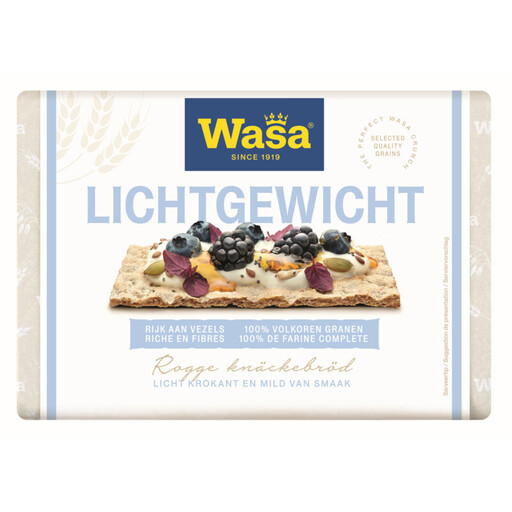 No image available
Worth considering if you’re looking for rye crispbread for the office. Check the grains and allergens on the pack before sharing it.
Pack weight: 300 g.
 No image available
A choice to consider if colleagues are specifically looking for a rye variety made with sourdough. Read the ingredients and allergen information on the pack.
Pack weight: 235 g.
 No image available
A wholegrain variety to compare for shared supplies. Check which grains are used on the pack and compare the nutritional values per 100 g with other options.
Pack weight: 375 g.
No image available
Another wholegrain option for the office. Compare fibre and salt on the current packaging and check the allergens before sharing.
Pack weight: 265 g.
 No image available
A rye variety to consider if you don’t want to base your choice on fibre content alone. Read the label if you want to compare fibre values precisely, and check the allergens before sharing.
Pack weight: 215 g.
No. Don’t use that claim as a substitute for checking the label. Compare the grains, fibre, protein and salt per 100 g, and check which allergens are relevant to your colleagues.
No, rye contains gluten. For example, Ryvita lists rye as an ingredient in its Original Crispbread. Always check the current packaging for the product you want to use.
Follow the storage advice on the pack you choose and protect the contents from moisture once opened. Jumbo advises storing Wasa Protein Wheat in a cool, dry, dark place.
No, don’t assume this without checking the label. The Netherlands Nutrition Centre says bread does not have to be made with baker’s salt. Check the ingredients for the specific crispbread if the type of salt matters to your choice.