
If you choose crispbread as a lunch staple
You eat it regularly for breakfast or lunch and want to compare wholegrain varieties and their fibre content on a like-for-like basis.


For a Mother’s Day breakfast with toppings, you could choose a thin, mild variety. For regular breakfasts or lunches, a wholegrain variety with a firmer texture may suit your preferences better. Thin and wholegrain are not mutually exclusive: check the exact packaging for shape, fibre per 100 g and allergens. Don’t assume crispbread is a substitute for bread made with iodised baker’s salt without checking the label.
You eat it regularly for breakfast or lunch and want to compare wholegrain varieties and their fibre content on a like-for-like basis.
You’re looking for a shape and texture that work with your toppings and the way you plan to serve the crispbread.
You check the ingredients and allergens in your chosen variety, for example because of gluten-containing cereals, milk or sesame.
First decide whether shape and toppings for brunch or the ingredients for everyday use matter most. Then check the exact packaging: ‘medium sliced’ doesn’t tell you the thickness or dimensions on its own.
| What to consider | What to check when buying | Who it matters to |
|---|---|---|
| Wholegrain and fibre | Check that it is labelled wholegrain and compare fibre per 100 g, not per piece. | If I eat crispbread regularly as a lunch staple, I want to know which varieties are wholegrain and how much fibre they contain. This is the most important factor for around 45% of consumers. |
| Shape and texture | Check the thickness, size and number of pieces on the packaging; choose a shape to suit the toppings you have in mind. | For a Mother’s Day brunch, I want crispbread that’s easy to top and serve. A suitable, light presentation comes first for around 33% of consumers. |
| Ingredients and labelling | Read the allergen information; compare salt per 100 g and check whether iodised salt is listed. | If I need to consider what guests can and can’t eat, I need to know which cereals and other allergens the variety contains. This label check is the top priority for around 22% of consumers. |
The Wasa and Bolletje varieties discussed here contain gluten-containing cereals; depending on the variety, they may also contain milk or sesame.
If you have an allergy, check the ingredients and allergen information on the exact packaging. Don’t judge by the pale colour or thin shape.
According to the Voedingscentrum, ‘wholegrain’ crackers must be made with wholegrain flour; colour alone doesn’t confirm this.
Check the product name and ingredients list. Use the nutritional information per 100 g to compare fibre content between varieties.
According to the Voedingscentrum, bread made with iodised baker’s salt is an important source of iodine in the Netherlands, but using this salt isn’t compulsory. The ingredients in a crispbread variety may be different.
Check whether baker’s salt or iodised salt is listed on the packaging; don’t assume you’ll get iodine just because it’s crispbread.
The fibre content won’t tell you how large or thick each piece is. For a brunch with toppings, the combination of size, texture and toppings may be what matters most.
Check the dimensions or look at the pieces themselves before buying for several guests. If you’re serving moist or heavy toppings, consider how sturdy you need the crispbread to be.
The Light variety is designed as a thin, mild base for toppings.
The Wholegrain variety is a crispbread option for breakfast or lunch.
Triangle Normalbaked Rye is a rye variety made up of triangular pieces.
Original Crispbread is a rye variety you can compare by its ingredients.
These Joybuy varieties offer options for a brunch with toppings and for regular breakfasts or lunches. Don’t choose by name alone: check the size, nutritional information and allergens on the packaging you buy.
 Image unavailable
A thin, mild base to consider for a brunch with toppings. Albert Heijn lists Light as containing 100% wholegrain rye and 20 g of fibre per 100 g. This variety contains milk ingredients and rye; if you have an allergy, check the packaging.
 Image unavailable
An option to compare if you’re looking for a variety for regular breakfasts or lunches. Check the packaging for fibre per 100 g, the cereals used and allergens. If you’re serving crispbread at brunch, assess the shape separately.
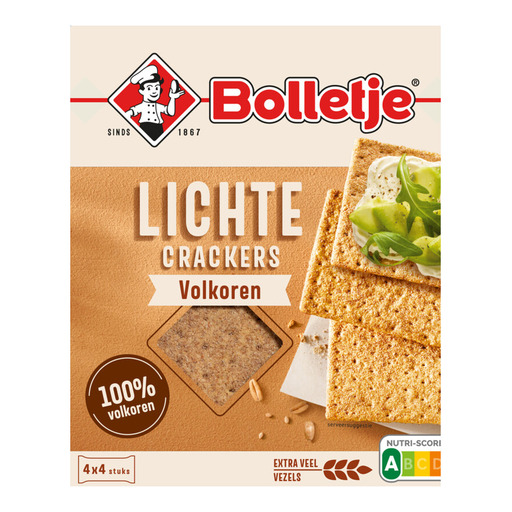 Image unavailable
An option to consider if you’re looking for a Bolletje variety to serve with brunch toppings. Check the thickness and number of pieces when planning how to serve it, and read the nutritional information and allergen details on the exact packaging.
 Image unavailable
A rye variety to consider if you’re looking for crispbread for breakfast or lunch. Compare the nutritional information per 100 g and check the allergens. For brunch, don’t rely on the name when choosing the shape or thickness.
 Image unavailable
A wholegrain variety to compare for breakfast or lunch. Joybuy’s product information lists 14 g of fibre and 0.97 g of salt per 100 g; the ingredients include wholegrain wheat flour, wholegrain rye flour and sesame seeds. If you have an allergy, check the label on the packaging.
Check the wholegrain claim and ingredients list for the variety you’ve chosen. According to the Voedingscentrum, crackers labelled ‘wholegrain’ must be made entirely with wholegrain flour. Fibre per 100 g is useful for an additional comparison, but it doesn’t replace this check.
Read the allergen information on the exact packaging, especially for gluten-containing cereals and any milk or sesame. The Wasa and Bolletje varieties discussed here differ in this respect; a thin or light texture tells you nothing about allergens.
No, not without checking the product’s ingredients. According to the Voedingscentrum, bread made with iodised baker’s salt is an important source of iodine in the Netherlands, but using baker’s salt isn’t compulsory. Check the crispbread label to see whether iodised salt is listed.
Store this variety in a cool, dry place and reseal the packaging carefully after opening. This is the storage advice on the Joybuy product page for Wasa Light; also follow any instructions on the packaging you receive.