
Organisers of a self-service buffet
You’ll want a base that guests can pair with a range of toppings. A plain option gives guests more choice over what they add than a seasoned cracker does.


For a meeting table with a range of toppings, plain wholemeal crispbread is generally more versatile than a single seasoned cracker. Set out a flavoured option separately as a snack, and if anyone has mentioned dietary requirements, choose a suitable alternative after checking the current packaging for ingredients and allergens.
You’ll want a base that guests can pair with a range of toppings. A plain option gives guests more choice over what they add than a seasoned cracker does.
You may be looking for a thin or flavourful cracker that can be served without elaborate toppings. A strong flavour works better as a separate option than as the only cracker on the table.
You’ll need to check the ingredients and allergens listed on the packaging for each option. The Netherlands Food and Consumer Product Safety Authority explains the allergen labelling requirements for pre-packed foods; a gluten-free label does not automatically answer questions about other allergens.
First decide whether guests will mainly choose their own toppings or whether you’ll serve the cracker as a snack in its own right. Then check that each option meets any stated dietary requirements and takes allergies into account.
| What to consider | What to check | Who it matters to |
|---|---|---|
| Presentation and self-service | Check the size and consider whether the flavour leaves room for a range of toppings. | If you want to set out a platter or topping station quickly, choose pieces that guests can easily pair with their own toppings. For around 33% of consumers, this way of serving is the top priority. |
| Dietary requirements and allergens | Read the current ingredients list and allergen information on every pack, and clearly set aside a suitable option. | If a guest has mentioned an allergy, I want to be able to point to exactly which option is intended for them. An estimated 27% of consumers put this check first. |
| Flavour and appearance | Consider whether herbs, seeds or nuts go with the other snacks, and whether you still need a plain option. | If the cracker will also be served on a drinks platter without toppings, it can have a distinctive flavour of its own. For around 20% of consumers, a distinctive flavour matters most. |
| Wholegrain and nutritional information | Check the wholegrain claim and compare the nutritional information per 100 g and, where provided, per serving. | For a snack table, I want to know what kind of base I’m serving and how the options compare for fibre and salt. Around 20% of consumers give this product information top priority. |
A seasoned cracker has a set flavour and may contain ingredients that aren’t suitable for every guest. For example, the Yespers cracker with cashew and brewer’s spent grain listed by Albert Heijn contains cashew and gluten-containing cereals.
Use a plain option as a base for toppings, and serve a strongly flavoured cracker separately if you wish. Keep the packaging available so guests can check the ingredients.
A gluten-free label tells you nothing about other allergens. The Wasa Gluten- & Lactosevrij Sesame & Sea Salt option listed by Jumbo contains sesame.
For every stated allergy, check the packaging of the specific option, even if the front of the pack carries a dietary claim.
Not all crispbread is made with iodised baker’s salt. According to the Netherlands Nutrition Centre, bakers aren’t required to use baker’s salt, and sea salt contains very little iodine.
Don’t assume which type of salt has been used based on the product’s Dutch origin or the words ‘sea salt’; check the ingredients information for the product you’ve chosen.
Wasa offers both simple crispbread options and thin, strongly flavoured crackers; Jumbo lists the Delicate range, among others.
Albert Heijn lists Leksands in its crispbread category, including Original and multigrain options.
Yespers offers crackers made with ingredients such as brewer’s spent grain, spelt or cashew for a separate flavour option.
ALDI describes Goud Gebakken as robust wholemeal crispbread with seeds, available in two varieties.
Ryvita describes Original Crispbread as a crispbread option made with wholegrain rye.
These products suit two ways of serving: crispbread as a base for a topping station, and a paprika cracker as a separate snack. If guests have stated dietary requirements, choose an option only after checking the packaging.
 Image unavailable
An option to consider for a topping station where guests can choose their own toppings.
Pack size: 300 g. If anyone has allergies, check the current ingredients and allergen information.
 Image unavailable
A crispbread option to consider for a meeting table with toppings served separately.
Pack size: 375 g. If the exact proportion of wholemeal flour matters to you, check the ingredients on the pack; check the allergen information too.
 Image unavailable
A crispbread option for anyone who wants to serve toppings alongside the meeting snacks.
Pack size: 215 g. If guests have allergies, check what the current packaging says about rye, milk and sesame.
 Image unavailable
A wholemeal option to serve as a simple snack or with toppings on the side.
Pack size: 265 g. Before serving, check the allergen information, including details of gluten-containing cereals and sesame.
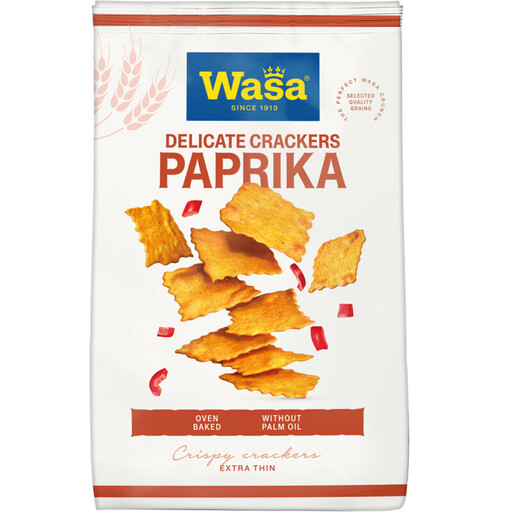 Image unavailable
A paprika cracker to serve as a separate flavour option with meeting refreshments, rather than as a plain base for all the toppings.
Pack size: 150 g. Check the current packaging for ingredients and allergens before serving this to guests.
Yes, especially if guests have mentioned allergies. The Netherlands Food and Consumer Product Safety Authority says allergens must be listed on the label of pre-packed foods; check the packaging of every option you choose before serving it.
No. Gluten-free doesn’t mean that other allergens are absent. For example, the Wasa Gluten- & Lactosevrij Sesame & Sea Salt option described by Jumbo contains sesame; always check which allergens are relevant to the guest in question.
Keep the packaging for the options you serve and make it clear which crispbread goes with which pack. That way, guests can check the ingredients and allergens for each product, even when the crackers are on a platter.
No. The Netherlands Nutrition Centre says bakers aren’t required to use baker’s salt and that sea salt contains very little iodine. If the type of salt used matters to you, check the ingredients for the specific option.