
If you want to compare sugar content
You want to compare sugar content using the nutrition table, rather than treating a claim on the front of the pack as decisive. Values per 100 g also show how products differ in fibre and salt.


For camping, compare similar types of crispbread by their sugar content per 100 g, rather than relying on a claim on the front of the pack. Also consider fibre, salt and allergens, and choose packaging that you can reseal and keep dry after opening. If you’re taking perishable toppings, you’ll need to consider refrigeration separately.
You want to compare sugar content using the nutrition table, rather than treating a claim on the front of the pack as decisive. Values per 100 g also show how products differ in fibre and salt.
You’re looking for a dry staple for meals or snacks. It’s also worth considering whether you can reseal the crispbread after opening and whether your chosen toppings can be kept without refrigeration.
Check the ingredients and allergen information on the pack you choose. Rye, wheat, gluten, sesame and warnings about the possible presence of other allergens vary from product to product.
Start with the nutrition information for similar types of crispbread. Then check that the packaging, storage instructions and allergen information suit your needs at the campsite.
| What to consider | What to check | Who it matters to |
|---|---|---|
| Sugars and nutritional value | Compare ‘of which sugars’ per 100 g for similar types of crispbread; also check fibre, salt and ingredients. | If I want to eat less sugar, I want to see the amount on the label rather than rely on a claim on the front of the pack. Around 45% of consumers give this comparison top priority. |
| Storage at the campsite | Check the best-before date and storage instructions, and make sure you can reseal the pack properly after opening. | Without reliable fridge space, I want to be able to take a dry staple with me and keep opened crispbread crunchy. For around 33% of consumers, ease of storage comes first. |
| Grains, seeds and allergens | Read the ingredients and allergen information, including any ‘may contain’ warnings, on the pack you choose. | If I need to avoid certain grains or seeds, I need clear allergen information before I pack anything. This is the main concern for around 22% of consumers. |
A lower sugar value alone doesn’t determine which product to choose. Albert Heijn lists 3.4 g of sugars, 12 g of fibre and 0.7 g of salt per 100 g for AH Knäckebröd volkoren; Jumbo lists 2.4 g, 10.9 g and 0.71 g per 100 g respectively for Jumbo Volkoren knäckebröd. These values relate to these specific products, so compare the current packaging if you’re choosing between them.
‘No added sugars’ doesn’t mean a product contains no sugars. According to the Netherlands Nutrition Centre, the ‘of which sugars’ line in the nutrition table shows the amount you can compare.
Compare the values per 100 g for similar types of crispbread, and check the ingredients list too if you’re specifically looking to avoid added sugar.
The storage instructions for AH Knäckebröd volkoren and Jumbo Volkoren knäckebröd say to store them in a dry place and reseal the pack properly after opening.
Take a sealable container or bag with you, and choose a pack size that suits the length of your stay.
Toppings that need to be kept chilled require different storage from dry crispbread at the campsite. The Netherlands Nutrition Centre recommends taking the kitchen and refrigeration facilities available into account when camping.
Check the storage instructions for your toppings separately, and choose them to suit the refrigeration you actually have.
As well as rye or wheat, a crispbread variety may contain seeds. For example, AH Knäckebröd volkoren lists sesame; other products may have additional allergen warnings on the pack.
If you have an allergy, read the full ingredients and allergen information on the exact pack you’re buying.
These brands give you a starting point for comparing labels. The ingredients and nutritional values always relate to a specific variety and pack.
Wasa offers several crispbread varieties, including Original, Volkoren and Protein Wheat.
Ryvita Original Crispbread is a rye variety you can compare with other types of crispbread.
AH Knäckebröd volkoren has product-specific nutritional information you can use to compare sugars, fibre and salt.
Jumbo Volkoren knäckebröd has its own wholegrain label to compare with other products.
ALDI’s Goud Gebakken range also includes wholegrain crispbread.
These products are crispbread or varieties described as crispbread that you can compare for camping. Use the nutritional information on the pack you choose to weigh your preference for less sugar against fibre, salt and allergens. A name such as ‘Light’ or ‘High-Fiber’ isn’t a substitute for checking the label.
 Image unavailable
A wholegrain variety to compare if you want to consider both sugars and fibre. If you have allergies, check the ingredients and allergen information on the current pack, and reseal the crispbread properly after opening.
 Image unavailable
A wholegrain variety for anyone looking for a dry base for toppings and wanting to compare sugar content. Also check the pack you choose for fibre, salt and information about gluten and possible allergens.
 Image unavailable
If fibre matters to you as well as sugars, compare the nutritional values per 100 g for this variety with those of other crispbreads. If you have allergies, also check the ingredients and warnings on the pack.
 Image unavailable
A wholegrain option to compare with other packs when both sugars and fibre matter. If you have allergies, check all the information on the pack carefully, and reseal opened packaging properly.
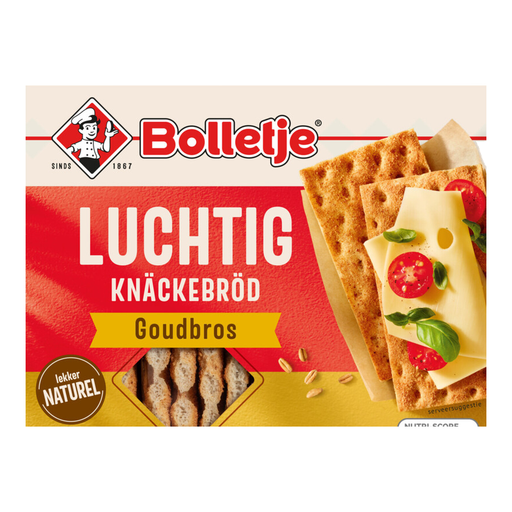 Image unavailable
If you’re considering this variety because of its sugar content, check the value per 100 g: ‘Light’ on its own doesn’t tell you how much sugar the product contains. Also compare fibre, salt and allergen information.
For similar products, compare the ‘of which sugars’ value per 100 g. According to the Netherlands Nutrition Centre, this is a useful basis for comparing labels. Also check fibre, salt and ingredients, as pack sizes and portion numbers can vary.
No. ‘No added sugars’ doesn’t mean the product contains no sugars at all. Check the amount listed under ‘of which sugars’ and read the ingredients if you want to distinguish between the product’s ingredients and the claim on the pack.
Follow the storage instructions on your pack and reseal it properly after opening. Albert Heijn and Jumbo recommend storing their wholegrain crispbreads in a dry place, so a sealable container or bag is handy if you can’t close the original pack.
No. Toppings have different storage requirements from crispbread. Check whether they need to be kept chilled and choose something that suits your refrigeration facilities and the length of your stay. The Netherlands Nutrition Centre recommends taking the kitchen facilities available at the campsite into account.