
Snackers who like generous toppings
If you want to make a crispbread slice with plenty of toppings for an evening snack, start by checking the product description and the weight per piece. Neither of these alone proves how much a slice can hold.


For generous toppings, crispbread described as robust is a sensible place to start, but ‘thick cut’ doesn’t guarantee a measured thickness or how much it can hold. Compare the weight per piece and the ingredients, and if in doubt, try a slice with the toppings you usually use. For lighter toppings, a variety described as airy may better suit the texture you’re looking for. Whichever you choose, check the label for allergens.
If you want to make a crispbread slice with plenty of toppings for an evening snack, start by checking the product description and the weight per piece. Neither of these alone proves how much a slice can hold.
If fibre is a factor in your choice, compare the nutritional information per 100 g as well as the amount you actually eat. Also check the ingredients and salt content.
If you’re keeping an eye on protein, allergens or iodine as part of your overall diet, the label gives you more useful information than a description such as ‘thick cut’. Check the details for the variety you want to buy.
Start with the toppings you want to use: a robust description can point to a good option for generous toppings, while an airy description mainly tells you about the intended texture. Then compare serving sizes and label information for each product.
| What to consider | What to look for | Who it matters to |
|---|---|---|
| Generous toppings | Look for a robust product description and compare the weight per piece; try a slice with your usual toppings. | If I use plenty of toppings, I want to know whether the slice is easy to handle. Around 40% of consumers prioritise a sturdy base. |
| Fibre and wholegrain | Compare fibre per 100 g and check which grains are listed in the ingredients; also look at the salt content. | For a regular evening snack, I want to compare the ingredients without assuming that ‘wholegrain’ tells me anything about thickness. Fibre and wholegrain are the top priorities for around 30% of consumers. |
| Airy texture | Read the texture description and compare serving sizes; ‘airy’ says nothing about how much it can hold or its nutritional value. | With lighter toppings, I mainly want a less dense cracker. This texture is the deciding factor for around 20% of consumers. |
| Specific label details | Check the protein per serving, the allergen information and, if iodine is relevant to your choice, the details on the packaging. | If I need to keep an eye on protein or certain ingredients, I prefer to choose based on the details for the exact variety. Around 10% of consumers put this kind of specific check first. |
Words such as ‘robust’ and ‘airy’ describe products, but they aren’t comparable measurements of thickness or break strength.
Use ‘robust’ as a first filter for generous toppings. Then compare the weight per piece and try the product with the toppings you usually use.
A fibre figure doesn’t tell you how much salt a product contains or which allergens it includes.
For the exact variety, read the nutritional information and allergen details on the current packaging.
Voedingscentrum explains that bread doesn’t have to be baked with baker’s salt. So you can’t assume a particular iodine content just because something is crispbread.
Check the packaging if iodine is a factor in your choice, and consider that information alongside the rest of your diet.
A different pack size may mean you’re not comparing the same version, even when the brand and product range match.
Check the net weight, ingredients and nutritional information on both packs before treating them as equivalent.
These brands offer options to compare across different types of crispbread. Always assess each individual variety rather than the brand as a whole.
The Oerknäck varieties are worth considering if you’re looking for a base described as robust for adding toppings.
The range includes varieties described as airy, as well as options focused on protein.
Albert Heijn lists several Leksands varieties for anyone wanting to compare rye crispbread.
The own-brand range includes wholegrain, golden-brown and seeded varieties.
Ryvita Original is a rye crispbread to consider if you find this specific variety at a retailer.
These products offer options for an evening snack with toppings, as well as for anyone who wants to consider wholegrain ingredients or a texture described as airier. If you want generous toppings, don’t choose based on the product name alone: you can only judge how sturdy it is by trying it.
 Image unavailable
An option to consider if you’re looking for crispbread for a snack with toppings. Try it with your usual toppings to see whether the slice is sturdy enough.
 Image unavailable
A good fit if you want to consider wholegrain ingredients. Check the nutritional information and allergens on the packaging; ‘wholegrain’ says nothing about how much topping it can hold.
 Image unavailable
A wholegrain option for an evening snack with toppings. If you’re mainly looking for a base for generous or wet toppings, check how sturdy an individual slice is.
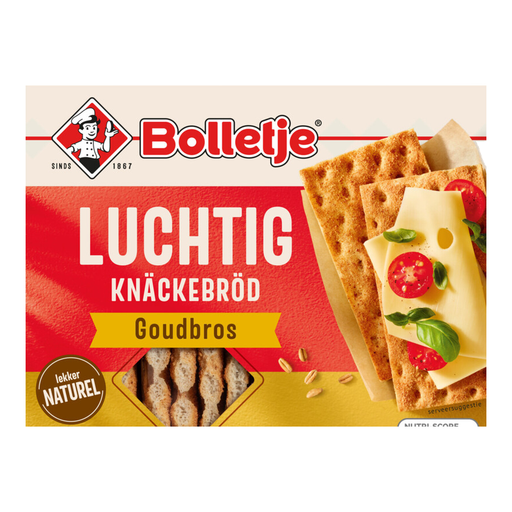 Image unavailable
An option if you’re looking for a texture described as airier to go with lighter toppings. ‘Light’ and ‘airy’ don’t prove that this slice can hold generous toppings or that it has a particular nutritional value.
 Image unavailable
An option to compare if fibre is one of your selection criteria. Read the nutritional information per 100 g and per serving; the name says nothing about how sturdy it is with generous toppings.
No. Don’t treat ‘thick cut’ as a guarantee of thickness or sturdiness. Compare the details for individual products and, if in doubt, try a pack with your usual toppings.
Start with a variety explicitly described as robust, such as Bolletje Oerknäck robust wholegrain on the Albert Heijn product page. This description doesn’t guarantee that the slice will stay intact with every type of topping; try the combination you want to make.
No. The product category doesn’t tell you how much iodine a variety contains. Voedingscentrum says that bread doesn’t have to be baked with baker’s salt, so check the packaging if iodine is relevant to your choice.
Always read the allergen information for the exact variety. The products discussed include gluten-containing cereals and sesame, among other allergens; possible traces vary by product.