
Fussy eaters at coffee break
Looking for a crisp base for sweet or savoury toppings, and may prefer a wheat blend to a strongly rye-based variety. Taste and texture are a matter of personal preference.


For a coffee break with fussy eaters, crispbread made with both wheat flour and wholemeal flour is an option if you’re looking for a milder grain base. If you want wholegrains only, choose a fully wholegrain variety and compare the fibre and salt per 100 g. Whichever you choose, check the ingredients and allergens on the exact pack.
Looking for a crisp base for sweet or savoury toppings, and may prefer a wheat blend to a strongly rye-based variety. Taste and texture are a matter of personal preference.
At a regular coffee break, they want to know whether the grain is entirely wholegrain and how much fibre the crispbread contains per 100 g. The Netherlands Nutrition Centre distinguishes fully wholegrain products from those that also contain non-wholemeal flour.
As well as the grain composition, they check the salt content and ingredients such as wheat, rye or sesame. For allergen information, always refer to the current packaging of the variety you choose.
First decide whether a flour blend or a fully wholegrain base is right for your coffee break. Then compare the nutritional information and allergens of the varieties you’re considering.
| What to consider | What to check when buying | Who it matters to |
|---|---|---|
| Taste and texture | Check which types of flour are listed in the ingredients and choose a variety with a texture that appeals to you. | If I don’t enjoy a strong rye base, I’d rather try a crisp wheat variety. For around 33% of consumers, taste and texture come first. |
| Wholegrains and fibre | Check the grain composition and compare the fibre per 100 g. The Netherlands Nutrition Centre distinguishes fully wholegrain products from flour blends. | For a regular coffee break, I mainly want the option of choosing a fully wholegrain base, even if the grain flavour is more pronounced. That’s the top priority for around 42% of consumers. |
| Salt and allergens | Compare the salt per 100 g and read the current ingredients and allergen information on the packaging. | If I need to keep an eye on salt or certain ingredients, I want to be able to assess a variety before eating it. Around 25% of consumers put checking the label first. |
Colour doesn’t tell you which types of flour have been used: Albert Heijn lists both wholemeal wheat flour and wheat flour in Wasa Goudbruin.
If a fully wholegrain base matters to you, check the ingredients list.
A higher fibre value doesn’t tell you how much salt a variety contains. Jumbo’s product information lists 20 g of fibre and 1.2 g of salt per 100 g for Wasa Volkoren; for Bolletje Volkoren Knäckebröd, Jumbo lists 14 g of fibre and 0.97 g of salt per 100 g.
Compare both values on the same basis, per 100 g, and take the ingredients into account too.
The varieties discussed use different grains; sesame is also listed for the Bolletje variety. Similar product names don’t mean the ingredients are the same.
If you have a food allergy or another dietary restriction, check the allergen information on the current packaging.
A mention of salt alone doesn’t tell you which type of salt has been used in the product.
Don’t assume it contains iodised baker’s salt unless this is confirmed in the product-specific information.
For this choice, both Goudbruin, made with a blend of flours, and Volkoren, made with rye, are worth considering.
The Volkoren Knäckebröd variety discussed is an alternative if you’re looking for a fully wholegrain base.
AH Knäckebröd volkoren is an own-brand variety made with wholemeal wheat and rye flour.
Jumbo lists its own-brand Volkoren Knäckebröd alongside branded varieties.
Albert Heijn lists several Leksands varieties in its range of rye crispbread.
These products offer a few different options for your coffee break: a grain blend, wholegrain varieties and a crispbread described as light. A product name or description of its texture alone doesn’t guarantee a mild flavour; use the label to make your final comparison.
 Image unavailable
An option to consider if you’re looking for a blend of flours for your coffee break. The presence of rye doesn’t guarantee a mild flavour, so check the current allergen information too.
 Image unavailable
An option if you’d like to compare a thin, crisp-textured base with a flour blend for your coffee break. Check the grain composition and allergens of this exact variety.
 Image unavailable
If you want to weigh up a fully wholegrain variety against a flour blend, this is one to consider. For Bolletje Volkoren Knäckebröd 265 g, Jumbo lists 14 g of fibre and 0.97 g of salt per 100 g; check the current packaging for allergens too.
 Image unavailable
For anyone who mainly wants to compare grain composition and nutritional information in a crisp base. Check the fibre and salt per 100 g on the label, and look at the allergens too.
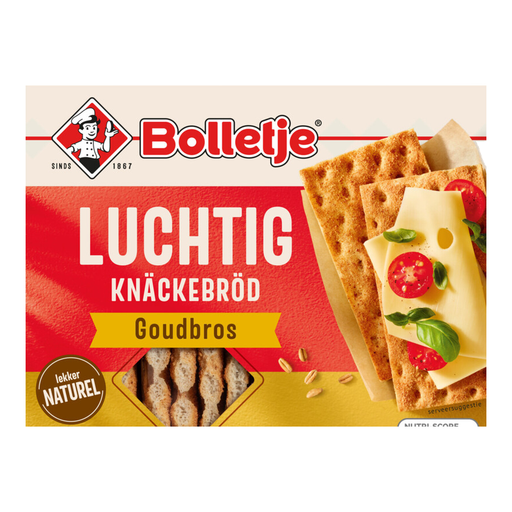 Image unavailable
An option described as light for anyone who mainly focuses on texture at coffee break. Don’t assume ‘Golden Crisp’ means it’s made entirely with wholegrains; check the ingredients and allergens on the packaging.
No. Albert Heijn lists both wholemeal wheat flour and wheat flour in Wasa Goudbruin. Read the ingredients list if you want a base made entirely from wholegrains.
You can’t assume that for every product. A mention of salt doesn’t confirm which type has been used; check the product-specific information if this matters to your choice.
No. The Wasa, Bolletje and AH varieties discussed contain gluten-containing grains such as wheat, rye or barley. If you need to avoid these, always check the label on the exact pack.
Store it in a dry, airtight container, following the storage instructions on the packaging you choose. For AH Knäckebröd volkoren, Albert Heijn recommends storing it in a sealed tin after opening.