
Caterers planning their orders
You’re buying crispbread for a larger group and want to know how many packs you’ll need for the buffet. Pack weight makes it easier to plan different sizes on a like-for-like basis.


For a conference buffet, start with a standard option in a pack size suited to the number of delegates. Add another variety if it meets a known guest need, and check the current label for each product. If you serve crispbread unpackaged, allergen information must be available before guests eat.
You’re buying crispbread for a larger group and want to know how many packs you’ll need for the buffet. Pack weight makes it easier to plan different sizes on a like-for-like basis.
You’re serving food to delegates and want to know which allergens are present on each platter. The Netherlands Food and Consumer Product Safety Authority says that, in this catering context, you must inform guests about the 14 legally recognised allergens.
You want to check the product description rather than judge by its colour or type of grain. According to the Netherlands Nutrition Centre, a crispbread can only be called wholegrain if it is made entirely from wholemeal flour.
Work out how much crispbread you want to serve and which guest requirements you already know about. Then choose the pack size and record the label information for each variety.
| What to consider | What to check when buying | Who it matters to |
|---|---|---|
| Order quantity | Compare the net weight of the packs and work out how many you’ll need for the planned service. | When I’m buying for a large number of delegates, I want to be able to plan how many packs I need. Around 33% of consumers put order quantity first. |
| Allergen information | Check the current label and, if serving the product unpackaged, keep the information available for each platter. | At an open buffet, I want to be able to tell guests clearly which allergens are in the option they choose. This is the main concern for around 27% of consumers. |
| Wholegrain and dietary options | Read the product description and ingredients, and check that a dietary option meets the guest’s specific needs. | When a delegate asks for a particular product feature, I want to be able to check it on the packaging. For around 20% of consumers, this suitability comes before other purchasing considerations. |
| Buffet layout | Decide how many varieties to serve alongside the standard option and how to keep the platters separate. | I want to be able to top up the buffet without mixing up the varieties. Around 20% of consumers prioritise this approach to serving. |
Guests won’t be able to tell which allergens are in each platter. The Netherlands Food and Consumer Product Safety Authority requires customers in the hospitality and catering sectors to be informed about the 14 legally recognised allergens.
Keep the current labels and make the information available for each platter before delegates start eating. Keep products with different ingredients clearly separate.
The mention of rye alone doesn’t prove that a crispbread is wholegrain. Nor can you assume from the Dutch description of baker’s salt that a particular product contains that ingredient.
Read the exact product description and ingredients on the pack you’ve chosen. Don’t make claims about iodine based on the product category alone.
Jumbo stocks several Wasa crispbread options, including wholegrain and high-fibre varieties, as well as speciality options.
The AH range includes wholegrain crispbread and varieties with ingredients such as seeds.
Jumbo stocks its own-brand crispbread alongside a range of branded and speciality options.
Goud Gebakken stocks, among other options, wholegrain and sesame crispbread in 375 g packs.
Lidl lists crispbread with sunflower seeds and pumpkin seeds in a 264 g pack.
These packs are options for planning quantities for a conference buffet or choosing a separate variety for guests. Compare the current labels before serving products unpackaged.
 Image unavailable
An option to consider if you want to serve crispbread for breakfast or lunch. The pack contains 265 g; check the current ingredients and allergens before serving the product unpackaged.
 Image unavailable
A 375 g pack to include when planning a buffet with toppings. Check the exact wholegrain description, ingredients and allergens on the current packaging.
 Image unavailable
A Wasa option if you want to serve a separate choice alongside a standard product. The pack contains 260 g; use the current label for ingredient and allergen information at the buffet.
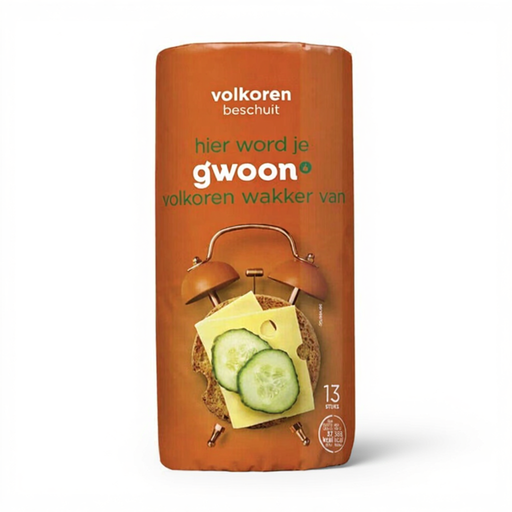 Image unavailable
A 125 g pack to consider for a separate platter. Check the exact wholegrain description and allergens on the current label before offering this variety to guests.
 Image unavailable
A Wasa option to consider if you want to offer a separate platter of crispbread with toppings. The pack contains 215 g; check the current label for ingredients and allergens.
Start with the amount you want to serve at the buffet, then compare the net weight of each pack. Remember to include separate varieties if you’re offering them to meet known guest requirements.
Yes. According to the Netherlands Food and Consumer Product Safety Authority, you must inform guests about the 14 legally recognised allergens in a catering context. If you serve crispbread unpackaged, use the current product information to make clear which details apply to each platter.
No, it doesn’t mean that all crispbread is made with baker’s salt. Dutch regulations define baker’s salt as iodised table salt for bread and other baked goods; check the ingredients of the specific product.
Check the product description on the packaging. According to the Netherlands Nutrition Centre, a crispbread can only be called wholegrain if it is made entirely from wholemeal flour; words such as ‘rye’ or ‘high-fibre’ alone don’t confirm this.