
Host of a coffee table shared with friends
You want to serve crispbread with toppings without running short halfway through. Packs that state the number of pieces or servings make it easier to work out how many you’ll need.


For coffee with friends, start by choosing crispbread with enough pieces and a size that suits your group and the toppings you plan to serve. Then compare the nutritional information if wholegrain or fibre content matters to you, and check the allergens on the exact pack if anyone has dietary requirements. The term ‘medium sliced’ doesn’t tell you the size of the pieces on its own.
You want to serve crispbread with toppings without running short halfway through. Packs that state the number of pieces or servings make it easier to work out how many you’ll need.
You compare the description on the front of the pack with the nutritional information per 100 g and, where available, per piece. That way, you can assess the product you actually plan to serve.
You ask your guests in advance what they need and check the ingredients and allergens for the variant you’ve chosen. The toppings and serving equipment matter too if cross-contamination is a concern.
Start with the number of guests and how many pieces you want to serve with toppings. Then choose based on the nutritional information or any dietary requirements that matter to your group.
| What to consider | What to check | Who it matters to |
|---|---|---|
| Enough pieces to share | Check the number of pieces or servings, and whether the size works with your toppings. | If I’m serving crispbread to several friends, I want to know whether there’ll be enough for everyone. That’s why having enough pieces is the top priority for around 33% of consumers. |
| Wholegrain and fibre | Read the product description and compare fibre per 100 g and, if stated, per piece. | I want to prioritise wholegrain or the stated fibre content, even if another pack seems easier to share. Around 27% of consumers say this is their priority. |
| Dietary requirements and allergens | Ask what your guests need and check the ingredients and allergens on the pack. | If a guest needs to avoid an ingredient, I want to choose the exact variant and toppings accordingly. This is the top priority for around 20% of consumers. |
| Pack size and leftovers | Compare the pack size with how much you expect to serve and read the storage instructions. | For a small coffee get-together, I don’t want to open much more than we’ll use. The right quantity is the first consideration for around 20% of consumers. |
The pack weight doesn’t automatically tell you how many pieces are inside. Jumbo lists 25 servings for its 375 g wholegrain crispbread; ALDI lists 25 pieces for its 375 g Goud Gebakken wholegrain crispbread. Check the details on the pack you choose to see how the quantity is stated, especially if you’re looking for a particular piece size.
Those words alone don’t tell you the dimensions or the number of pieces. The pack may therefore be different from what you expect for your toppings and number of guests.
Check the piece size if it’s stated, as well as the number of pieces or servings. If you’re unsure, ask for the dimensions of the exact variant.
According to Jumbo’s product information, the Wasa Gluten- & Lactosevrij Sesame & Sea Salt variant contains sesame and may contain milk, mustard and soya.
Discuss your guest’s dietary requirements with them, read the label on the exact pack and watch out for cross-contamination from toppings or serving equipment.
These descriptions don’t tell you how much fibre is in a piece of a particular product. The Netherlands Nutrition Centre gives average figures of 1.4 g of fibre for a 10 g piece of wholegrain crispbread and 2.4 g for a 10 g piece of high-fibre crispbread; individual products may differ.
Compare the nutritional information on the packs themselves, including the stated serving size, before choosing based on fibre content.
According to the Netherlands Nutrition Centre, using baker’s salt when baking bread isn’t compulsory. So the product type alone won’t tell you which salt was used in a particular crispbread.
Check the ingredients list on the pack you’ve chosen if the presence of baker’s salt matters to your decision.
Wasa offers crispbread made with different grains and additions, including a sesame variant described as gluten- and lactose-free.
Albert Heijn’s range includes AH wholegrain crispbread and AH golden-brown crispbread.
Jumbo lists its wholegrain crispbread in a 375 g pack containing 25 servings, and also offers a pumpkin seed variant.
Lidl lists a 250 g pack of wholegrain crispbread as a store-brand product.
ALDI lists its Goud Gebakken wholegrain crispbread in a 375 g pack containing 25 pieces.
These crispbreads are worth considering as a base for toppings at coffee time. For a table shared with friends, compare the pack size with the number of pieces you need; check the product information and label for the size you want and any dietary requirements.
 No image available
An option if you want to serve crispbread with toppings and are looking for a 215 g pack.
Check how many pieces are in the pack and how large they are. If you have dietary requirements, ask about the ingredients and allergens in this variant.
 No image available
A good fit if you want to serve wholegrain crispbread with toppings.
The pack contains 265 g. Compare the nutritional information per 100 g and per serving, and check the number of pieces and allergens on the pack.
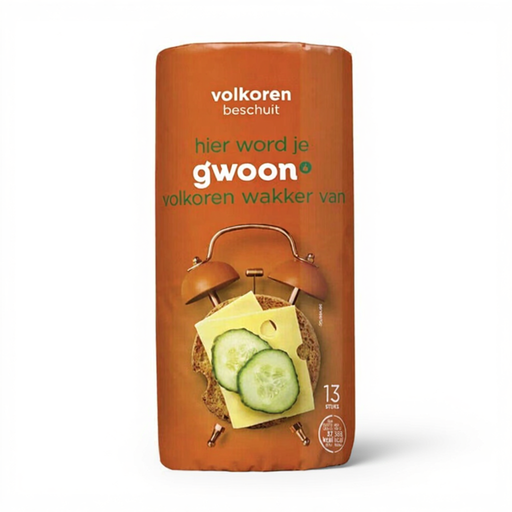 No image available
A wholegrain option to consider if you’re looking at a 125 g pack for your coffee table.
Check whether the number and size of the pieces suit your group. If you have dietary requirements, check the ingredients and allergens on the pack.
No, that description doesn’t rule out other allergens. According to Jumbo, the Wasa Sesame & Sea Salt variant contains sesame and may contain milk, mustard and soya. Ask your guest which ingredients they need to avoid, and check the toppings and serving equipment too.
Follow the storage instructions on the pack and seal it well after use. Jumbo advises keeping its wholegrain crispbread in a cool, dry place and resealing it carefully after opening; instructions may vary by product.
Use that information to compare products, but read the label on the pack you buy before serving. Albert Heijn notes that ingredients, nutritional values and allergy information can change.
You can’t tell from the product type alone. The Netherlands Nutrition Centre says using baker’s salt when baking bread isn’t compulsory; check the ingredients list for the crispbread you’ve chosen.