
Small households planning a one-off drinks evening
You’re looking for a crunchy base for a few toppings, but don’t want to be left with lots of opened crispbread. Compare the pack size and number of portions, and check how to store any leftovers.


For an Asian-themed evening, choose a simple rye variety if you want the toppings to provide the flavour, or one with sesame or seeds if you want the crispbread itself to add flavour. For a small gathering, compare the pack size with how much you expect to use, and check the allergens and storage instructions on the label. Don’t use ‘half loaf’ as a measure for crispbread.
You’re looking for a crunchy base for a few toppings, but don’t want to be left with lots of opened crispbread. Compare the pack size and number of portions, and check how to store any leftovers.
You may want the crispbread to provide a simple base, or for sesame or seeds to add flavour. Choose the ingredients to suit what you’ll be serving with it.
You need clear information about ingredients and packaging warnings for yourself or your guests. Wholegrain crispbread made with rye or wheat isn’t automatically gluten-free.
First, work out how much crispbread you’ll need and what role it will play alongside the toppings. Then check that the ingredients are suitable for everyone at the table.
| What to consider | What to check | Who it matters to |
|---|---|---|
| Quantity and storage | Compare the net weight and number of portions with the number of people; read the storage advice for after opening. | For a small drinks evening, I want to finish the pack or keep any leftovers crisp. For around 42% of consumers, getting the right quantity comes first. |
| Flavour with the toppings | Check the type of grain and whether it contains sesame or seeds; decide whether the toppings or the crispbread should provide the main flavour. | If the toppings are the star, I want a base that works well with them. For around 33% of consumers, flavour combinations matter most. |
| Ingredients and allergens | Check the current ingredients list, dietary claims and any warnings about the possible presence of allergens. | If someone at the table needs to avoid gluten or sesame, I want to check the label before serving. For around 25% of consumers, this check comes first. |
Wholegrain doesn’t mean a product is gluten-free. Jumbo lists rye flour in Wasa Wholegrain.
If you need a product labelled gluten-free, check for that claim and review the other allergen information on the current pack.
The Wasa Gluten- & Lactose-Free Sesame & Sea Salt described by Jumbo contains sesame. A claim about gluten or lactose says nothing about the other ingredients.
Check the ingredients and any ‘may contain’ warnings on the pack for all your guests.
According to the Netherlands Nutrition Centre, using baker’s salt in bread isn’t compulsory. So you can’t assume crispbread contains iodine just because of the product category.
Check the listed ingredients if baker’s salt is relevant to your choice.
A 375 g pack may be more than you need for one small gathering, even if the crispbread goes well with the toppings.
Compare the pack size with how much you expect to use that evening and whether you’ll use it again later.
After opening, store any leftovers in an airtight container to keep them crisp.
Wasa offers, among other options, a wholegrain rye variety and a separate gluten- and lactose-free sesame variety, as described on Jumbo’s product pages.
Albert Heijn’s own-brand AH Wholegrain Crispbread comes in a 375 g pack. Albert Heijn lists 25 portions of 15 g.
ALDI Netherlands lists a Goud Gebakken wholegrain crispbread with 25 pieces in a 375 g pack.
Lidl Netherlands describes crispbread varieties with sunflower seeds or pumpkin seeds in 264 g packs.
These packs offer crispbread as a base for toppings or as part of a drinks spread. Compare the weight with the number of people; a larger pack may mean planning another occasion to use it.
 No image available
An option to serve with toppings if you’re looking for a 215 g pack.
Compare the number of pieces on the pack with the number of people. For allergen information, check the current details on rye, gluten and possible traces of milk or sesame; seal the pack tightly after opening.
 No image available
This 265 g pack is an option if you’d like to serve wholegrain crispbread with toppings.
Check how many pieces are in the pack. For allergen information, read the current label, paying particular attention to wheat, rye, barley, gluten, sesame and the possible presence of lupin.
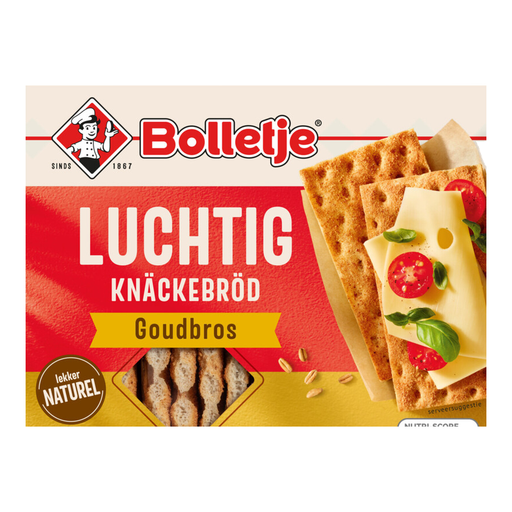 No image available
At 240 g, this is a pack to consider for a smaller drinks gathering.
Check the pack to see how many pieces you can serve. For allergen information, check the details on wheat, gluten, sesame and the possible presence of lupin; store any leftovers in an airtight container.
 No image available
This 375 g pack is best suited to you if you’ll also want crispbread after your Asian-themed evening.
Check how many pieces are in the pack and store any leftovers in an airtight container. For precise ingredient and allergen information, read the current label, especially if anyone at the table needs to avoid something.
No, don’t use that description to work out how much you’ll need for your gathering. Compare the stated weight and number of pieces or portions with how much you expect to serve.
No, you can’t assume that. The Netherlands Nutrition Centre says baker’s salt isn’t compulsory in bread, so check the label to see which ingredients are listed for the crispbread you’ve chosen.
Store any leftovers according to the instructions on the pack and seal them tightly after opening. Albert Heijn recommends storing its wholegrain crispbread in a closed tin after opening.
Not automatically: the Wasa Wholegrain described by Jumbo contains rye and gluten. If you need a gluten-free product, check the claim on the pack you choose and read the other allergen information too.