
Vandaag of morgen in huis

Kwaliteit gegarandeerd

Welkomstaanbiedingen ontgrendelen: GRATIS bezorging | Tot 80% korting | Gratis 30 dagen JoyPlus-proefperiode
Download de app
As a creator, designer, or hobbyist, you know how frustrating it is to wait for a slow 3D print. You have an idea, and you want to bring it to life quickly without compromising on quality. The Creality K1 series is designed to tackle this problem, focusing on high speed and reliability. But with different models like the K1, K1C, and K1 MAX, it can be challenging to choose the right one.
This article will help you understand the specifications and navigate the differences, so you can make an informed decision for your next 3D printer purchase based on what your projects truly require.
Before making a choice, it's important to consider a few key aspects that determine your printer's performance and capabilities.
The K1 series is renowned as a high-speed 3D printer, largely thanks to its CoreXY 3D printer architecture. This system allows for lighter moving parts, resulting in higher accelerations and print speeds of up to 600 mm/s. The question is: how large do your prints need to be?
While PLA is a fantastic and user-friendly material, professional applications and functional parts often require more advanced filaments. Think of materials that are stronger, more heat-resistant, or more wear-resistant.
If you plan to work with engineering-grade materials, a printer capable of handling them is essential. A carbon fibre 3D printer, for example, needs a hardened steel nozzle to prevent wear and a hotend that can reach temperatures of 300°C. The K1C is specifically equipped for this.
Time is precious. Constantly having to manually level the print bed is a time-consuming process that can also lead to failed prints. A printer with a reliable auto-levelling system takes this work off your hands. The K1 series comes equipped with hands-free automatic calibration, where sensors measure the print bed's height and correct it automatically. This ensures a perfect first layer, which is crucial for a successful print.
Based on specifications and applications, we have selected our top models from the K1 series and a matching filament.
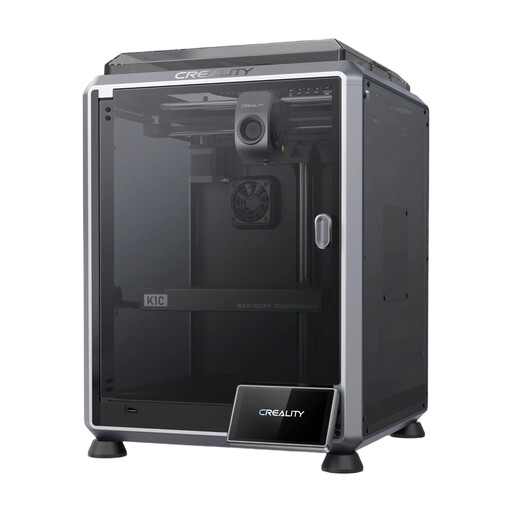
Why It Stands Out The 'C' in K1C stands for Carbon. This model is optimised for printing with fibre-reinforced filaments. It features a clog-free direct drive extruder and a "Unicorn" tri-metal nozzle that resists wear from abrasive materials. The built-in AI camera for monitoring and the quiet mode (≤45dB) make it a sophisticated machine.
Pros
Who Is It For? For prosumers, engineers, and designers who need reliable, functional parts and prototypes from engineering-grade materials. If your projects demand strength and durability, the K1C is the logical choice.

Why It Stands Out The K1 MAX combines the high speed of the K1 series with an impressive 300x300x300 mm build volume. What truly sets it apart is the addition of an AI LiDAR scanner. This scans the first layer with 1μm precision to optimise flow, significantly increasing the chances of a perfect start. The robust cube frame ensures stability, even at top speed.
Pros
Who Is It For? For users who want to print large objects—such as cosplay parts, architectural models, or large-scale prototypes—without waiting for days. Also ideal for small production runs.
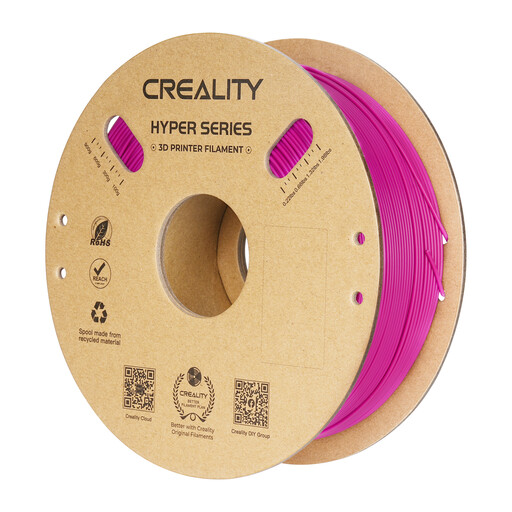
Why It Stands Out A high-speed printer needs high-speed filament. Creality Hyper PLA is specially formulated to provide the high fluidity and rapid cooling required for printing at speeds up to 600 mm/s. Standard PLA can cause under-extrusion issues at these speeds. Hyper PLA ensures a smooth and consistent line, even at top speed.
Pros
Who Is It For? For any owner of a K1, K1C, or K1 MAX who wants to unlock their machine's full speed potential while maintaining high print quality.
This purple Hyper PLA is a popular choice, but there's a whole world of colours and materials to explore. Whether you're looking for a specific shade for a project or want to experiment with other materials, there are plenty of options.
Explore our range of purple 3D printing filament here
The K1 is the base model that introduced high-speed printing. The K1C is an upgrade optimised for carbon fibre and other engineering filaments, featuring an improved extruder and nozzle. The K1 MAX offers the same high speed but with a much larger build volume and an added AI LiDAR scanner for even better calibration.
Yes, generally speaking. In a CoreXY system, the printhead is moved by two stationary motors working together via a belt system. This makes the printhead itself lighter than in other systems (like a Cartesian setup where a motor moves along with the X-axis). Less moving mass means the printer can accelerate and change direction faster with fewer vibrations, resulting in higher and more stable print speeds.
The Creality K1C is specifically designed for this. Its hardened steel nozzle withstands the abrasive nature of carbon fibres, and its 300°C hotend can handle the higher temperatures required for filaments like PA-CF and PET-CF. While the K1 MAX can also reach high temperatures, the K1C's specific extruder and nozzle setup makes it the more suitable choice for consistently printing with these types of materials.
