
Same-day & Next-day Delivery

Quality Guaranteed

Unlock Your Welcome Offers: FREE Delivery | Up to 80% OFF | Free 30-day JoyPlus trial
Download the APP
A pencil case full of coloured pencils, brush pens and felt-tip pens may seem convenient, but more materials do not automatically mean more creativity. When buying drawing and craft supplies, shoppers regularly pay for features they barely use. Small details, such as a nib that dries out quickly or unclear age guidance, can also lead to disappointment.
It is therefore worth paying particular attention to three common pitfalls:
Coloured pencils are suitable when you want to work layer by layer. Check the hardness of the core, the shape of the pencil and whether the pencils are already sharpened. A hexagonal wooden barrel is less likely to roll off the table and gives you better control while drawing.
Brush pens have a flexible nib that allows you to create both thin and thicker lines. This is useful for hand lettering, small drawings and cards. A set with a brush nib is not the same as a set of dual-tip markers: the latter usually has two different nibs, such as a brush nib and a chisel nib.
For school, journalling or administrative tasks, gel pens and highlighters are often more practical. When buying gel ink, check whether the ink is erasable or particularly prone to smudging. With highlighters, line widths are important. A chisel tip, for example, can create both a narrow underline and a broad highlight.
For young children, children’s craft kits with clear warnings and a suitable minimum age are important. Small parts can pose a choking hazard. A creative set suitable from the age of 7 should not be given to a toddler without supervision.
Look for information such as CE, EN 71 and ventilated caps when these are mentioned on the product page. This information does not replace supervision. Children should not put pens, pencils, inks or decorative components in their mouths.
When it comes to claims about non-toxic or washable ink, use the information provided by the manufacturer as stated. According to Jar Melo’s own product information, the dual-tip markers use water-based ink described as alcohol-free, odourless and non-toxic. The manufacturer also states that the ink is washable from 90% of skin and most fabrics. This is not a guarantee for every surface or stain.
Caps should be closed securely after use. This is particularly important for brush pens, felt-tip pens and highlighters. Ideally, store your materials in a dry place away from direct sunlight. A storage box prevents nibs from bending and makes it easier to find colours.
For scrapbooking, scrapbooking supplies, dies and glue rollers are also useful. When buying dies, check that you have a compatible die-cutting machine; a metal die will not work on its own. A glue roller is handy for cards and photo albums, but test the adhesion on a scrap piece of paper first.
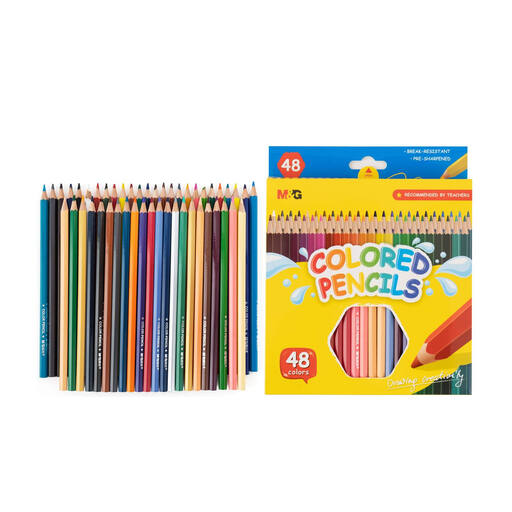
Why it suits this profile: A set of 48 colours gives budding artists plenty of scope to practise colouring, shading and simple illustrations.
The hexagonal barrel is less likely to roll away, and the pencils are supplied pre-sharpened according to the product information.
48 individual colours; wooden barrel; suitable for colouring, sketching and school use.
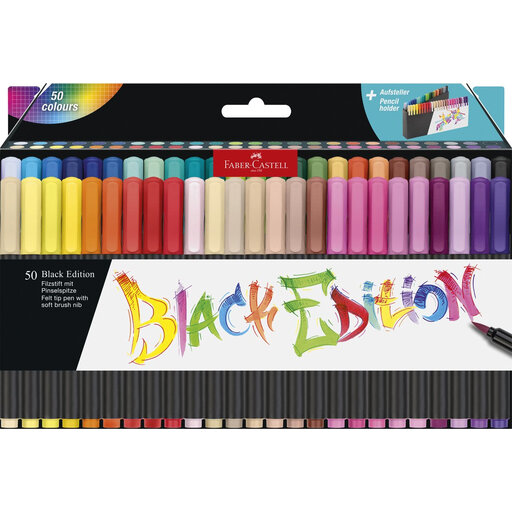
Why it suits this profile: For users who regularly do hand lettering, draw or want to combine colour variations in one box.
The product information lists 50 colours, washable ink and a choice of thin and thick lines. The pens are intended for light-coloured paper, not black paper.
50 brush pens; inks made with food-grade colourants according to the product description; EN 71 information.
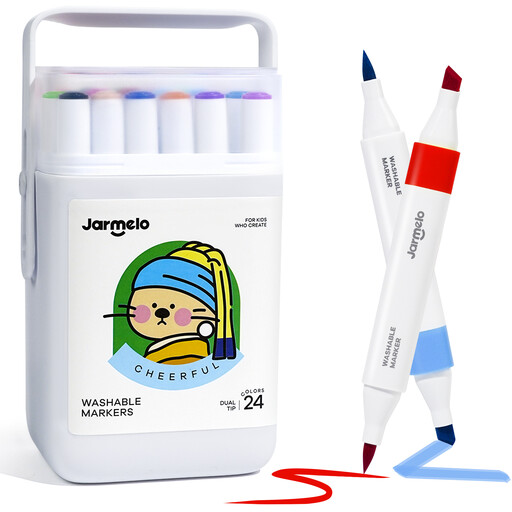
Why it suits this profile: A practical choice for children who want to switch between colouring small details and filling in larger areas.
Each of the two nibs has a clear purpose: the brush nib is for details and the chisel nib is for broad strokes. The caps are ventilated.
24 dual-tip markers; carry case with handle; water-based ink according to the product description.
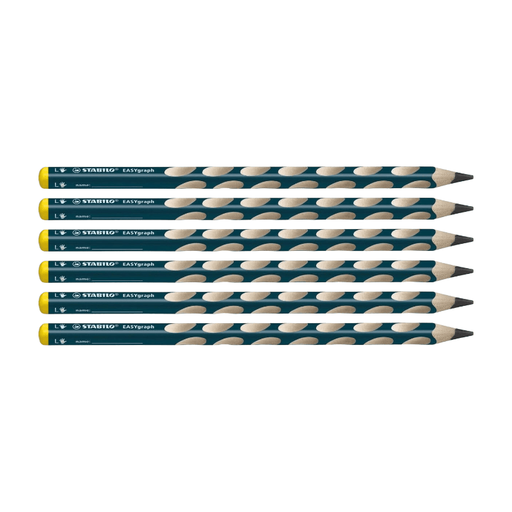
Why it suits this profile: The shape and grip are specifically designed for beginner left-handed writers who value control when writing and drawing.
The left-handed version is recognisable by its red tip. The finger grooves, triangular shape and non-slip zones provide a secure hold.
HB grade; 3.15 mm graphite core; wood from PEFC-certified forests according to the product information.
We have put together a complete, up-to-date list of products that fully meet these strict selection criteria and the applicable European safety regulations.
A good basic set does not have to consist of one large pack. For example, combine:
Before checking out, always check the number of pieces, nib shape, ink type, recommended age and what is or is not included. This helps you avoid having to buy a pencil sharpener, die-cutting machine, paper or glue later on.
Choose materials with a clear minimum age, sturdy components and appropriate safety information. For young children, simple coloured pencils, washable felt-tip pens and craft kits without loose small parts are often easier to manage. Continue to supervise children, even when a product is marketed for their age group.
Replace the cap immediately after use and press it on firmly. Store pens away from direct sunlight and extreme heat. A box or pencil case helps keep them organised. With dual-tip markers, it is especially important to close both ends securely.
That depends on what you need it for. For school and everyday colouring, a single set of coloured pencils or felt-tip pens is often enough. For journalling and scrapbooking, you may also need gel pens, highlighters, glue rollers and paper. Do not compare only the price of the pack: also consider the number of usable colours, the nib types and any additional materials required.
