
Weighing couscous portions
You want to weigh dry couscous in grams before cooking it for your salad. The Netherlands Nutrition Centre explains that couscous gets heavier during cooking; the right portion depends on your meal.


For weighing couscous for a salad, digital kitchen scales with a tare function are handy if you want to weigh it in your own bowl: place the empty bowl on the scales, zero them, then add the dry couscous. A flat model is practical if you’re short on storage space; a backlit display or included bowl may suit you better if easy reading or using a separate bowl is a priority. A 1 g graduation does not, by itself, prove accuracy to 1 g.
You want to weigh dry couscous in grams before cooking it for your salad. The Netherlands Nutrition Centre explains that couscous gets heavier during cooking; the right portion depends on your meal.
You want to zero the bowl and add ingredients one after another without repeatedly transferring them. The Soehnle, Brabantia and Beurer models mentioned here include a tare function.
You want to be able to read the display with a bowl on the platform and put the scales away neatly after use. The Consumers’ Association considers readability and measurement accuracy separately; size, display and platform vary by model.
Weigh the couscous dry if you’re following a recipe based on dry weight. Then focus on the bowl, tare function and visibility that best suit your kitchen.
| What to consider | What should you look for? | Who is this important for? |
|---|---|---|
| Dry portions | Choose scales that display grams. The displayed increments alone don’t tell you how accurately or consistently the model measures. | If you want to match the amount of dry couscous to your recipe, weigh it in grams before cooking. Around 36% of consumers prioritise weighing portions. |
| Tare function and one bowl | Check that the scales have a tare function and that the bowl won’t cover the display or buttons. Remember that the bowl and ingredients count towards the total weight. | If you want to weigh ingredients one after another in the same bowl, a tare function is useful. Around 29% of consumers prioritise this convenience. |
| Display and platform | Compare the position and lighting of the display, and the size of the platform, with the bowl you use. | If you use a wide bowl or want to read the display quickly after an evening class, consider visibility and space. Around 21% of consumers prioritise readability and room for a bowl. |
| Storage and batteries | Compare the external dimensions with your drawer and check which type of battery is needed and whether batteries are included. | If drawer space is limited, you’ll want to know whether the scales will fit and what power source they need. Around 14% of consumers prioritise compact storage and power requirements. |
A 1 g indication describes the increments shown, but doesn’t prove that the scales measure accurately or consistently to within 1 g. The Consumers’ Association treats accuracy and consistency as separate test points.
Use the increments as a specification, and look for independent test results if accuracy is essential.
A bowl may cover the display or buttons. The bowl and ingredients also count towards the maximum load.
Check the controls and visibility with a similar bowl, and keep the total weight below the limit for the model you choose.
Cleaning instructions for a removable bowl don’t automatically apply to the electrical appliance. Beurer specifically says that the removable bowl on the KS 25 is dishwasher-safe; Brabantia advises wiping the glass surface of the Tasty+ model mentioned here.
Follow the instructions for both the bowl and the scales for your model.
Models may use different batteries and have different external dimensions. Even if a battery is included, you’ll need to replace it eventually.
Before buying, check the dimensions, battery type and what’s included with the product.
The Page Compact 300 is a flat set of scales for weighing ingredients in your own bowl and storing away neatly.
The battery-powered Tasty+ is worth considering if you want a backlit display and a hanging loop.
The flat KS 19 and the KS 25 with its removable bowl offer different set-ups.
The Optiss BC50U0V0 is an option if you’re looking for a backlit display and a wider glass platform.
This Joybuy selection includes digital kitchen scales and scales whose product names indicate they’re designed for coffee. Check each model to see whether its features suit weighing couscous and the way you like to work.
 No image available
Its product name indicates that it’s designed for espresso and pour-over coffee, making it a less straightforward choice if you only want to weigh couscous.
The product name lists a timer, a water flow function and a coffee-to-water ratio.
 No image available
Flat kitchen scales to consider if you have limited storage space after use.
The product name lists stainless steel and dimensions of 17 × 13 × 2 cm. Check that your preferred bowl fits on the platform and leaves the display visible.
Batteries aren’t included.
 No image available
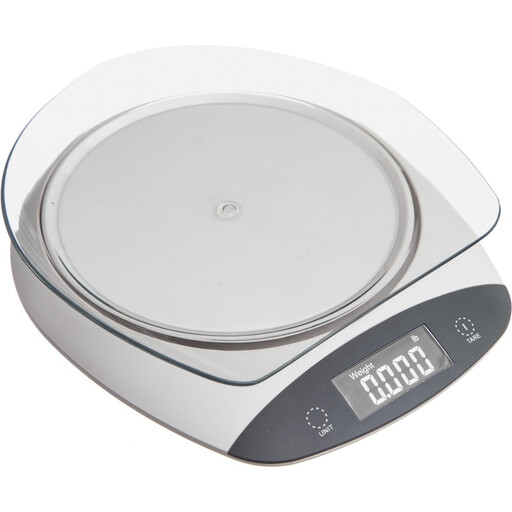
A model with an included bowl to consider if you’d rather not use your own bowl every time.
The product name lists a removable bowl and dimensions of 20,5 × 18 × 4,5 cm. Check that its shape and capacity suit your salad preparation.
It requires 2 AAA batteries, which aren’t included.
 No image available
Kitchen scales to consider if you also want to use the Bluetooth and app features mentioned; they may not be necessary if you’re only weighing couscous.
The product name lists a 10 kg capacity, multiple units and app integration.
The product information recommends cleaning with a damp cloth and says the scales must not be submerged.
 No image available
Its product name indicates that it’s designed for pour-over coffee; if you mainly weigh couscous, ordinary kitchen scales may be a better fit.
The product name lists a timer, a water flow function, a capacity of 2000 g and a sensitivity of 0.1 g.
The product information recommends cleaning with a damp cloth and says the scales must not be submerged.
Weigh dry couscous before cooking if you’re following a recipe based on dry weight. The Netherlands Nutrition Centre says couscous weighs around three times as much after cooking; for example, 35 g uncooked is about 100 g cooked. This is a conversion, not a recommended portion for everyone.
Place the empty bowl on the scales and use the tare function to zero the reading before adding the couscous. Check how the controls work on your chosen model, and keep the combined weight of the bowl and contents within the maximum capacity.
No. Increments of 1 g show how the weight is displayed, but don’t by themselves prove measurement accuracy to 1 g. The Consumers’ Association considers accuracy and consistency as separate test points.
Don’t assume so. Beurer specifically says that the removable bowl on the KS 25 is dishwasher-safe; Brabantia advises wiping the glass surface of the Tasty+ model mentioned here. Follow the cleaning instructions for your model.
According to ACM ConsuWijzer, a seller must resolve, free of charge, an issue with a product that doesn’t do what you could reasonably expect during normal use. This could mean a repair, replacement or refund. The right solution depends on the circumstances.