
For blending in the pan
You cook the soup in a pan and want to blend it there, without transferring it first. The Consumers’ Association describes a hand blender as handy for blending directly in the pan.


If you cook your courgette soup in a pan and want to blend it in the pan, a hand blender is often the most practical choice: there’s no need to transfer the soup. A jug blender may be better for larger quantities, but check the instructions for the exact model before using it with hot soup. A soup maker or heated blender is worth considering if you’d also like the appliance to heat the soup.
You cook the soup in a pan and want to blend it there, without transferring it first. The Consumers’ Association describes a hand blender as handy for blending directly in the pan.
You also make larger quantities of liquid dishes and want a smooth result. Compare the jug’s usable capacity with the quantity you want to prepare; the Consumers’ Association also highlights the importance of a jug being suitable for hot soup.
You want to heat and blend soup in the same appliance, as long as its capacity suits your portions. Tefal and Philips describe heating functions for soup on specific models.
Start with how you prepare your courgette soup and how much you make. The Consumers’ Association explains the practical difference between blending in a pan and using a jug; always check the instructions for the exact model when making hot soup.
| What to consider | What to look for | Who should consider this? |
|---|---|---|
| Blending in the pan | Check that the blending foot is suitable for your pan and follow the model’s instructions. | If I’ve already cooked the soup in a pan, I want to blend it there without transferring it. Around 31% of consumers prioritise this direct preparation method. |
| Portion size and texture | Check the jug’s usable capacity and the guidance for hot ingredients. | If you make larger portions or want a smooth result, consider the jug capacity and preparation instructions. Around 23% of consumers put this need first. |
| Heating and blending | Compare the programmes and capacity with the amount of soup you usually make. | If I want to heat and blend the ingredients in the same appliance, its programmes and capacity need to suit the amount I make for lunch. Around 23% of consumers make this combination their top priority. |
| Cleaning and accessories | Check which parts are included and how they can be cleaned according to the instructions. | If you mainly make soup, you may want to limit the number of separate parts and the storage space they need. Around 23% of consumers prioritise easy cleaning and minimal extra equipment. |
Guidance on hot ingredients can vary between models. Philips gives separate temperature advice for some specific blenders; this guidance doesn’t automatically apply to other models.
Check the instructions for the exact model and follow the guidance on temperature and filling before blending hot soup.
For the Philips HR3020/20, Joybuy lists a total capacity of 2 litres and a usable capacity of 1.5 litres. This difference may determine whether you can blend a portion in one go.
Compare the usable capacity of the specific model with the amount of soup you usually make.
If the usable capacity isn’t enough, you may need to blend the soup in several batches.
If the soup is already cooked in a pan, you may not use the heating function. Extra parts also take up storage space and need cleaning.
Start with how you prepare your soup, and choose extra functions or accessories only if you’ll use them for other dishes too.
More separate parts mean more things to store and clean.
ErgoMaster hand blenders are designed for blending in the pan. Bosch Netherlands lists a detachable metal blending foot and stepless speed control for the MSM6M810.
MultiQuick hand blenders are available in versions with different accessories. Braun Household describes the MQ50236M as coming with a chopper, whisk and measuring beaker.
Philips sells jug blenders and SoupMakers. For the refurbished Viva Collection SoupMaker HR2204/80R1, Philips Netherlands lists heating programmes for soup and a capacity of 1.2 litres.
Tefal describes the Perfectmix Cook BL83SD30 as a heated blender with programmes for smooth and chunky soup, among other things.
These hand blenders are selected for blending soup and are suitable if you prepare your soup in a pan.
 No image available
Suitable if you want to blend soup with a hand blender without transferring it.
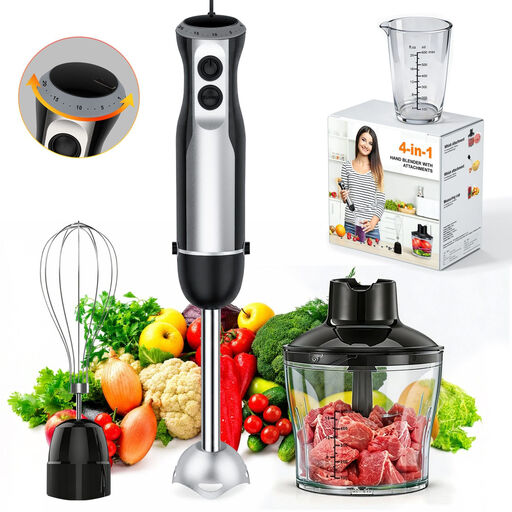
The product name lists a chopper and whisk. For hot ingredients, the description mentions a heat-resistant bowl and small portions; follow the instructions for this version.
 No image available
The hand blender design is suited to blending in the pan, without first transferring the soup to a blender jug.
The product name lists 1000W, 20 speeds and a turbo function.
 No image available
Suitable if you want to blend soup with a hand blender without transferring it.
The product name lists 1200W, 15000rpm, a 700ml measuring beaker and a 500ml chopper. The description limits continuous use to 1 minute, followed by a 1-minute rest.
 No image available
A hand blender is suited to blending directly in the pan, without transferring the soup first.
The product name lists 800W and stainless steel. The description mentions variable speeds and a turbo function.
 No image available
Suitable if you want to blend courgette soup with a hand blender and make use of other accessories too.
The product name lists 600W and 2 speeds; the set includes a whisk, chopper and beaker.
No, don’t assume that you can. The Consumers’ Association highlights the importance of using a heat-resistant jug; Philips gives restrictions on hot liquids for some specific models. Check the instructions for the exact model before pouring in hot soup.
Blend the cooked vegetables and add a little liquid if needed, as the Consumers’ Association advises. According to the Netherlands Nutrition Centre, cover leftovers, let them cool and refrigerate them within 2 hours of cooking, separate from raw foods; they can be kept chilled for up to 2 days.
No. ACM ConsuWijzer explains that if a product breaks too soon despite being used normally, the seller is legally required to provide an appropriate solution at no extra cost. An additional commercial guarantee has its own terms and doesn’t replace your statutory rights.
For online purchases, you generally have a legal cooling-off period of up to 14 days after delivery, according to ACM ConsuWijzer. Check whether a legal exception applies; the cooling-off period relates to the purchase, not the appliance’s features.