
Workshop hosts with large dinner plates
Measure your own plates rather than relying on the stated place-setting capacity. For example, Tomado gives a maximum plate diameter of Ø 25 cm for the TDW5501B.


Start by measuring your largest dinner plate and working out how many full loads need to be clean between workshop sessions. A capacity of six place settings doesn’t automatically mean every plate will fit or that a cycle will finish in time. Then consider the connections, available space and programme duration. For larger loads or a tight schedule, a full-size dishwasher may be more suitable than a countertop model.
Measure your own plates rather than relying on the stated place-setting capacity. For example, Tomado gives a maximum plate diameter of Ø 25 cm for the TDW5501B.
Match the load size and duration of your chosen programme to when you’ll need clean tableware again. The Consumers’ Association puts compact dishwashers at around six place settings; programme duration varies by model and programme.
Check both the water supply and drainage at your intended location. A tank can take care of the water supply, but wastewater still needs to be disposed of properly.
First, measure your plates and count the items to be washed between workshop sessions. Then check the connections, operating time and the washing process that suits your workshop.
| What to consider | What to look for | Who should consider this? |
|---|---|---|
| Plate size and rack | Measure your largest plate and check the maximum diameter and rack layout for the exact model. Tomado states a maximum of Ø 25 cm for the TDW5501B. | If you want to make sure your dinner plates will fit, check the rack before buying; around 29% of consumers prioritise plate fit. |
| Load size and throughput | Count the full load between sessions and compare it with the rack capacity and duration of your chosen programme. Bosch lists six place settings and 3:55 hours for the Eco programme on the SKS2ITW00E, and says this model is no longer available. | If you need enough clean tableware for back-to-back groups, the key question is whether a cycle fits your schedule; around 23% prioritise throughput. |
| Water, drainage and space | Check the external dimensions, space for the door to open, water supply and the required drainage arrangements in the manual for the exact model. | If you work at different or space-constrained venues, you’ll want to know whether the water supply, drainage and installation space can be arranged; around 18% of consumers look at this first. |
| Food-safe working practices | Establish which procedures apply to your workshop and assess your dishwashing process against the relevant food safety plan or hygiene code. The NVWA outlines requirements for certain food-selling activities. | If you need to follow food-safe procedures for a business, a programme name alone doesn’t prove compliance; around 18% put this consideration first. |
| Consumption and maintenance | Compare kWh per 100 Eco cycles and water per Eco cycle on a like-for-like basis. Also check programme duration and maintenance instructions. Milieu Centraal recommends loading the machine properly and wiping off food scraps rather than rinsing dishes with hot water first. | If you use your dishwasher often, you’ll want to weigh up consumption and maintenance against your working schedule; around 12% of consumers prioritise ongoing running costs. |
The place-setting capacity doesn’t tell you what size plates will fit in the rack. Tomado lists a maximum of Ø 25 cm for the TDW5501B.
Measure your largest plate and check the maximum diameter and rack layout for the exact model. A rack that isn’t suitable could mean running extra wash cycles.
A reservoir supplies water; wastewater still needs to be drained in line with the installation instructions.
Check the manual to see how both the water supply and drainage work, and whether your chosen location is suitable. Filling the tank by hand and finding a way to collect wastewater can take extra time.
The figures on the EU energy label relate to the Eco programme. They don’t tell you how much a shorter or more intensive programme uses, or how long it takes.
Compare label figures on a like-for-like basis, and check separately how long the programme you plan to use for your workshop takes.
The name of a dishwasher programme doesn’t, by itself, prove that your dishwashing process meets the rules for a commercial food business.
Find out which NVWA requirements apply to your activity and include your dishwashing process in the relevant plan or hygiene code.
The TDW5501B is a freestanding countertop model with capacity for six place settings. Its stated maximum plate diameter lets you check the rack size against your own dinner plates before buying.
The VVW5520 is a freestanding model for six place settings, with Eco and hygiene programmes among its features.
The manufacturer lists a capacity of six place settings for the Amazonia 6, product code 10041203.
This selection includes countertop dishwashers with a water tank and a model that needs a fixed water supply. Check the plate size, load capacity and drainage arrangements for each model.
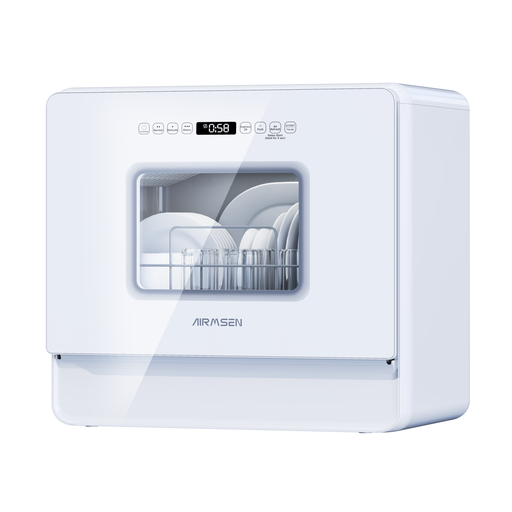 No image available
An option if you want a water tank and need to wash larger plates, provided you can remove the upper rack.
Built-in 5-litre water tank and a 28-minute Express programme. According to the product description, plates up to 300 mm fit only when the upper rack is removed.
 No image available
A compact option if you want to wash four place settings and use a tank for the water supply.
The product information lists plates up to 26 cm, a 5-litre water tank and a 29-minute Quick programme. In tank mode, the description says the drain hose must run into a collection container.
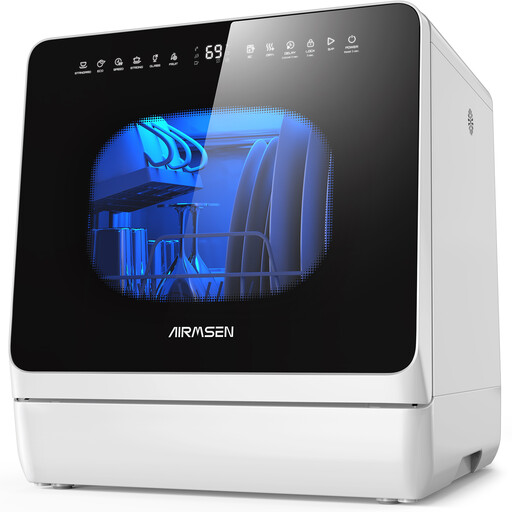 No image available
This model is designed for a smaller load. Compare its capacity of four place settings with the tableware you need cleaned between workshop sessions.
The product information lists 31 pieces of tableware, plates up to 26 cm and a 5-litre water tank. The Quick programme takes 29 minutes and Intensive takes 89 minutes, according to the description.
 No image available
Worth considering if you need to balance the available width against a capacity of four place settings.
The product information lists a 5-litre water tank, with both tank and tap modes. Check the connection and drainage instructions for the model you choose.
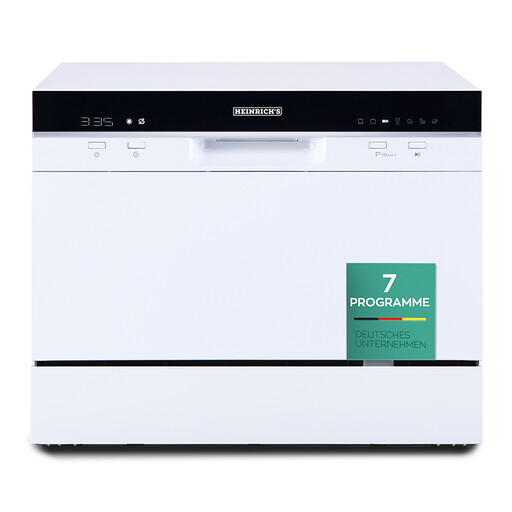 No image available
A model for anyone who needs to wash six place settings at a time and has access to a water supply and drainage at the venue.
The product information lists seven programmes, including a 30-minute quick programme, and a 1500 mm inlet hose and 1720 mm drain hose.
Not always. As well as the place-setting capacity, the maximum plate diameter determines whether your plates will fit in the rack. Tomado lists a maximum of Ø 25 cm for the TDW5501B; check the limit for the model you’re considering.
Only if the specific model is designed to be used with a water tank. Also check the manual for instructions on draining wastewater: not needing a fixed water supply doesn’t mean you can do without drainage.
Compare energy label figures based on the Eco programme and follow the instructions for your chosen model. Milieu Centraal recommends loading the machine properly and wiping off food scraps rather than rinsing dishes with hot water first.
For a purchase by a private consumer, the product must be of satisfactory quality; in the Netherlands, there is no fixed statutory warranty period of two years. The Dutch Government says the retailer is your point of contact if there’s a problem. Check the terms separately if a workshop organisation is buying for business use.
No. That can’t be determined by the type of machine or the name of a programme. For certain activities, including repeated food sales, the NVWA sets out registration requirements and the need to follow a food safety plan or hygiene code. Whether those rules apply to your workshop depends on what you actually do; assess your dishwashing process as part of the applicable procedures.