
Cook with a narrow worktop
Wants to wash the everyday dishes in a machine, but needs to check that the appliance and its open door won’t take up too much usable worktop space.


First, measure the available space and compare your usual evening washing-up with the basket layout and maximum plate size; the number of place settings alone won’t tell you whether everything will fit. Choose a model with a water tank if you don’t have a fixed water supply, or compare plumbed-in models if you want to wash more dishes per cycle. A smaller machine isn’t automatically the most economical choice if you need to run it more often.
Wants to wash the everyday dishes in a machine, but needs to check that the appliance and its open door won’t take up too much usable worktop space.
Wants to wash as many plates, glasses and cutlery as possible in one cycle, so compares their own dishes with the basket layout.
Is looking for a model with a water tank and also needs to find a suitable place for the drain hose.
When choosing a countertop model for a small worktop, the available space and the size of your own dishes are crucial. Then check the water supply, drainage and consumption for the amount of washing-up you actually do.
| What to consider | What to look for | Who is this important for? |
|---|---|---|
| Available worktop space | Measure the width, depth and height, as well as the space in front of the door and for the hoses. | If I have limited worktop space, I want to know whether the appliance and its open door will leave enough room to use it. Around 36% of consumers give available worktop space their top priority. |
| Your everyday washing-up | Compare the basket layout and maximum plate diameter with your largest plates, glasses and usual load. | I want to fit as much of my usual evening washing-up as possible into one cycle, not just meet a particular place-setting capacity. Around 29% of consumers choose mainly according to how much of their own washing-up fits in each cycle. |
| Water supply and drainage | Check whether the model uses a water tank or a fixed supply, and how the drain hose should be positioned and secured. | If a fixed water supply isn’t possible, I want to know whether I can fill the tank and safely drain the wastewater. Around 21% of consumers prioritise having a workable water supply and drainage setup. |
| Consumption per load | Compare the energy and water figures on the label, and take into account how many cycles your washing-up will need. | I want to assess consumption for the amount of washing-up I actually do, not just for a single cycle. Around 14% of consumers give consumption for their own amount of washing-up top priority. |
An appliance might fit on the worktop but be difficult to open or connect. Also measure the depth and height, and check the clear space in front of the door and the installation instructions for your chosen model.
Compare the dimensions and connection instructions for the exact model with the space where you plan to use it.
A stated number of place settings doesn’t guarantee that your large plates, glasses and cookware will all fit in the basket together. For example, Tomado lists a maximum plate diameter of Ø 25 cm for the TDW5501W.
If everything won’t fit at once, you may need to run extra cycles or wash pans by hand.
Check the maximum plate size and basket layout for the exact model against your own crockery and a typical load.
A model with a water tank may not need a fixed water supply, but the wastewater still has to go somewhere. In its first impressions of Bob in 2021, the Consumentenbond described a drain hose leading to, for example, a sink or fixed drain.
Beforehand, check where the hose can drain according to the manual and how to secure it safely.
Consumption per cycle doesn’t tell you how many cycles your washing-up will need. Milieu Centraal recommends running a dishwasher when it’s full and notes that washing by hand with a small amount of hot water can generally use less energy and water. So compare the label figures with how you use it.
Check the water consumption per eco cycle and energy consumption per 100 eco cycles, and factor the expected number of cycles into your decision.
Bob is an option to compare if space is tight and a water tank is important to you.
The VVW5520 is worth comparing if you have room for a 55 cm-wide countertop model and can use a water connection.
The TDW5501W is a 6-place-setting option to compare if a fixed connection works for your kitchen.
The Amazonia 6 is another option to compare for size, basket layout and connection.
This selection focuses on compact countertop dishwashers for small worktops, including models with a water tank and models with a water connection.
 No image available
Could suit a small kitchen where you want a water tank or tap connection; check the dimensions and space for the drain hose.
Stated dimensions: 45,8 × 42,8 × 42,5 cm. The description lists capacity for up to 4 place settings and a 5-litre tank.
The drain hose needs to lead to a sink or collection container.
 No image available
An option to compare if you’re looking for a compact countertop model with a tank and the choice of tank or tap water supply.
The product name lists a 5-litre tank and dimensions of 37 × 50 cm. The description gives a capacity of up to 4 place settings.
The description lists 7 wash programmes plus 2 additional programmes.
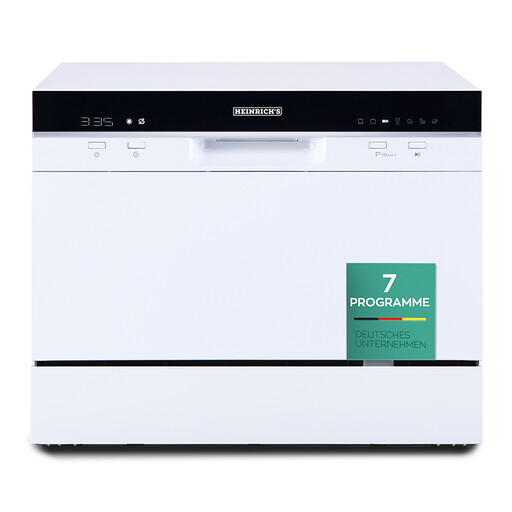 No image available
Worth comparing if your everyday washing-up fits a capacity of 6 place settings and you can use a water connection kit.
The description lists 7 programmes and a water softener. The title states 47 dB.
 No image available
Could suit a smaller everyday load; check whether 3 place settings match your washing-up and whether a tank or tap water supply is practical.
The description lists a 5-litre water tank and 7 programmes. The title states 56,3 dB.
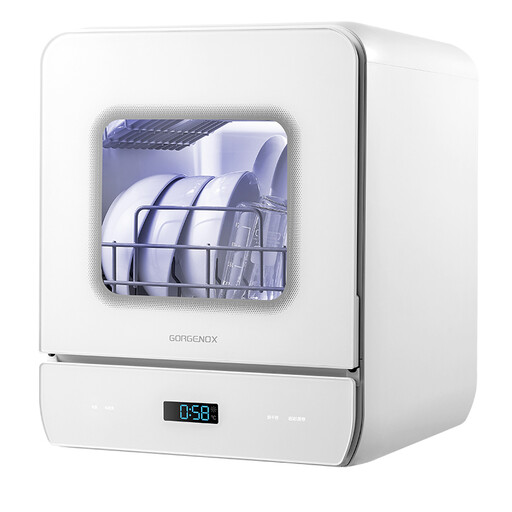 No image available
A compact option to compare if a capacity of 3 place settings suits your everyday washing-up.
The product name lists a water-softening system and wash, dry and storage functions.
Don’t touch hot or UV-treated surfaces immediately after a cycle.
Yes. Daan Tech says Bob’s integrated tank can be filled. You’ll also need suitable drainage: in its first impressions, the Consumentenbond described a drain hose leading to, for example, a sink or fixed drain. Follow the manual for your chosen model when setting it up.
Scrape off food scraps instead of routinely rinsing dishes with hot water first, keep the spray arms clear and generally use the eco programme. The Consumentenbond recommends these tips; check your own model’s manual for care and cleaning instructions.
If you’ve used the product normally, Dutch statutory consumer rights may apply if it doesn’t meet the standard you could reasonably expect. ACM ConsuWijzer says the retailer must resolve a valid issue free of charge, for example by repairing or replacing the product; any manufacturer’s guarantee doesn’t replace this right.
Yes. The Dutch government says dishwashers are among the appliances that must have an energy label. For dishwasher labels, the European Commission lists information including energy consumption per 100 eco cycles, water consumption per eco cycle, capacity and noise. This doesn’t mean you have to choose a particular energy class.