
For a small kitchen
You want to wash your daily dishes in a machine, but first need to check that the appliance, its open door and your crockery will all fit.


Choose a countertop dishwasher based on the size of your crockery, the space available and how the appliance takes in and drains water. Only then compare the number of place settings. An extra-compact model with a reservoir may suit small amounts of washing-up or a kitchen without a fixed water supply. A six-place-setting model can handle more in one cycle, but needs more space and a suitable connection. Compare consumption using the eco programme figures, and consider how many cycles your small loads will actually need.
You want to wash your daily dishes in a machine, but first need to check that the appliance, its open door and your crockery will all fit.
You’re looking for a countertop model that suits your water supply and want to know in advance how water is fed in and drained away.
You want to wash small loads without assuming that a smaller machine is automatically more economical for the same amount of washing-up.
Choose this if: you have only a small amount of washing-up at a time and don’t want to use a fixed water supply for the appliance.
The trade-off: you’ll need to fill the reservoir and arrange the drainage separately. Also check that your crockery fits in the smaller basket.
Choose this if: you want to wash several plates, bowls and glasses together, and have enough space and a suitable connection.
The trade-off: six place settings don’t tell you whether your plates will fit. Some models also lack a half-load option.
Choose this if: you really have very little washing-up and can wash it in a washing-up bowl using a small amount of hot water.
The trade-off: you’ll have to do the work yourself. Milieu Centraal’s advice on the environmental impact of washing up by hand is based on using hot water sparingly.
When you have small amounts of washing-up each day, your main buying decisions are linked: check that your crockery and set-up will fit, then compare consumption using the same label figures.
| Concern | What should you check before buying? | Who is this more important to? |
|---|---|---|
| Crockery fit and capacity | Measure your largest plates and check the maximum plate diameter and basket layout for the exact model. | I’d prefer to fit my everyday plates, glasses and bowls in together, without having to guess whether the place-setting capacity suits the size of my crockery. Around 36% of consumers mainly focus on whether their dishes will fit in each load. |
| Connections and space | Check the water supply, drain hose and space required, including with the door open. | I need to know whether the appliance will work with my tap and drain, and fit on my available worktop space. Around 29% of consumers prioritise the connections and installation. |
| Consumption with small loads | Compare kWh per 100 eco cycles, litres per eco cycle and capacity; consider how many cycles you expect to run. | I want to know what small loads mean if I don’t fill the basket every time. Around 21% of consumers mainly weigh up consumption against the amount of washing-up. |
| Noise and cycle time | Check the stated noise level and programme duration for the exact model. | I want a programme and noise level that suit the times I use the dishwasher. Around 14% of consumers mainly focus on noise or cycle time. |
A place setting doesn’t indicate the maximum plate diameter. If a plate doesn’t fit, you may need to run extra cycles or wash it by hand.
Measure the largest plates you usually use, and check the maximum diameter and basket layout for the exact model before comparing capacity.
The water supply method varies by model. According to Klarstein, the Klarstein Aquatica 10047348 connects to a tap. A reservoir doesn’t automatically remove the need to arrange drainage.
Check the water supply and drainage separately in the specifications and instruction manual for the exact model.
If the set-up isn’t suitable, you may still have to wash up by hand or buy the right connection parts.
Label figures are based on the eco programme. Consumption per cycle doesn’t tell you how many cycles you’ll need for the same amount of washing-up.
Compare models using the same label figures, and factor in capacity and how full you expect to load the machine. Milieu Centraal advises only running the dishwasher when it’s full.
If you split the same amount of washing-up across more cycles, your water, electricity and dishwasher detergent use may also increase.
The features listed apply to the specific models below; they are not a general assessment of all products from these brands.
A freestanding countertop model for six place settings, designed for anyone who wants to combine everyday washing-up into a larger small load.
A countertop model for six place settings with a fixed water supply and drainage.
A smaller countertop model for two place settings which, according to Klarstein, connects directly to a tap.
A freestanding compact model for six place settings, with stated label figures you can compare.
The product picks below are compact countertop models for small daily loads. For each model, check the water supply and drainage method, basket layout and how much space the appliance takes up.
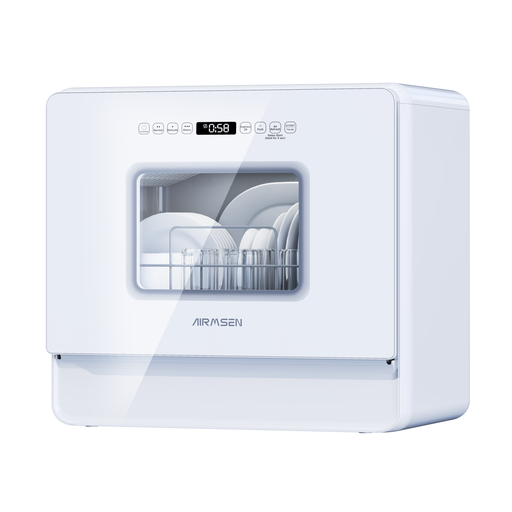 No image available
Worth considering if you’re looking for a compact worktop model with a built-in water tank.
The product title lists a 5-litre tank and a two-tier rack. According to the product information, plates up to 300 mm fit only when the upper basket is removed.
 No image available
A compact model to consider if you’d prefer a built-in tank rather than relying solely on a fixed water supply.
The product title lists a 5-litre tank and 5+1 wash cycles. According to the product information, when using the tank, wastewater drains through a hose into a container.
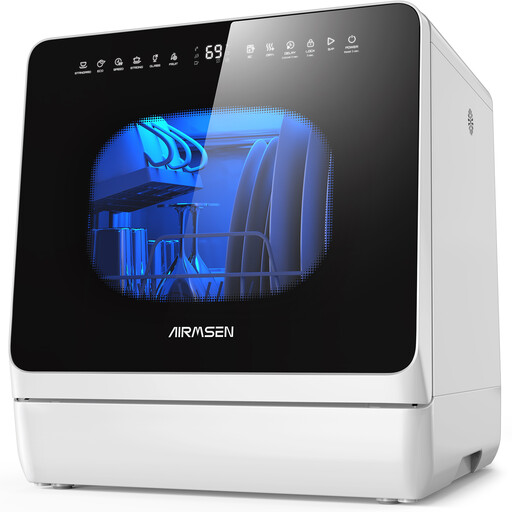 No image available
A portable compact model to consider if you’re looking for a version that, according to the title, doesn’t need a fixed connection.
The product title lists eight wash programmes, an integrated water softener, a delay-start function and a child lock.
 No image available
A compact countertop model to consider if a built-in tank and several programmes suit your everyday washing-up.
The product title lists a 5-litre tank, nine programmes, dimensions of 37 × 50 cm and energy rating D.
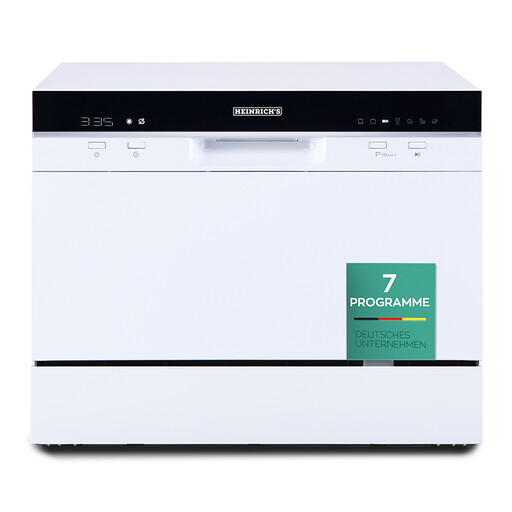 No image available
A countertop model to consider if you want to wash several place settings in one cycle and have a water connection available.
The product title lists six place settings; the product information lists seven programmes and a water connection. It names ECO, intensive, glass and quick as programme options.
No, the number of place settings doesn’t indicate the maximum plate diameter. Measure your own plates and compare their size with the maximum diameter and basket layout for the exact model. For example, Tomado lists a maximum of 25 cm for the TDW5501B.
It depends on the model. Klarstein says that the Aquatica 10047348 connects to a tap. For a model with a reservoir, check separately how to fill it and where the drain hose empties.
Scrape off food scraps rather than rinsing dishes in hot water, and use the eco programme with a full basket where appropriate. Follow the chosen model’s instruction manual for connections, filter cleaning and maintenance.
According to the European Commission, the EU label includes figures such as kWh per 100 eco cycles, litres per eco cycle, capacity, noise level and programme duration. To compare models based on your own usage, you’ll also need to consider how many cycles you expect to run; the label figures don’t automatically apply to a quick programme.
No. ACM ConsuWijzer explains that statutory consumer rights in the Netherlands are separate from a retailer’s or manufacturer’s guarantee. If a product, when used normally, doesn’t do what you could reasonably expect, the retailer is responsible for providing an appropriate solution. The outcome depends on the circumstances.