
Washing cutlery with limited worktop space
You want to wash dishwasher-safe cutlery and some crockery without the appliance getting in the way in your kitchen. Its external dimensions, door clearance and layout are all important.


Choose a countertop dishwasher based on the space available, a practical way to drain the water, and how much cutlery and crockery you want to wash at a time. A model with a fixed water supply needs suitable connections; a tank can replace the water supply, but not the drainage. Milieu Centraal advises against compact mini dishwashers from an energy and water use perspective, preferring a full standard-size model. However, limited space may make a countertop model the practical choice.
You want to wash dishwasher-safe cutlery and some crockery without the appliance getting in the way in your kitchen. Its external dimensions, door clearance and layout are all important.
There’s no suitable fixed water supply where you want to put the appliance, so you’re looking at a model with a manually filled tank. Remember to consider how the used water will drain away, too.
You have only a small amount of washing up each time and want to know how often you can fill the machine. Compare consumption per programme with the amount of washing up you actually do.
Suitable for: a spot with a suitable water supply and drainage, if you regularly wash cutlery with other crockery.
Bear in mind: the connections required and the space available. The Inventum VVW5520 and Tomado TDW5501W are examples with a stated capacity of 6 place settings and a cutlery basket.
Suitable for: a spot without a fixed water supply, when smaller loads are enough.
Bear in mind: you’ll need to fill the tank, and wastewater still has to be drained away. The Bob package described comes with a basket for 3 place settings and a drain hose.
Suitable for: a situation where there isn’t enough worktop space, or a countertop model can’t handle enough washing up at a time.
Bear in mind: from an energy and water use perspective, Milieu Centraal prefers a full standard-size model; available space remains a practical constraint.
| What to consider | What to look for | Who is this important for? |
|---|---|---|
| Space and cutlery layout | Measure the space and check the external dimensions, door clearance, room for hoses and layout with your own cutlery. | If I want to wash cutlery with crockery without the machine getting in the way in my kitchen, both the space and the basket layout need to work. Around 36% of consumers put space and cutlery layout first. |
| Water supply and drainage | Check how water is supplied, where the wastewater can go and which hoses are included with the model. | If there’s no fixed water supply where I want to put it, a tank may be an option, but I still need somewhere for the wastewater to go. Around 29% of consumers focus mainly on connection options. |
| Consumption for a typical load | Compare the energy label, kWh per 100 eco cycles, water consumption where stated, capacity and expected load size on a like-for-like basis. | If I want to assess consumption for the amount of washing up I do, I look not only at a single cycle but also at how often I can fill the machine. Around 21% of consumers prioritise consumption. |
| Care and after-sales support | Check the care instructions, included parts and warranty terms; make sure you know which parts are included with the model you’re choosing. | If I want to keep the machine clean and know who to contact if it develops a fault, care and after-sales support matter. Around 14% of consumers give these the highest priority. |
Compact models vary in external dimensions, capacity and water supply. An appliance may fit, but the door, hoses or the load you want to wash may not work well in practice.
Measure the entire set-up, including space for the door and hoses, and check in advance where the wastewater will drain.
A tank can replace a fixed water supply, but it won’t automatically take care of draining the used water.
Check that the drain hose supplied with the model you’re choosing will work where you plan to put it.
A low figure per cycle doesn’t tell you how many cycles you’ll need for all your cutlery and crockery. Milieu Centraal advises against compact mini dishwashers from an energy and water use perspective; available space and the loads you typically wash are still relevant to your choice.
Compare label information on a like-for-like basis and estimate how often you can run the machine with a suitable load.
A manufacturer’s warranty does not, by itself, determine your statutory rights if the product does not conform to the contract.
Keep your proof of purchase and contact the seller first if there’s a problem.
The Inventum VVW5520 is a compact freestanding model with a stated capacity of 6 place settings and a removable cutlery basket.
According to Tomado, the TDW5501W is a countertop model for 6 place settings, with a cutlery basket and fixed water supply and drainage.
Bob is an extra-compact option with a water tank. For the package described, the manufacturer lists a basket for 3 place settings and a drain hose.
The CDWMTO201D (W) is a separate countertop model with a water tank. The seller’s page lists a built-in 5-litre tank and a ‘3 sets’ version.
These Joybuy products are countertop dishwashers for small loads. The selection includes models with a water tank and one with a fixed water supply. Check the capacity, connection type and space available for each model.
 No image available
A countertop model for small loads in a spot without a fixed water supply; according to the product description, the drain hose carries water into a container.
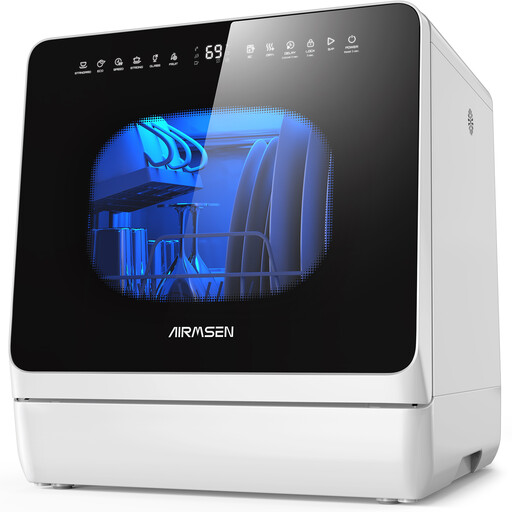
Capacity: 4 place settings. Tank: 5 litres. Dimensions: 45,8 × 42,8 × 42,5 cm. The product title lists 5+1 wash cycles.
 No image available
A countertop model for anyone who wants a built-in water tank and finds a capacity of 4 place settings suitable for their usual load.
Capacity: 4 place settings. Tank: 5 litres. The product information lists 8 programmes, a water softener and space for plates up to 26 cm.
 No image available
A countertop model with tank-fed water and, according to the product information, the option to connect the machine to a tap.
Capacity: up to 4 place settings. Dimensions: 37 cm wide and 50 cm deep. Tank: 5 litres. The title lists energy rating D.
 No image available
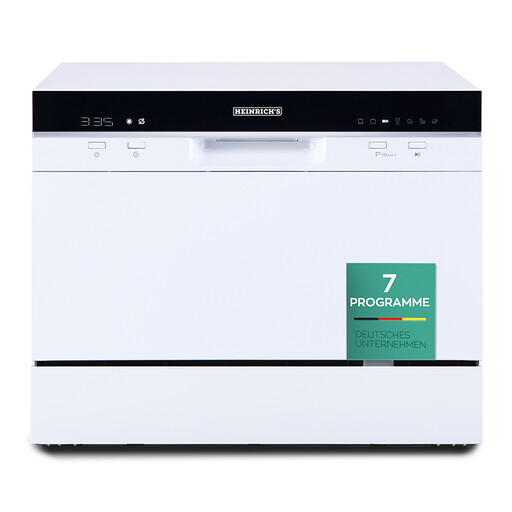
A countertop model with a cutlery basket for anyone who wants to wash cutlery with other items and can use a fixed water supply.
Capacity: 6 place settings. The product information lists 7 programmes, a 1500 mm inlet hose, 47 dB and energy rating D.
 No image available
A smaller countertop model for a limited load of cutlery and washing up; the product information describes both tank-fed water and a connection to a water supply.
Capacity: 3 place settings. The product information lists a built-in 5-litre tank, a cutlery basket and 7 programmes. The title lists 56,3 dB and energy rating C.
A cutlery basket is easy to take out of the dishwasher; a cutlery drawer leaves more room for other crockery in the basket below. Check which option the countertop model has and whether your cutlery will fit.
For the Bob model described, the built-in tank can replace the fixed water supply, but wastewater still needs to be drained away. The package described includes a drain hose for this; check the drainage route and package contents for the model you choose.
According to the Consumentenbond, pre-rinsing is usually unnecessary. Remove food scraps and don’t stack items in a way that blocks the water jets; follow the care instructions for the machine and filters.
Check the energy label and the number of kWh per 100 washes, and compare water and energy consumption only on a like-for-like programme basis. The number of loads you actually need to wash also affects your decision.
For a consumer purchase, the seller must offer a solution if the product does not conform to the contract. There is no fixed statutory warranty period in the Netherlands; a manufacturer’s warranty may provide additional cover, but it does not replace your statutory rights.