
Cook with limited worktop space
You want to wash everyday plates and cutlery in a machine, but the space available will determine which appliances fit. Measure the appliance and the room needed to use it before comparing capacities.


First, measure the space for the appliance, including room for the door to open. Then check whether your everyday dishes will fit in the rack. A water tank can remove the need for a fixed water supply, but you’ll still need to fill the tank and provide a suitable drain. A larger rack takes up more space. Also compare eco-cycle consumption with the amount of washing-up you actually do per load: a smaller appliance isn’t automatically the most economical choice.
You want to wash everyday plates and cutlery in a machine, but the space available will determine which appliances fit. Measure the appliance and the room needed to use it before comparing capacities.
You’re looking for a countertop model that you can fill by hand. Also check where the wastewater can drain: a water tank removes the need for a fixed water supply, but not for a suitable drain.
You may be able to make room for a larger appliance and want to check whether a countertop model with more place settings, a slimline dishwasher or washing up by hand would suit the amount you wash each day. The Consumers’ Association describes slimline dishwashers as around 45 cm wide; these are a different type of appliance from countertop models.
Choose this if: you have limited worktop space or there’s no fixed water supply where you plan to put the appliance.
Bear in mind: you’ll need to fill it by hand and provide a suitable drain, and the rack is smaller. In an initial impression from 2021, the Consumers’ Association described Bob’s capacity as limited; this wasn’t a test of every current version.
Choose this if: you have enough worktop space and suitable connections, and want a rack with more place settings. Inventum lists 6 place settings for the VVW5520; Tomado lists the same for the TDW5501W.
Bear in mind: the space and connection requirements. Tomado specifies a maximum plate diameter of 25 cm for the TDW5501W.
Consider this if: you want to wash more dishes per load and have space for a different type of dishwasher or for washing up by hand.
Bear in mind: a slimline dishwasher isn’t a countertop model. Milieu Centraal advises against compact mini dishwashers on water and energy efficiency grounds; that doesn’t automatically determine whether a countertop model is right for you.
| What to consider | What should you check? | Who should pay extra attention? |
|---|---|---|
| Appliance and dishes fit | Measure the width, height, depth and clearance needed for the door to open. Measure your largest plates too, and check the rack layout. | If my everyday plates or the open door might clash with my limited kitchen space, I want to make sure everything fits first. Around 40% of consumers put fit first. |
| Room for everyday washing-up | Compare the stated place settings and rack layout with the plates, bowls, glasses, cutlery and any pans you usually wash. | If I’d rather wash up less often, I want to know whether my usual load will fit in one cycle. Around 30% of consumers prioritise everyday capacity. |
| Water supply and drainage | For each model, check how water is supplied, where the drain hose leads and what placement instructions apply. | If there’s no fixed water supply where I want to put the appliance, I need a suitable way to fill it and drain it. Connection flexibility is the top priority for around 20% of consumers. |
| Consumption per useful load | Compare the consumption per eco cycle and the capacity on the EU energy label. Work out how many cycles you’ll need for your daily washing-up. | If I want to weigh up consumption against the amount I actually wash, I look beyond one small cycle. Around 10% of consumers prioritise consumption in use. |
Place settings describe the crockery and cutlery for a standard meal, but they don’t guarantee that your plates and pans will fit in the rack. The depth, height and clearance for an open door can also affect where you can put the appliance.
Measure the space and your everyday dishes, then compare them with the dimensions and rack layout of the exact model.
If an appliance doesn’t fit properly, you may still have to wash your dishes by hand.
A tank can replace a fixed water supply, but the used water still needs to drain away.
Check how the exact model drains and follow the installation instructions.
If the rack is small, you may need several cycles for your usual washing-up. Consumption per cycle alone doesn’t tell you how much you can wash with that amount of energy and water.
Compare eco-cycle consumption and capacity together, and also consider washing up efficiently by hand or using a larger, fully loaded machine.
If your daily washing-up won’t fit in one load, running several cycles takes extra time.
In the Netherlands, statutory consumer rights aren’t always limited to a fixed two-year period. According to ACM ConsuWijzer, the seller is responsible for providing an appropriate solution if a product breaks under normal use sooner than you could reasonably expect.
Keep your proof of purchase and contact the seller if something goes wrong.
Bob is a slim countertop model for situations where worktop space and water supply are key considerations.
The CDWMTO201D (W) is a compact countertop model for a small everyday load.
The VVW5520 is a 55 cm-wide countertop model for those with room for a larger rack.
The TDW5501W is a countertop model with 6 place settings and a fixed water supply and drain.
The Aquatica is a 42 cm-wide alternative for a small load, provided a tap connection is suitable where you plan to put it.
These countertop models are designed for everyday washing-up in a compact kitchen. They differ in features such as water supply, stated capacity and dimensions. For each appliance, also check the drainage requirements and the space available on your worktop.
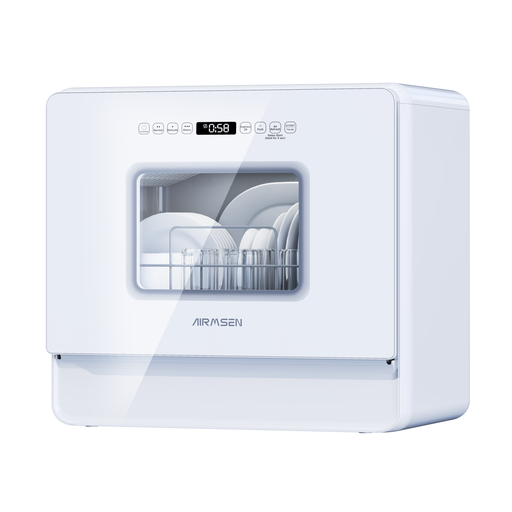 No image available
An option to consider if you’re looking for a countertop model with a water tank and the stated load suits your everyday washing-up.
The product information lists a built-in 5-litre tank, five place settings and room for more than 40 items of crockery. According to the description, plates up to 300 mm fit when the upper rack is removed; it also mentions a tap water supply.
 No image available
A compact option if four place settings are enough and you want the choice of a tank or tap water supply.
The description lists a 5-litre tank, four place settings, five wash programmes and automatic drying. Dimensions: 45,8 × 42,8 × 42,5 cm (h × w × d). The drain hose needs to reach a suitable drainage point.
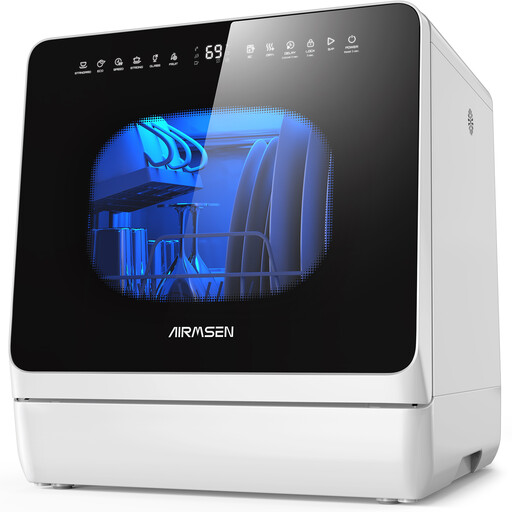 No image available
This version may suit you if you’re looking for a countertop model with the option of a water tank and a stated capacity of four place settings.
The product information lists room for 31 items of crockery and plates up to 26 cm. The title lists 8 wash programmes; the description mentions eco and intensive programmes, among others. According to the description, a fixed water supply is an alternative to using the tank.
 No image available
An option if you’re looking for a slim countertop model with a tank supply and four place settings are enough for you.
The product information lists a width of 37 cm, a 5-litre tank, up to four place settings and energy class D. The title lists 9 wash programmes; the description also mentions a tap water supply.
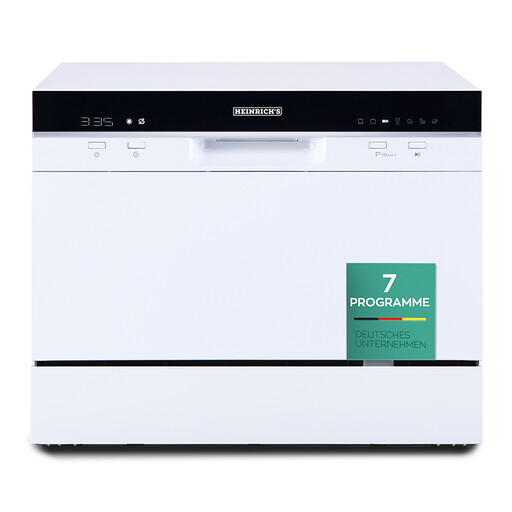 No image available
A countertop model worth comparing if six place settings are a better match for your everyday washing-up than a smaller rack.
The product information lists 7 programmes, including eco, glass and quick, a maximum of 6,5 litres of water per cycle, 47 dB and energy class D. Check that the supplied water connection is suitable for where you plan to put it.
Measure the diameter of your largest everyday plates and compare it with the specification for the exact model. Also check whether bowls and glasses will fit in the rack at the same time. Tomado lists a maximum plate diameter of 25 cm for the TDW5501W.
A tank can replace a fixed water supply, but the used water still needs to drain away. Daan Tech describes Bob as having a drain hose that leads to the sink or another suitable drain; follow the installation instructions for your chosen model.
Compare eco-cycle consumption with the capacity you’ll actually use, and, as Milieu Centraal recommends, run the machine full on the eco programme. Milieu Centraal also advises scraping off food scraps and skipping a hot pre-rinse; leftover food can clog the filter.
In addition to any manufacturer’s guarantee, statutory consumer rights apply in the Netherlands. According to ACM ConsuWijzer, the seller is responsible for providing an appropriate solution if the product breaks under normal use sooner than you could reasonably expect. There’s no general, fixed statutory warranty period of two years.
Household dishwashers covered by EU rules must display an energy label when sold online too. The EU dishwasher label includes information such as energy consumption per 100 eco cycles, water consumption per cycle, capacity and noise level. Compare the details for the exact model.