
Family with lots of mugs
Wants to wash several mugs, and possibly other dishes, in one load after a meal. Inventum’s manual lists mugs as a possible rack load, but check that your own mugs will actually fit.


Choose a countertop dishwasher only after checking that your mugs fit upside down in the rack without touching one another or obstructing the spray arm. The number of place settings doesn’t guarantee they’ll fit. Inventum’s manual lists mugs as a possible rack load. Then check whether you can arrange the water supply and drainage, and compare the dimensions and energy label information of suitable models.
Wants to wash several mugs, and possibly other dishes, in one load after a meal. Inventum’s manual lists mugs as a possible rack load, but check that your own mugs will actually fit.
Has space for a compact appliance, but needs a practical way to arrange the water supply and drainage. Tomado specifies a fixed connection for the TDW5501W; check whether another version has a tank on a model-by-model basis.
Wants to compare energy label and water-use information, while taking usage habits into account. The Consumers’ Association advises loading the dishwasher properly; the energy label rating alone doesn’t tell you what each wash will cost.
Suitable if: there are connections where you plan to put the dishwasher and you want to wash mugs with other dishes. Check the rack against your own mugs.
Bear in mind: according to the manufacturer, a model such as the Tomado TDW5501W needs a fixed water supply and drainage.
Suitable if: there’s no fixed water supply and you’re prepared to check how to fill the appliance and arrange drainage for the exact model.
Bear in mind: the MEDION DWT20 (MD370764) described here is a German version with space for up to two place settings; check the version sold in the Netherlands.
| What to consider | What should you check? | Who is this important for? |
|---|---|---|
| Space for mugs | Measure your mugs and check that they can stand upside down without touching one another or the spray arm. Inventum defines a place setting as crockery and cutlery for one person, not as a count of large mugs. | After a family meal, I’d ideally like to wash the mugs with the other dishes. Around 36% of consumers prioritise the number of mugs that will fit in a load. |
| Water connection | Check the water supply, filling method and drain hose for the exact model. Tomado specifies a fixed connection for the TDW5501W; MEDION describes a tank option for the German DWT20 version. | If there’s no fixed tap connection, I want to know how the appliance gets water and where the wastewater can go. Around 29% of consumers give connection options top priority. |
| Worktop space | Measure the available width, height and depth, and allow for the door, hoses and connections. The Tomado manual specifies a sturdy, level surface. | With limited worktop space, I want to know in advance whether the appliance and the room needed to install it will fit. Around 21% of consumers prioritise the space available. |
| Running costs | Compare the energy and water information on the label and consider how many loads your washing-up requires. The Dutch government explains that dishwasher energy labels also include information about water use. | If the machine runs often, I want to take its consumption figures into account alongside dishwasher detergent and any other products needed to use it. Around 14% of consumers prioritise running costs. |
A place setting refers to a standard set of crockery and cutlery for one person; large mugs and their handles may fit differently in the rack.
Measure your own mugs and check the rack layout in the manual before relying on the number of place settings.
If the mugs don’t all fit together, you may need to run an extra wash for the same meal.
According to the manufacturer, the Tomado TDW5501W connects to a fixed water supply and drainage.
Check the connection method for the exact model and decide in advance where the wastewater can go.
A spot without a suitable water supply and drainage may not be suitable; you may need to adapt the connections.
If mugs obstruct one another, they can restrict water distribution. The Consumers’ Association advises against stacking dishes and recommends leaving the spray arms free to rotate.
Leave space between the mugs, place them opening-side down and check that the spray arm can move freely.
The VVW5520 is a compact freestanding model for six place settings. Its manual specifically mentions mugs when explaining how to load it.
The TDW5501W is a countertop model for six place settings, with a fixed water supply and drainage.
The Amazonia 6 is a countertop model for six place settings, which Klarstein also describes as freestanding.
Bosch Netherlands describes the SKS62E32EU as a freestanding compact dishwasher, 55 cm wide.
This selection features compact countertop dishwashers for washing mugs with other dishes. Check the water supply and drainage for each model, and make sure your mugs will actually fit in the rack.
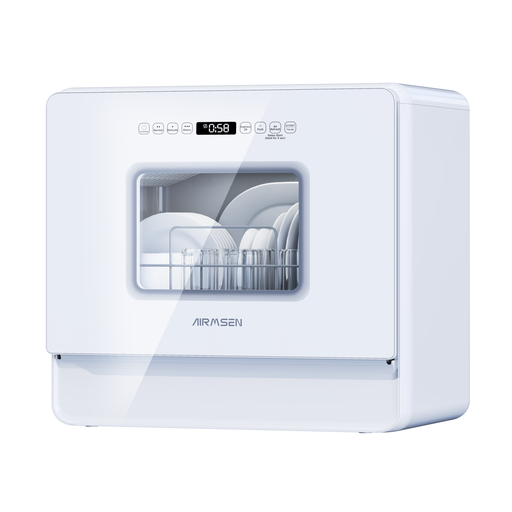 Image unavailable
The built-in tank is worth considering if there’s no fixed water supply where you plan to put the appliance; also check where the water can drain.
Product information lists five place settings, a two-level rack, a 5 L tank and three spray arms. The number of place settings doesn’t confirm how many large mugs will fit.
 Image unavailable
The tank makes this model worth considering if there’s no fixed water supply; make sure you have a practical place for the drain hose.
Product information lists four place settings, a 5 L tank, 5+1 wash programmes and an automatic drying function. Without a fixed water supply, the description says wastewater drains through a hose into a container or sink. Large mugs may take up more room than the place-setting count suggests.
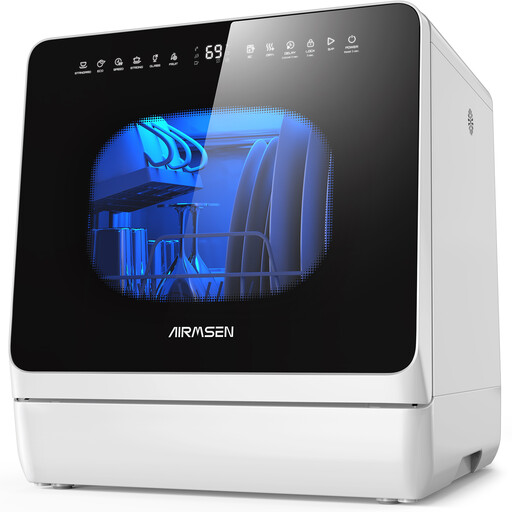 Image unavailable
The built-in water tank and stated capacity are useful points of comparison if you want to wash mugs with other dishes.
Product information lists four place settings, a built-in water tank, eight wash programmes and an adjustable water softener. The stated number of place settings doesn’t guarantee that large mugs will fit.
 Image unavailable
Product information lists both a tank and a tap connection as water supply options; check which connection suits your space.
Four place settings, a 5 L tank, nine programmes, dimensions of 37 × 50 cm, a 1–24-hour timer and twin spray arms. The stated energy class is D. Check the rack with your own mugs.
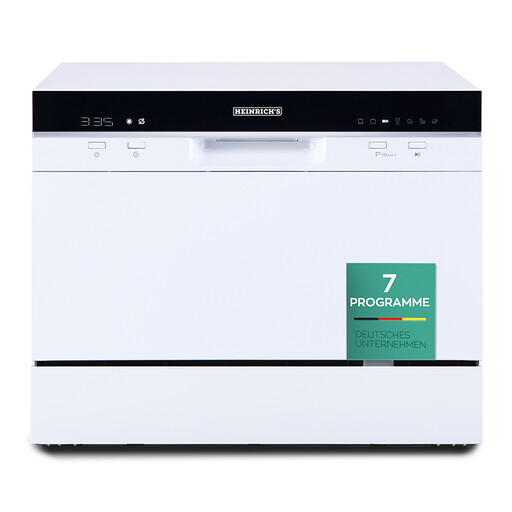 Image unavailable
The stated capacity makes this model worth comparing for a load of mugs and other dishes after a meal; check the rack’s actual capacity.
The product name lists six place settings, seven programmes, automatic door opening for drying, 47 dB and energy class D. The description also mentions a cutlery basket and water softener.
Place dishwasher-safe mugs opening-side down and don’t stack them. Leave the spray arm free to rotate; the Consumers’ Association advises against stacking dishes, and Inventum lists mugs in its manual as a possible rack load.
No, it depends on the model. Tomado specifies a fixed water supply and drainage for the TDW5501W. MEDION says the German DWT20 (MD370764) can be used with or without a fixed water connection; check the exact version and how the wastewater is drained.
Compare the energy and water information on the label, and allow for dishwasher detergent and, depending on the appliance and how you use it, salt and rinse aid. The Dutch government explains that dishwasher energy labels also include water-use information. Clean the appliance according to the manual.
According to the Dutch government, dishwashers carry an energy label with information about energy and water use. The Netherlands Authority for Consumers and Markets’ ConsuWijzer service explains that statutory guarantees apply alongside any manufacturer’s guarantee. Ask the seller what solution is available if an appliance doesn’t meet your expectations.