Start by checking that your lunchbox, lid and any separate parts will fit, and follow the cleaning instructions for each item. The number of place settings does not tell you whether they will fit in the rack. A tabletop model with a fixed water connection may suit you if you want to wash several containers and the plumbing is practical. A smaller model with a water tank may work if you have limited worktop space or no fixed water supply, but you’ll still need a way to drain the wastewater. Follow the lunchbox manufacturer’s instructions for drying.
Who is this suitable for?
Washing several lunchboxes at once
Want to wash several containers and lids after unpacking, perhaps along with everyday dishes, in one load? Check the rack layout and the actual dimensions of your items. Place settings alone don’t tell you whether they’ll fit.
No fixed water supply
If you’re looking for a model you can fill by hand, check how the used water drains away too, and whether the setup will work in your kitchen.
Careful cleaning and drying
Check the care instructions for the container, lid and any separate parts individually. Mepal recommends drying the container and lid separately for its own lunch products.
What should you look for?
Tabletop model with a fixed water connection
Suitable for washing several lunchboxes or everyday dishes at once, if you have enough space and can arrange suitable water supply and drainage.
Consider the fixed connections and available space determine whether installation is practical; six place settings don’t tell you how many lunchboxes will fit.
Smaller model with a water tank
Suitable for kitchens without a fixed water supply or with limited worktop width, especially for smaller loads.
Consider you’ll need to fill the tank by hand and arrange somewhere for the wastewater to go; check that your items will fit in the rack too.
For anyone wanting to clean dishwasher-safe lunchboxes after a trip to the market, the main considerations are fit, connections, material care instructions and what to do after the wash.
| Consideration |
What to look for |
Who it matters most to |
| Fit and capacity |
Measure the containers and lids, then compare them with the usable rack space. Check with a trial layout that the spray arm can rotate freely. |
If I want to wash several containers and lids at once, I check the rack and make sure the spray arm has room to turn. Around 33% of consumers prioritise whether these items will fit. |
| Water and installation |
Check whether the model has a tank or fixed water supply, how the water drains away, and whether the external dimensions suit the space. |
If there’s no fixed water supply or my worktop space is limited, I want to know how filling and draining work. Around 27% of consumers prioritise the connections and available space. |
| Cleaning and materials |
Follow the instructions for each item and only use a programme approved for it. Remove loose food and keep the spray arm clear. |
If I want to clean plastic parts without choosing an unsuitable programme, I check the guidance for each item. Around 20% of consumers prioritise looking after materials and cleaning. |
| Energy use and drying |
Compare energy label figures on a like-for-like basis and check the programme duration. Also check how the lunchbox parts should be dried. |
If I want to balance energy use against when I can put my lunchbox away, I look at the label figures and drying instructions. Around 20% of consumers prioritise energy use and drying. |
Common mistakes
-
Assuming six place settings means room for six lunchboxes
Place settings indicate capacity for tableware for a meal, not the size or shape of lunchboxes and lids.
Measure your own items and compare them with the usable rack space. Also check that the spray arm can rotate freely once everything is in place.
-
Assuming a water tank means there’s no drain
A water tank can remove the need for a fixed water supply, but it doesn’t remove the need to drain the wastewater.
Check the instructions for the exact model to find out how to fill it and where the used water goes.
-
Automatically choosing a hygiene or intensive programme for plastic lids
A dishwasher programme doesn’t guarantee that every lunchbox part can withstand that type of cleaning.
Follow the lunchbox manufacturer’s care instructions for each part. If necessary, dry the container and lid separately.
Brands to compare
Inventum
The VVW5520 is a tabletop model with six place settings, designed for anyone wanting to wash containers alongside everyday dishes.
- Inventum says the VVW5520 has six programmes, including a hygiene programme, and an optional automatic door opening at the end of the cycle.
- Inventum doesn’t list a half-load option for this model. The stated capacity doesn’t confirm whether your lunchboxes will fit.
Tomado
The TDW5501B is a tabletop model with six place settings and fixed water supply and drainage connections.
- Tomado lists five programmes, a cutlery basket and space for plates up to Ø 25 cm.
- Tomado doesn’t list a half-load option. The stated plate size doesn’t tell you whether a lunchbox or loose lid will fit in the rack.
Daan Tech
Bob is a smaller model with a water tank, for anyone with limited worktop space or no fixed water supply.
- Daan Tech lists Bob as 34 cm wide, with a capacity of three place settings.
- The smaller stated capacity and external dimensions don’t prove that your lunchboxes will fit in the rack. Check how the wastewater drains away too.
Klarstein
The silver Amazonia 6 is an example of a tabletop model with six place settings.
- Klarstein lists six programmes and 49 dB for this model.
- The product page describes it as both built-in and freestanding. Check the installation manual for the exact model before deciding where to put it.
Joybuy products
Joybuy countertop dishwasher options for lunchboxes, with different water supply and capacity features.
 No image available
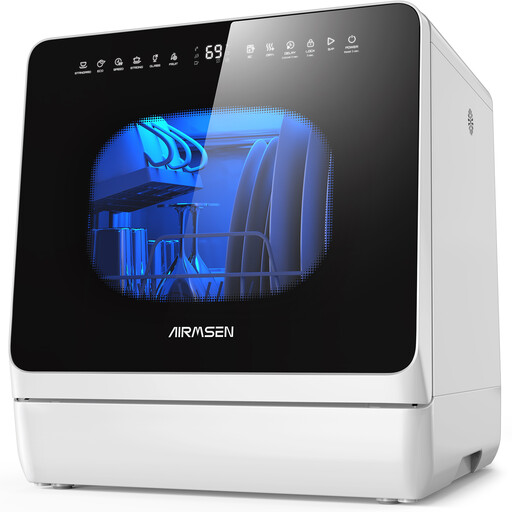
AIRMSEN Countertop Dishwasher, 8 Wash Programs
May suit a small setup where you don’t want a fixed connection; check how the wastewater drains away.
The product information lists four place settings, eight wash programmes, twin spray arms and a drying programme. The number of place settings doesn’t tell you how many lunchboxes will fit in the rack.
View at Joybuy
 No image available
AIRMSEN Tabletop Dishwasher with Built-in 5L Water Tank, 9 Wash Programmes, 37 × 50 cm
May suit you if you want a water tank or would also like the option of a tap connection; check the drainage and available space.
The product information lists a built-in 5 L tank, a tap connection, four place settings, nine programmes, and drying and ventilation functions. The stated dimensions are 37 × 50 cm; check separately that your lunchboxes will fit.
View at Joybuy
 No image available
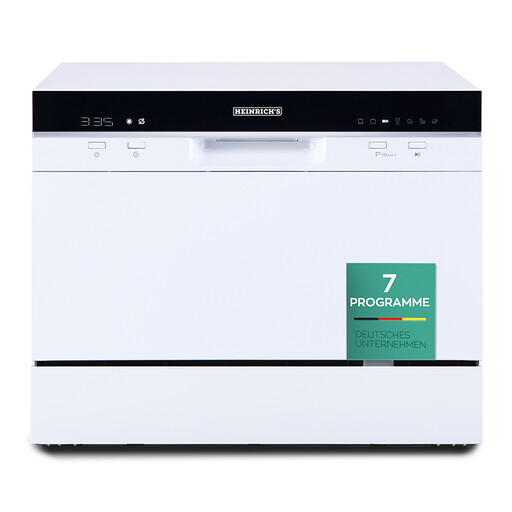
Heinrich's HTG 8840 Weiss, 6 place settings, 7 programmes
May suit you if you’re looking for a tabletop model with a water connection; check that the hoses and available space work in your kitchen.
The product information lists six place settings, seven programmes, automatic door opening for drying, and a water connection with inlet and drain hoses. It also lists 47 dB and energy class D. The number of place settings doesn’t tell you how many lunchboxes will fit.
View at Joybuy
 No image available
Heinrich's HTG 8855, 3 place settings, 7 programmes
May suit a small load if you want the option of using a water tank or direct tap connection; check the drainage and available space.
The product information lists three place settings, seven programmes and an optional 240-minute drying function. It also lists 56.3 dB and energy class C. The stated capacity doesn’t confirm that your lunchboxes will fit.
View at Joybuy
 No image available
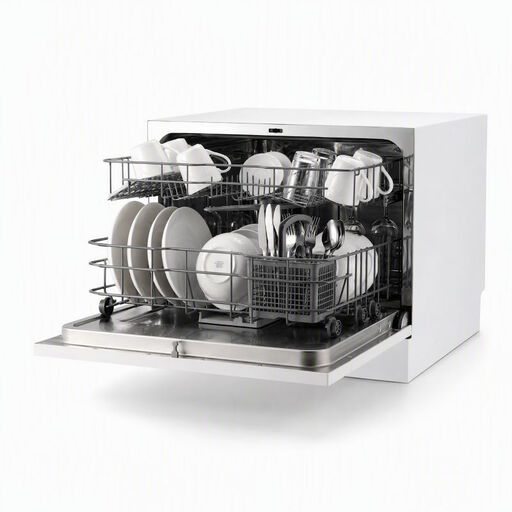
ochama Counter-Top Dishwasher, 6 Standard Place Settings, 30-Minute Quick Wash
May suit you if you’re looking for a countertop model for lunchboxes and possibly everyday dishes; check the rack with your own items.
The product information lists six place settings, a 30-minute quick wash, a 24-hour delay start and eight functions. A water softener is also mentioned. Place settings aren’t a measure of lunchbox size.
View at Joybuy
Frequently asked questions
Can I put a dishwasher-safe lunchbox with its lid away straight after washing?
Check the care instructions for your lunchbox first. Mepal recommends drying and storing the lid and container separately for its own lunch products; don’t assume the same guidance applies to other products.
Does a water tank mean I don’t need a drain?
No. A tank may mean you don’t need a fixed water supply, but check the manual to find out how the used water drains away.
What should I do with loose food before loading the dishwasher?
Remove loose food, keep the spray arms clear and check the filter regularly. This care advice comes from the Voedingscentrum.
How do I compare electricity and water use?
Compare the EU energy label figures on a like-for-like basis. Among other things, it shows energy use per 100 eco cycles and water use per eco cycle. These figures don’t necessarily show the consumption of a particular short or intensive programme.
Do EU energy labels and ecodesign requirements apply to household countertop dishwashers?
Yes. Household dishwashers within the scope of EU rules must meet the applicable energy labelling and ecodesign requirements. The European Commission describes these product rules; they don’t set a specific minimum energy label class for this purchase.


