
Student without a fixed water supply
Wants to wash lunchboxes without a permanent tap connection, and also needs to arrange a suitable spot and safe drainage.


First, choose a countertop dishwasher that suits the space, water supply and drainage in your student kitchen. Then check whether your lunchboxes fit in the rack when open, and whether a programme stays within the boxes’ temperature limits. A model with a refillable reservoir can be useful if you don’t have a fixed water supply, while a connected model with six place settings offers more room for shared washing-up. A model with a reservoir still needs safe drainage and a suitable place to stand.
Wants to wash lunchboxes without a permanent tap connection, and also needs to arrange a suitable spot and safe drainage.
Want to fit everyday crockery in a countertop model as well as lunchboxes, and have a usable water supply and drain connection.
Needs to choose a wash programme and arrange the rack to suit the instructions for their lunchbox, lid and seal.
Suitable if: you don’t have a usable fixed water supply and mainly wash small loads.
Bear in mind: you’ll need to fill it by hand, consider the rack space and arrange a separate drainage solution.
Suitable if: you have enough worktop space and a suitable water supply and drain connection, for example for washing up after housemates.
Bear in mind: installation and the space the appliance takes up.
| Consideration | What to look for | Who should pay particular attention? |
|---|---|---|
| Water supply and drainage | Check whether the model uses a reservoir or a fixed water supply, and how drainage and positioning need to be arranged. | If I can’t use a fixed tap, I want to know how to fill the appliance and drain it safely; around 28% of consumers are particularly concerned about connections and positioning when buying. |
| Fit and temperature | Compare the space for open lunchboxes and loose parts with the rack layout, and check the maximum programme temperature. | If I use plastic lunchboxes, I want both the box and the lid to stay within their own guidelines; around 28% of consumers are particularly concerned about lunchbox compatibility. |
| Space for shared washing-up | Check the rack layout alongside the number of place settings; place settings don’t tell you how many lunchboxes will fit. | If I also want to wash my housemates’ crockery, I want to know whether it will fit in the machine alongside my lunchboxes; around 22% of consumers prioritise shared capacity in particular. |
| Worktop space and noise | Measure the available space for the exact model and check its stated noise level if living and studying happen close together. | If my worktop is small or right next to my study area, I want to take the external dimensions and noise level into account; around 11% of consumers are particularly concerned about space and noise. |
| Consumption | Compare energy use per 100 eco cycles and water use per eco cycle on the same basis, and consider which programmes you use. | If I plan to use an appliance often, I want to weigh up consumption information alongside my usage and tariffs; around 11% of consumers are particularly concerned about running costs. |
A lunchbox may have a maximum wash temperature that’s lower than that of some programmes. For example, Mepal states a maximum of 65 °C for the Take a Break midi; this doesn’t automatically apply to other boxes.
Check the instructions for your own box, lid and seal, and compare them with the programme you choose.
A programme that exceeds the permitted temperature can damage parts, which may need replacing.
A place setting means the standard cutlery and crockery for one person at one meal. Open containers, lids and drink bottles take up a different amount of space.
Measure your largest open lunchbox and check whether it fits in the rack with its lids and the rest of your washing-up.
A reservoir supplies water, but doesn’t tell you how wastewater is drained or where the appliance can be placed safely.
Before buying, read the installation instructions for the exact model and check the drainage and positioning in your kitchen.
Depending on your kitchen, you may need a separate drainage solution or extra installation work.
The VVW5520 is a freestanding countertop model with six place settings, suited to anyone looking for a fixed connection and room for extra washing-up.
The TDW5501B is a connected countertop model with six place settings, for sharing small loads.
Bob is a compact alternative to compare if a refillable reservoir and a narrow footprint are important to you.
The Amazonia 6 is a six-place-setting alternative for anyone comparing compact models.
This selection includes models with a refillable water reservoir and connected countertop models, for small lunchbox loads or shared washing-up. Check the rack space, temperature limit and installation instructions for each model.
 No image available
A model to consider if you want to wash a small load and don’t have a fixed water supply.
The product information lists a built-in 5 l water tank and a tap mode. The title states 9 wash programmes and dimensions of 37 × 50 cm.
The stated steam function of 75 °C is only suitable if the instructions for your lunchbox, lid and seal allow that temperature.
 No image available
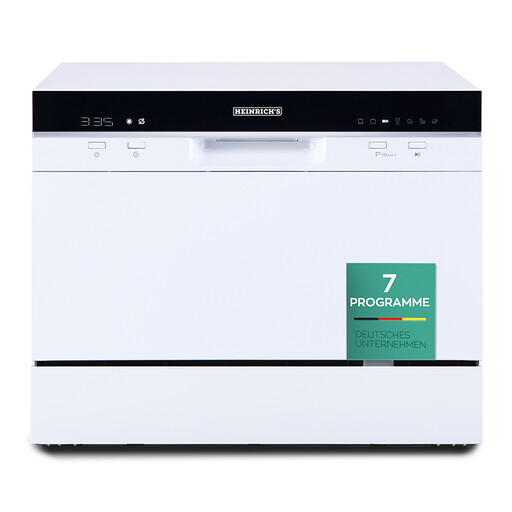
A connected countertop model to compare if you want to wash crockery as well as lunchboxes.
The product information lists 6 place settings and 7 programmes. A water inlet hose and drain hose are mentioned.
Check the rack with your own open lunchboxes and lids; the number of place settings doesn’t tell you whether they’ll fit.
 No image available
A compact model to consider if you wash small loads and want to manage the water supply using a tank or a connection.
The product information lists a capacity of 3 place settings, 7 programmes and a 5 l water tank; connection to a tap is also mentioned.
Check whether your lunchboxes and loose lids will fit in the smaller rack.
 No image available
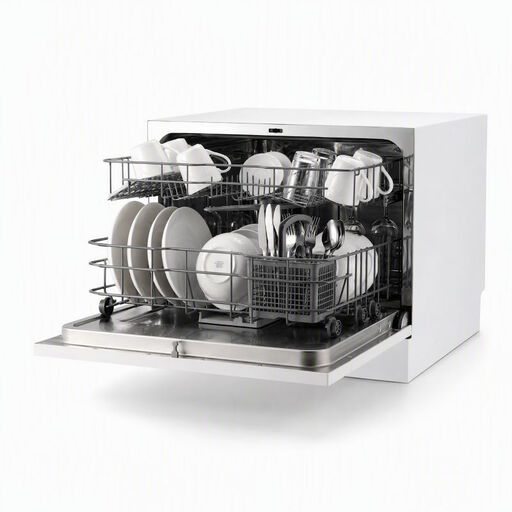
A countertop model to compare if you want to wash lunchboxes alongside standard crockery.
The product information lists 6 standard place settings, 8 functions and a 30-minute quick wash programme.
The quick wash programme is listed as using a 70 °C water spray. Only use it if the instructions for your lunchbox, lid and seal allow that temperature.
 No image available
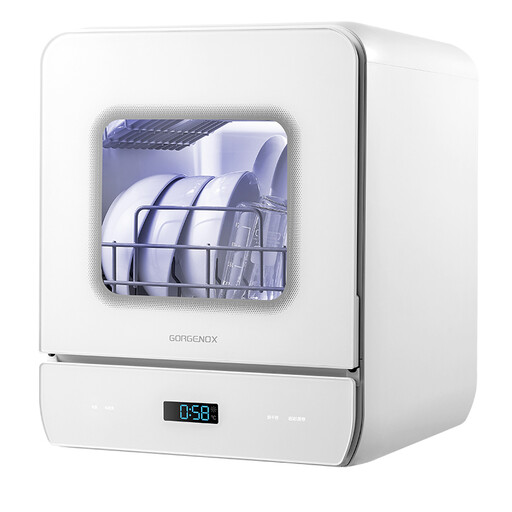
A compact model to consider if you wash a small load and want to use a tank or water connection.
The product information lists a capacity of 3 place settings and describes filling the water tank or connecting to a water source.
According to the instructions, the appliance should be placed indoors on a stable, level worktop.
No. Check the instructions for your specific box and its parts. For example, Mepal states a maximum of 65 °C for the Mepal Take a Break midi; that limit doesn’t automatically apply to other lunchboxes. Also check that the box and lid fit in the rack without blocking the spray arm.
A refillable reservoir supplies water; it doesn’t automatically take care of drainage. Check how the model you choose drains wastewater and follow the installation instructions. Don’t assume that drainage is unnecessary just because there’s no fixed water connection.
Compare the figures on the EU energy label on the same basis: energy consumption per 100 eco cycles and water consumption per eco cycle. Your own costs also depend on how often you use the appliance and your tariffs.
No. According to ACM ConsuWijzer, the statutory guarantee applies alongside the manufacturer’s or seller’s guarantee. With normal use, a product must do what you could reasonably expect of it; there’s no fixed end date for the statutory guarantee that applies to all appliances.
Yes. The Dutch Government lists dishwashers among the household appliances that must have an energy label. The European Commission describes the current label as using a scale from A to G. This general requirement doesn’t prove that a specific listing complies with all applicable rules.