Who is a countertop dishwasher suitable for?

Families with lots of lunch boxes

If you want to wash lots of containers, lids and cutlery after a get-together, a layout that suits the items you own is key. Place settings aren’t a direct measure of this: the Consumers’ Association describes compact dishwashers as having their own limited rack layouts.

Households without a suitable permanent water connection

A model with a built-in reservoir can supply water without a permanent connection, but you’ll still need a practical way to drain the wastewater. Daan Tech describes this reservoir option for Bob; in its first impressions review in 2021, the Consumers’ Association highlighted the limited loading space and filling the reservoir as practical points to bear in mind.

People who use plastic lunch boxes

If you want to clean containers, lids and seals carefully, check the care instructions for each part and allow for drying time. Mepal advises storing the lid and container separately for its own on-the-go products; this guidance does not automatically apply to lunch boxes from other brands.

What should you look for when choosing?

Six-place-setting countertop model

Suitable if: you want to try loading several lunch boxes per cycle and have a suitable tap, drain and worktop space.

The trade-off: connecting it takes some preparation, and six place settings doesn’t mean six lunch boxes.

Compact model with a reservoir

Suitable if: you don’t have a permanent water connection and are happy to wash smaller loads.

The trade-off: you’ll need to fill the reservoir yourself and drain the wastewater; in its first impressions review of Bob in 2021, the Consumers’ Association noted its limited loading space.

Extra-small model with a tap connection

Suitable if: saving worktop space matters more than washing lots of lunch boxes in one cycle; according to Klarstein, the Klarstein Aquatica holds two place settings.

The trade-off: this model connects to a tap, and its smaller capacity makes it less suitable for a large pile of lunch boxes in one go.

What to consider What to look for Who it matters most to
Capacity and fit Measure your containers and lids, then compare them with the rack layout; place settings aren’t a measure of lunch box size. If I want to run as few cycles as possible after a family get-together, I’ll check that my containers and separate lids really fit. Shoppers who focus mainly on capacity make up around 36% of consumers in this choice context.
Water and positioning Check the water supply, drainage, available space and instructions for the exact model. If I don’t have a permanent connection on my worktop, I’ll want to know in advance how both the water supply and drainage will work. Shoppers who prioritise the connection make up around 29% of consumers in this choice context.
Parts and drying Follow the instructions for your container, lid and seal, and check how water can drain away. If I want to clean and dry plastic parts carefully, I’ll check the instructions for each part separately. Shoppers who give this the most weight make up around 21% of consumers in this choice context.
Energy use and maintenance Compare label values on the same basis, and keep the filters and spray arms clean. If I expect to run several cycles, I’ll also want to know how long the programmes take and what maintenance is needed. Shoppers who prioritise repeat cycles and maintenance make up around 14% of consumers in this choice context.

Common mistakes

  • Assuming six place settings means six complete lunch boxes

    A place setting refers to standard tableware for one person, not the shape or space taken up by a container and its separate lids. As a result, the machine may hold fewer of your items than you’d expect from the place-setting figure.

    Measure the parts and check the rack layout before choosing based on capacity.

    A smaller load that fits may mean you need to run extra cycles after the get-together.

  • Thinking a reservoir means you don’t need drainage

    A reservoir can replace a permanent water supply, but the used water still needs to drain away. The connection and positioning vary by model.

    Check how the water supply and drainage work for the exact appliance, and plan for both.

  • Looking at an energy rating per cycle in isolation

    The EU energy label gives values based on the eco programme. If your lunch boxes need to be split across several cycles, the figure for one cycle won’t tell you directly how much energy the whole load of washing will use. The Consumers’ Association also notes that eco programmes take longer.

    Compare models using the same label basis and factor in the number of cycles your items will need.

Brands to consider

Inventum

According to Inventum, the VVW5520 is a countertop model that holds six place settings and has an automatic door-opening function.

  • The manufacturer lists a hygiene programme and automatic door opening.
  • The place-setting figure doesn’t tell you how many lunch boxes will fit; Inventum doesn’t list a half-load option.

Tomado

According to Tomado, the TDW5501W is a countertop model for six place settings, with a stated maximum plate diameter of Ø 25 cm.

  • The plate size gives you a specific point of comparison alongside the dimensions of your own containers.
  • The manual says to position it near a tap, drain and power socket; the plate size doesn’t prove that a lunch box will fit.

Daan Tech

Bob is worth considering if you don’t have a permanent water supply and are happy with smaller loads.

  • Daan Tech describes a built-in water reservoir.
  • In a first impressions review from 2021, the Consumers’ Association mentioned the limited loading space and practical drawbacks when filling the reservoir; this isn’t a current test of every version.

Klarstein

According to Klarstein, the Aquatica is an extra-small countertop model that connects to a tap.

  • The product page lists two place settings and three programmes.
  • Its stated capacity makes this model less suitable for washing lots of lunch boxes at once; you’ll still need a tap.

Joybuy countertop products

These Joybuy products are countertop dishwashers for compact loads; the stated place settings are useful for comparison, but don’t tell you how many lunch boxes and separate parts will fit.
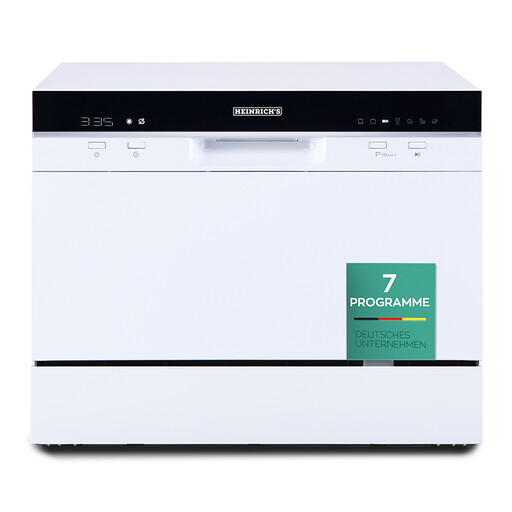
Heinrich’s HTG 8840 Weiss countertop dishwasher

Heinrich’s HTG 8840 Weiss, 6 place settings

A countertop model to consider for a compact wash; check that your own containers and lids fit in the rack.

6 place settings; 7 programmes; automatic door opening and drying.

Joybuy
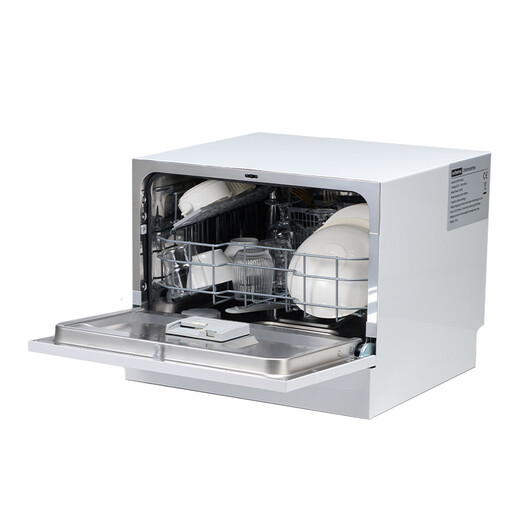
ochama Counter-Top Dishwasher for 6 standard place settings

ochama Counter-Top Dishwasher, 6 standard place settings

This countertop dishwasher is a compact option to compare if you want to load several items; check that your own lunch boxes fit.

6 standard place settings; 30-minute quick wash programme; delayed start up to 24 hours; 8 functions.

Joybuy

Heinrich’s HTG 8855 countertop dishwasher for 3 place settings

Heinrich’s HTG 8855, 3 place settings

A compact model to compare if worktop space is limited; its lower stated capacity could mean extra cycles for a large pile of items.

3 place settings; 7 programmes; according to the product name, it can be used with or without a water connection.

Joybuy

Frequently asked questions

Can every dishwasher-safe lunch box go in every programme?

No. Dishwasher-safe doesn’t automatically mean that every part can withstand every programme. Check the instructions for your container, lid and seal separately. Mepal advises storing the lid and container separately for its own on-the-go products so they can dry properly; this isn’t general guidance for all brands.

Can a dishwasher with a reservoir run without a tap and without drainage?

A reservoir can remove the need for a permanent water supply, but the wastewater still needs to drain away. The Consumers’ Association described Bob as having a drainage hose that can be directed into a sink or collection container, for example.

How do I maintain the machine after washing lots of lunch boxes with food residue?

Scrape off any large food scraps and check the filter regularly. The Consumers’ Association points out that a blocked filter or dirty spray arms can affect performance; follow your model’s instructions when cleaning or removing parts.

What do the energy label and warranty tell me when buying in the Netherlands?

For dishwashers, the EU energy label lists information including energy use per 100 eco cycles, water use per eco cycle, programme duration, capacity and noise. Statutory consumer rights also apply in the Netherlands: if a product breaks sooner than you could reasonably expect under normal use, the seller must provide an appropriate solution free of charge, according to ACM ConsuWijzer. A manufacturer’s warranty doesn’t replace this statutory right.
