
Breakfast dishes for several guests
You want to wash bowls, cups and cutlery in as few loads as possible. The layout of the rack may matter more than the stated number of place settings.


Start by checking the available space and drainage. A countertop model with a water tank may not need a permanent water supply, but the wastewater still needs somewhere to go. Next, check whether your breakfast bowls fit in the rack and how much washing-up you want to do at once. For a small amount, washing by hand in a washing-up bowl with a little hot water may be the simpler option. Milieu Centraal notes that, under these conditions, hand-washing is often more energy-efficient than using a dishwasher.
You want to wash bowls, cups and cutlery in as few loads as possible. The layout of the rack may matter more than the stated number of place settings.
You’re looking for a countertop model you can fill without a permanent water connection, but you’ll still need to find a safe place for the drain hose.
You only have a small space available, and you’ll also need to leave enough room to open the door and use the appliance.
A good fit if: you don’t have a suitable permanent water supply, but can safely position the drain hose. Daan Tech lists Bob as having a 3.9-litre tank and a drain hose.
Trade-off: you fill the tank by hand. Bob is listed for 3 place settings, so check that your bowls fit in the rack.
A good fit if: the holiday cottage has suitable water and drainage connections, and you want to try fitting several bowls, cups and cutlery together. The Inventum VVW5520 and Tomado TDW5501B are listed for 6 place settings.
Trade-off: follow the installation instructions for your chosen model and check the rack with your own crockery. A place-setting capacity doesn’t tell you whether a deep bowl will actually fit.
A good fit if: you have only a little breakfast washing-up, or don’t want to use up space and connections for an appliance. Milieu Centraal advises using a little hot water and turning off the tap while washing up.
Trade-off: you’ll be doing the washing-up yourself. Compare the amount of crockery and number of loads before weighing up machine use against hand-washing.
| What to consider | What should you check? | Who should give this more weight? |
|---|---|---|
| Whether your dishes fit | Measure your largest bowls and check whether they fit in the rack alongside cups and cutlery. Compare the full load you want to wash, not just the number of place settings. | If I want to wash breakfast dishes for several guests in one load, I need to know whether my bowls will fit alongside cups and cutlery. Around 36% of consumers prioritise rack space for breakfast dishes. |
| Water supply and drainage | Check the water-supply method, hose route and a suitable drainage point for each model. A tank doesn’t remove the need to drain the wastewater. | If there’s no suitable connection in the holiday cottage, I want to know in advance whether I can fill the appliance and drain the water safely. Around 29% of consumers prioritise connection options. |
| Space for positioning | Measure the width, height and depth, including the space needed to open the door and keep the hoses and plug accessible. | With little free worktop space, I want to be sure the appliance will still be usable with the door open. Around 21% of consumers focus mainly on the available work surface. |
| Consumption and use | Compare the energy consumption per 100 eco cycles and water consumption per cycle on the energy label. Also consider how many cycles your breakfast dishes will need. The EU energy label includes these details. | If I only have a small amount of breakfast washing-up, I want to weigh up using the machine against washing by hand. Around 14% of consumers prioritise consumption and running costs. |
A model with a tank still uses water, which has to go somewhere. Daan Tech says Bob’s drain hose can run to a sink or a suitable container, for example.
Before buying, work out the route from the drain hose to your chosen drainage point.
A place setting is a measure of crockery capacity, not a size specification for your particular bowls. The rack layout also affects whether deep bowls fit alongside cups and cutlery.
Measure the bowls you actually use and compare them with the rack layout and model information.
Consumption per cycle doesn’t tell you how many cycles you’ll need for your dishes. Milieu Centraal says hand-washing in a bowl with a little hot water is often more energy-efficient than using a compact mini dishwasher.
Compare consumption on the same eco-cycle basis and allow for the number of loads. If you wash by hand, don’t leave the hot tap running.
Bob is a slim countertop model with a water tank, researched for situations where a permanent water supply isn’t available.
The VVW5520 is a countertop model for anyone with a suitable permanent water supply who wants to compare a model listed for 6 place settings.
The TDW5501B is a countertop model with fixed water supply and drainage, listed for 6 place settings.
This selection includes countertop dishwashers for breakfast dishes, with different stated capacities and water-supply options. For each model, check that the water supply and drainage are suitable for the holiday cottage, and that the rack can accommodate your bowls.
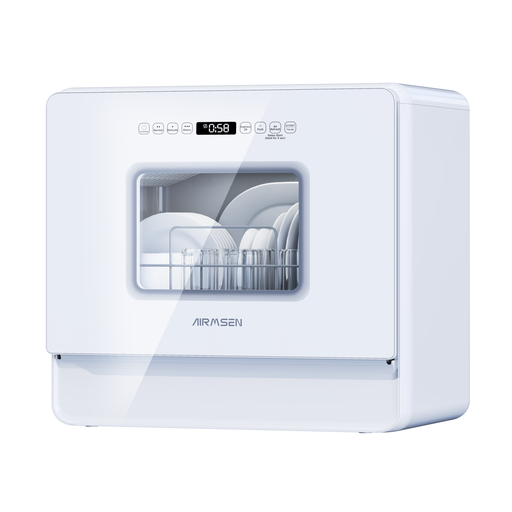 No image available
The listed two-tier rack and capacity of 5 place settings are worth considering for breakfast dishes. Check that your bowls fit.
The product information lists a built-in 5-litre water tank, water supply from a tank or tap, 3 spray arms and a 12-hour delay start.
 No image available
The product information lists a capacity of up to 4 place settings. Compare the rack with the bowls and cups you want to wash at the same time.
Listed features include a 5-litre tank, 9 wash programmes and dimensions of 37 × 50 cm.
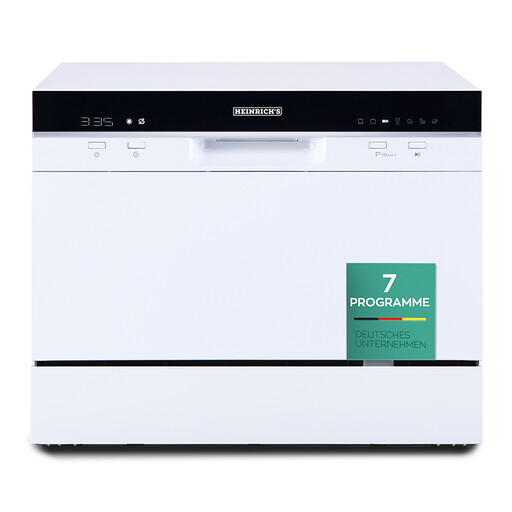 No image available
The stated capacity is 6 place settings. Check whether your breakfast bowls fit in the rack alongside the cutlery.
The product name lists 7 programmes and energy class D.
 No image available
The product name lists 3 place settings. Check whether that gives you enough room for the breakfast dishes you want to wash.
The product information lists a 5-litre water tank or a tap connection, and 7 wash programmes.
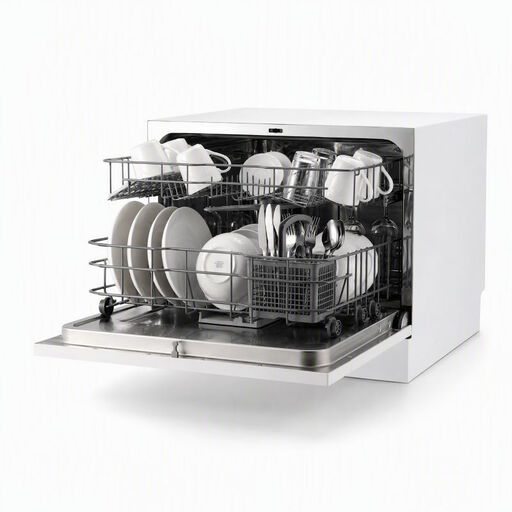 No image available
The stated capacity is 6 standard place settings. Check whether the shape and depth of your bowls will fit.
The product name lists a 30-minute quick wash programme and a delay start of up to 24 hours.
Daan Tech says Bob can be filled using its built-in 3.9-litre tank. No permanent water supply doesn’t mean no drainage: the hose needs to run to a sink or suitable container, for example.
Follow the manual for the exact model. For the TDW5501B, Tomado specifies a sturdy, level surface and accessible connections. Milieu Centraal advises removing food scraps to help prevent the filter from becoming blocked.
The EU energy label includes details such as energy consumption per 100 eco cycles, water consumption per cycle and capacity. Use this information to compare models on the same programme basis, and also allow for the number of loads your dishes will need.
In the Netherlands, statutory consumer rights apply: the seller must offer an appropriate solution if a product doesn’t meet what you’re entitled to expect. The Dutch government says there is no fixed statutory two-year warranty period; what’s reasonable depends, among other things, on the product.
For dishwashers, the EU energy label is useful for comparing energy and water consumption and capacity, among other things. The European Commission publishes product information on energy labels and ecodesign. Also check the installation instructions for your chosen model and the space available in the holiday cottage.