
Cook with plenty of washing-up
Wants to fit as many plates, glasses and pieces of cutlery as possible into one cycle after cooking, and has room for a countertop model with a suitable connection.


Start by measuring your largest dinner plate and the space available on your worktop. Then choose a model based on how many plates, glasses and pieces of cutlery you want to wash at once. A countertop dishwasher with around six place settings and a fixed connection may suit larger meal loads, while a narrower model with a reservoir could be an option if you don’t have a fixed water supply — but you’ll still need a way to drain the wastewater. Also compare the figures on the EU energy label: a smaller appliance isn’t automatically more energy-efficient.
Wants to fit as many plates, glasses and pieces of cutlery as possible into one cycle after cooking, and has room for a countertop model with a suitable connection.
Has limited kitchen space or no practical fixed water supply by the sink. A model with a reservoir may be suitable, provided there’s also a workable way to drain the wastewater.
Wants to check first that their plates will fit through the door and in the rack. Manufacturer specifications vary by model: Tomado gives a maximum diameter of Ø 25 cm for the TDW5501B, while Daan Tech states that Bob can take plates up to 29 cm.
Choose this if: you want to wash several plates, glasses and pieces of cutlery at once, and have a suitable fixed connection.
Consider: the space it will take up on your worktop, and check the maximum plate diameter and rack layout for the specific model.
Choose this if: you have limited width available or no fixed water supply, but can arrange a suitable drain.
Consider: a reservoir replaces the fixed water supply, not the drain hose. A smaller dishwasher may also wash fewer place settings at once.
| Point to consider | What should you check? | Who is this important for? |
|---|---|---|
| Dinner plate diameter | Measure your largest plate and compare it with the maximum diameter specified for the model. Tomado gives Ø 25 cm for the TDW5501B; Daan Tech states 29 cm for Bob. | If my dinner plates are the main reason I’m buying a machine, I want to be sure they’ll fit. Around 29% of consumers put plate fit first. |
| Room for a full meal load | Compare the stated number of place settings and check whether the rack layout also leaves room for glasses, bowls and cutlery. | I want to fit as much washing-up as possible into one cycle after a meal, not just the plates. Around 29% of consumers prioritise capacity for a full meal load. |
| Positioning and connections | Measure the space, including room for the door and hoses. Check how the water is supplied and where the wastewater can drain. | If there’s no fixed water supply by my sink or space is limited, the setup still needs to be practical. Around 21% of consumers prioritise positioning and connections. |
| Consumption with regular use | Compare the energy per 100 eco cycles and water consumption per eco cycle on the EU energy label. Also check which programme and load size suit the way you use it. | I want to know what regular use means for my choice and whether I can usually fill the machine sufficiently. Around 21% of consumers start by looking at consumption and frequency of use. |
A place setting describes the tableware for one person for one meal; it doesn’t automatically tell you whether your plates will fit or how much cookware can go in the rack at once.
Measure your largest plate, then check whether the rest of your meal’s washing-up will fit in the racks too.
A smaller usable load may mean you need to run the dishwasher more often or wash some items by hand.
According to Daan Tech, Bob’s reservoir replaces the fixed water supply; used water still needs to be drained through a hose.
Before buying, check where the appliance can go and how you’ll manage the water supply, drain, power and door clearance.
Milieu Centraal points out that consumption also depends on the load and programme. So a compact machine isn’t automatically the most energy-efficient choice for the way you use it.
Compare the EU label figures on the same eco basis, and consider whether you’ll usually be able to wash a full load. Milieu Centraal recommends using a full load and the eco programme when using a dishwasher.
Tomado describes the TDW5501B as a freestanding countertop model for six place settings, with a fixed water supply and drain.
Inventum describes the VVW5520 as a freestanding dishwasher for six place settings.
Daan Tech’s Bob is a narrower countertop model with a built-in reservoir or an optional fixed water supply.
Klarstein describes the Amazonia 6 as a model for six place settings that can be used freestanding or built in.
These models include compact countertop dishwashers with reservoirs and a model with six place settings and a water connection. Measure your plates and check the available space, drainage and model-specific details before choosing.
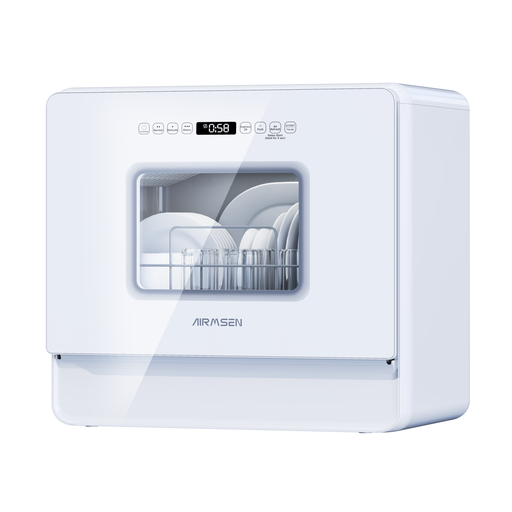 No image available
An option to consider if you don’t have a fixed water supply; check in advance how you’ll drain the wastewater.
Built-in 5 L reservoir; 2-tier rack. According to the product information, plates up to 300 mm will fit only when the top rack is removed.
 No image available
A reservoir model to consider if there’s no fixed water supply; remember to allow for the drain hose too.
Built-in 5 L water reservoir; 5+1 wash cycles; double-tempered glass door.
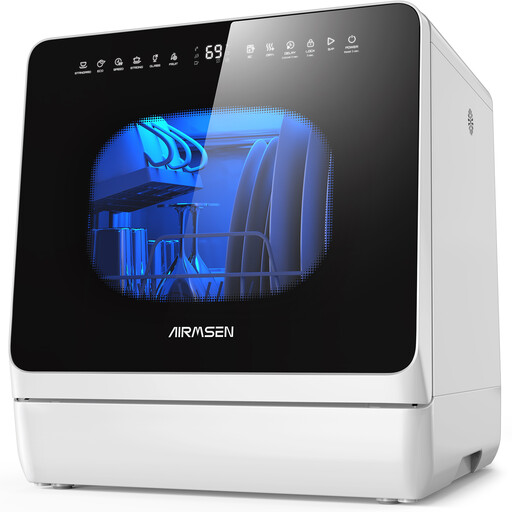 No image available
A portable countertop model to compare if a compact dishwasher would suit your kitchen or the place you plan to use it.
8 wash programmes; portable mini size according to the product title.
 No image available
A compact option to consider if you don’t have a fixed water supply where you plan to put the dishwasher; also check the space available for the hoses and door.
Built-in 5 L reservoir; 9 wash programmes; stated dimensions 37 × 50 cm; energy label D.
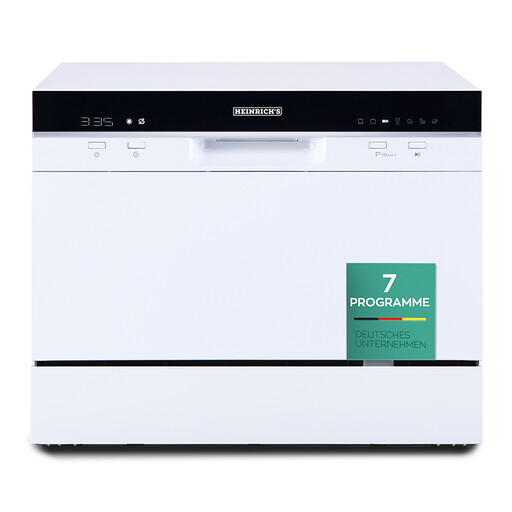 No image available
A model to compare if you want to wash several place settings at once and the stated connection set suits your space.
Six place settings; 7 programmes; 47 dB; energy label D.
Measure the diameter of your largest plate and compare it with the maximum diameter specified for the exact model. Tomado gives Ø 25 cm for the TDW5501B; Daan Tech states 29 cm for Bob. Also check whether there’ll still be room for the rest of your washing-up with those plates inside.
No. According to Daan Tech, Bob’s reservoir replaces the fixed water supply, but used water still needs to flow through a drain hose to a suitable outlet. Follow the instructions for your chosen model when positioning and connecting it.
No. Size alone doesn’t determine which appliance is the most energy-efficient choice for the way you use it. Milieu Centraal recommends using a full load and the eco programme. Compare the energy per 100 eco cycles and water per eco cycle on the EU energy label.
Milieu Centraal recommends removing food scraps, but generally advises against rinsing dishes with hot water beforehand. Food scraps can block the filter; follow your appliance’s instructions for cleaning the filter and using detergents.
According to the Dutch government, there’s no fixed statutory warranty period in the Netherlands; what you can reasonably expect depends on factors including the product. If a product is faulty, contact the seller to arrange an appropriate solution. A manufacturer’s warranty doesn’t replace your statutory rights.