
Small kitchen, few dishes
You want to wash breakfast bowls in a machine, but have little floor or worktop space. Start by checking the space and connections available; the Dutch Consumers’ Association recommends taking size and design into account.


Start by checking where the appliance will go, the connections available and how much room your bowls will take up in the rack. A countertop model suits smaller amounts of washing up and a spare spot on the worktop; a slimline dishwasher offers more capacity if dishes build up throughout the day. If you only have a few breakfast bowls, washing them by hand in a washing-up bowl with the hot tap turned off is another option.
You want to wash breakfast bowls in a machine, but have little floor or worktop space. Start by checking the space and connections available; the Dutch Consumers’ Association recommends taking size and design into account.
You want room for cups and plates from later meals as well as breakfast bowls. So check the rack layout and loading space: the number of place settings doesn’t tell you how many bowls will fit in your dishwasher.
You don’t have many dishes and want to work out whether washing up by hand or using a full dishwasher better suits your routine. Milieu Centraal recommends only starting a dishwasher on the eco programme when it’s full.
Best for: smaller amounts of washing up and a spare spot on the worktop.
Bear in mind: less loading space than a slimline model; check that your bowls will fit in the rack.
Best for: anyone who wants to save dishes from later meals for one wash and has room for a freestanding appliance.
Bear in mind: the floor or alcove space required, along with the water supply and drain.
Best for: a few bowls that are easy to wash in a washing-up bowl.
Bear in mind: it takes your time, and the comparison also depends on how much hot water you use.
Measure your bowls and the space available before choosing a model. Compare energy figures on the same eco basis; Energielabel.nl explains that dishwasher labels include figures such as energy use per 100 eco cycles and capacity.
| What to consider | What to look for when buying | Who should consider this? |
|---|---|---|
| Space and fit | Measure the space available and your bowls; check the rack layout and the dish sizes specified by the manufacturer. | If I have little kitchen space, I want to know where the appliance can go and whether my bowls will fit. That’s why around 40% of consumers focus mainly on space and fit. |
| Loading space | Compare the rack with the bowls, cups and plates you want to wash on a typical day. | If I want to save dishes from later meals for one wash, I look at the usable loading space. For around 30% of consumers, everyday loading space comes first. |
| Energy and water use for smaller loads | Compare kWh per 100 eco cycles and litres per eco cycle; also consider whether you can usually wait until the machine is full. | If I only have a few dishes, I want to weigh up energy and water use against washing up by hand and waiting until the machine is fuller. Around 20% of consumers prioritise energy and water use based on their own routine. |
| Installation, connections and noise | Check the appliance type, connection instructions and noise level on the energy label. | If my kitchen space or connections limit my choice, I first want to know whether the model can be installed there. For around 10% of consumers, installation, connections or noise are the main concern. |
A place setting refers to standard tableware; it doesn’t tell you how your particular bowls will fit side by side in the rack.
Measure your bowls and check the rack layout before choosing a model.
The Dutch Consumers’ Association points out that a small dishwasher isn’t necessarily more efficient. What’s more, the stated energy-label figures apply to the eco programme, not automatically to a quick or half-full cycle.
Compare models on the same eco basis and consider how many cycles your household actually needs.
Running a machine that’s often nearly empty can use extra electricity, water and dishwasher detergent.
Freestanding and integrated models differ in how they’re installed and finished. Choosing one that doesn’t suit the space could mean making alterations or returning it.
Check the appliance type, available space and connection instructions for the exact model.
Inventum lists both a compact freestanding countertop model and a slimline freestanding model.
Bosch lists a compact freestanding model and a slimline freestanding model. Check the appliance type and dimensions of each model to see which will suit your kitchen.
Beko lists slimline freestanding models for anyone who wants to save more than just breakfast bowls for a wash.
This selection focuses on compact countertop models for smaller amounts of washing up. Measure your bowls and the worktop space available; the stated capacity doesn’t tell you how many of your own bowls will fit in the rack.
 No image available
This compact countertop model is designed for a small amount of breakfast dishes and sits on your worktop.
The product information lists a built-in 5-litre water tank, space for 4 place settings and dishes up to 26 cm in diameter. The product title says a fixed water connection isn’t required. Use the appliance indoors on a stable, level surface.
 No image available
This countertop model is designed for a compact set-up and a small amount of washing up.
The product information lists a 5-litre water tank, 9 programmes and a capacity of up to 4 place settings. The product title gives dimensions of 37 × 50 cm; the description says it can be supplied with water from the tank or a tap. Use the appliance indoors on a stable, level surface with a correctly earthed connection.
 No image available
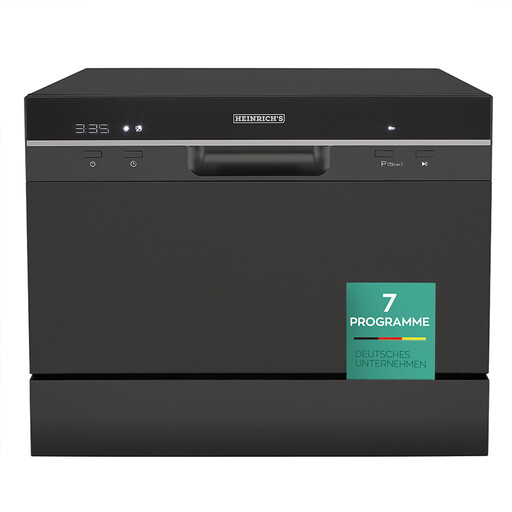
According to the product title, this countertop model has room for 6 place settings, making it suitable for anyone who wants to save breakfast bowls alongside other tableware.
The title lists 7 programmes, a water tank, 47 dB and energy class D. The product information also mentions a tap connection.
 No image available
The stated capacity of 3 place settings suits anyone who only wants to wash a small amount of dishes at a time.
The product title lists 7 programmes, 56,3 dB and energy class C. According to the product information, the appliance can be used with a water tank or a tap connection. Place it indoors on a stable, level worktop.
 No image available
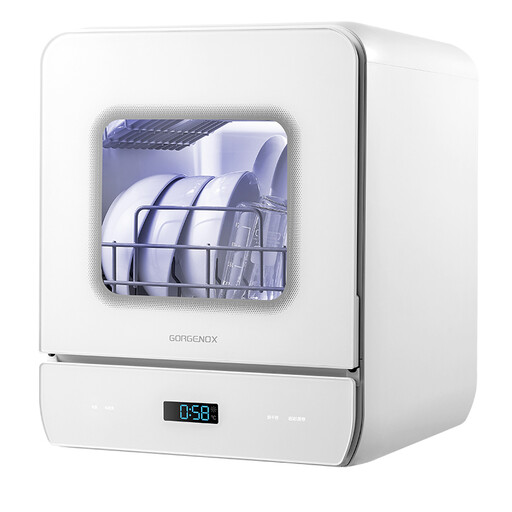
According to the product title, this compact countertop model is designed for a small amount of tableware.
The product title lists a capacity of 3 place settings and describes washing, disinfecting, drying and storing as features. Use the appliance indoors on a stable, level worktop.
You can’t tell from the number of place settings alone: a place setting refers to standard tableware. Measure your bowls and check how they fit in the rack; the manufacturer also recommends checking the sizes of your tableware beforehand.
No. Milieu Centraal says there’s no need to pre-rinse dishes before putting them in the dishwasher. Do remove food scraps to help prevent the filter from getting blocked.
Follow the instructions for your model. Bosch recommends removing the filter from its dishwashers, rinsing it under running water and putting it back securely; these instructions don’t automatically apply to other brands.
Allow for installation, water, electricity and dishwasher detergent, without assuming a fixed amount. If a product is faulty in the Netherlands, the seller is responsible for statutory guarantees; a manufacturer’s guarantee doesn’t replace that right.
Dishwasher energy labels give details such as energy use per 100 eco cycles, water use per eco cycle, capacity and noise. According to the Dutch government, the current label runs from A to G; these figures don’t automatically describe the energy and water use of a quick or half-full cycle.