What should you look for when choosing one?
First compare your daily load with the connections available. Then check that the size, use and energy consumption are right for your shared kitchen.
Countertop model with a water tank
Choose this if: there’s no suitable fixed water supply and your breakfast dishes fit in the smaller rack.
Bear in mind: you’ll need to fill the tank and arrange safe drainage; a lower stated capacity doesn’t guarantee that your bowls will fit.
Countertop model with a fixed water inlet and drain
Choose this if: your kitchen has suitable connections and you want to collect dishes from several people.
Bear in mind: the connections and worktop space required. A capacity of six place settings alone doesn’t tell you whether wide bowls will fit comfortably in the rack.
Washing up by hand
Choose this if: you have only a few dishes or need the shared worktop space for other kitchen tasks.
Bear in mind: Milieu Centraal says washing up by hand is usually better for the environment if you use little hot water, use a washing-up bowl and turn off the hot tap.
| Factor |
What should you check? |
Who is this important for? |
| How well your dishes fit |
Compare your usual bowls, cups and cutlery with the rack, and check that the spray arm can rotate freely. |
If I want to wash breakfast dishes from several housemates together, I need to know whether our bowls will actually fit in one load. Around 31% of consumers prioritise shared loading space. |
| Water supply and drainage |
For each model, check how it takes in water, the drain hose, a suitable place for drainage and the installation instructions. |
If there’s no fixed water connection, I need to know whether a tank is practical and where the wastewater can go. Around 31% of consumers prioritise a workable water supply and drainage solution. |
| Space and noise |
Measure the width, height and depth, including space for the open door and hoses. Discuss where to put it and when it can run. |
In a shared kitchen, I want to leave enough room to work and consider my housemates when the machine is running. For around 23% of consumers, shared space and potential disruption are their main purchasing concerns. |
| Energy use for small loads |
Compare the eco figures for the exact model and check whether the recommended load suits your daily dishes. |
If I want to know what regular use means for our small breakfast load, I compare the stated consumption with the way we wash up. Around 15% of consumers focus mainly on energy use and regular running costs. |
Countertop dishwashers at Joybuy
These countertop dishwashers are worth comparing for breakfast dishes in a shared kitchen. Check the connections, available space and fit of your own bowls for each model.
 No image available
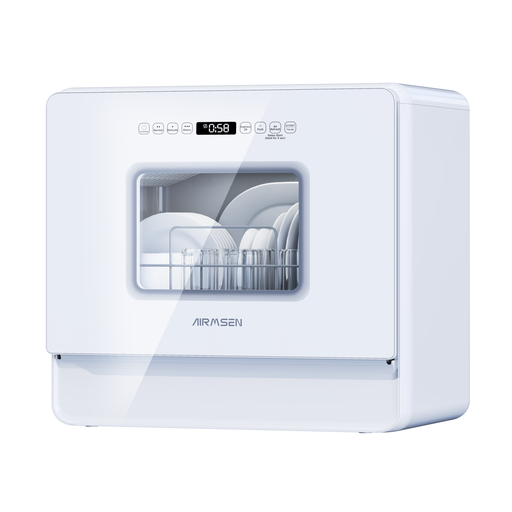
AIRMSEN A01 Large Slim Countertop Dishwasher
A model with a built-in water tank may be an option if there’s no fixed water supply. Check where the wastewater can go too.
The product title lists a 5-litre tank, two rack levels and three spray arms.
View at Joybuy
 No image available
AIRMSEN Portable Countertop Dishwasher
The built-in water tank may be useful when there’s no fixed water supply. Check how to use the drain hose safely.
The product title lists a 5-litre tank, 5+1 wash cycles and a double-tempered-glass door.
View at Joybuy
 No image available
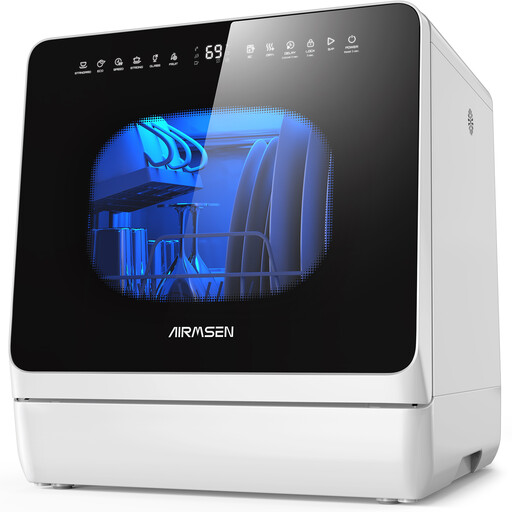
AIRMSEN Countertop Dishwasher – 8 Wash Programs
Compare the programmes with the dishes you usually want to wash together, and check whether the rack suits your breakfast bowls.
The product title lists eight wash programmes and a built-in water softener. Check the water connection and drainage arrangements for this model.
View at Joybuy
 No image available
AIRMSEN Tabletop Dishwasher – 9 Wash Programmes
A built-in tank is an option to compare if there’s no fixed water supply. Check the drainage arrangements and space required.
The product title lists a 5-litre tank, 9 programmes, dimensions of 37 × 50 cm and a D energy rating.
View at Joybuy
 No image available
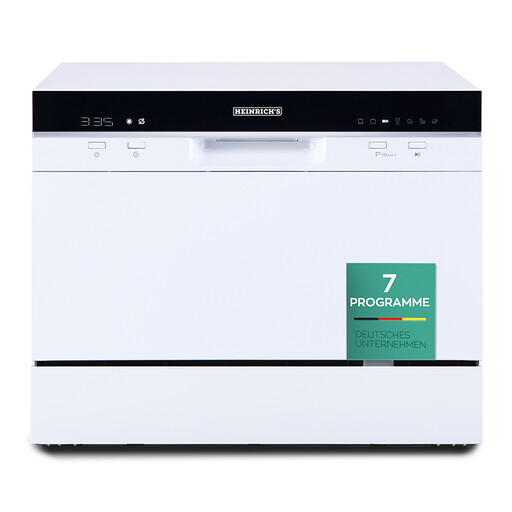
Heinrich's HTG 8840 Weiss
The stated capacity can help you compare models for shared dishes, but check whether the rack works with your own bowls.
The product title lists six place settings, seven programmes, a noise level of 47 dB and a D energy rating. Check the connections required for the exact model.
View at Joybuy
Frequently asked questions
Does a dishwasher with a water tank mean I don’t need any connections at all?
A water tank can remove the need for a fixed water supply, but the wastewater still needs to go to a suitable drain or container. Daan Tech lists a drain hose for Bob; check the instructions for the version you’re considering.
How do I install a countertop dishwasher safely?
Follow the manual for the exact model. For the Tomado TDW5501B, the manufacturer specifies a firm, level surface and suitable water, drainage and electrical connections. The manual also warns against using an extension lead or multi-socket adaptor. These instructions apply to this model and not automatically to every dishwasher.
Is a countertop dishwasher always more economical than washing up by hand?
You can’t tell without comparing how it will be used. Milieu Centraal recommends running a full dishwasher and choosing the eco programme. The organisation says washing up by hand is usually better for the environment if you use little hot water, use a washing-up bowl and turn off the hot tap.
Do I need permission to install a connection in a rented home?
It depends on the work involved. According to the Rijksoverheid, you don’t need permission for minor changes that can be reversed without too much expense, but you do for renovations such as a new kitchen. Check with your landlord in advance whether the specific plumbing or kitchen work falls into this category.
Which energy rating and water consumption figures should I compare?
Compare the energy rating and water figures for the exact model. The Rijksoverheid describes the European A to G energy rating scale for dishwashers and notes that the label also includes information about water use. The energy rating alone won’t tell you how much a small load of breakfast dishes will use.


