
Careful tie ironer
You want to remove creases from a cotton tie without damaging the fabric, lining or shape. GINETEX emphasises that the care label tells you which treatments are allowed.


For the occasional cotton tie in a flat, a standard steam iron is usually a practical place to start: the Dutch Consumers' Association says this type is suitable for small amounts of ironing and limited storage space. A steam generator is worth considering if you also regularly iron larger amounts of cotton and have room for the complete system. Always follow the tie’s care label and press gently, ideally with a cloth in between and using little pressure.
You want to remove creases from a cotton tie without damaging the fabric, lining or shape. GINETEX emphasises that the care label tells you which treatments are allowed.
You iron small amounts and don’t want to move or store a bulky base unit afterwards. The Dutch Consumers' Association lists limited storage space as a reason to consider a standard steam iron.
You regularly iron shirts or other cotton items as well as ties. The Dutch Consumers' Association suggests considering a steam generator if you do a lot of ironing.
A good fit if: you mainly iron a tie or small amounts of laundry and want an appliance that’s easy to store.
The trade-off: the water tank is built into the iron itself; the Dutch Consumers' Association says these models generally produce less steam than steam generators.
A good fit if: as well as ties, you often iron larger amounts of cotton with stubborn creases, and have room for the separate tank and base unit.
The trade-off: the complete system takes up more space and can be harder to move; extra steam doesn’t automatically make it more suitable for a tie.
| What to consider | What should you check? | Who is this important for? |
|---|---|---|
| Preserving the fabric and shape | Follow the care label: GINETEX describes it as a guide to the treatments allowed. SuperStropdas recommends placing a cotton cloth between the tie and the soleplate and applying little pressure. | I want to remove creases from my cotton tie without risking damage to the fabric or shape. Around 36% of consumers put preserving the fabric and shape first. |
| Storage and moving the appliance | Consider the space needed for the complete appliance and whether your ironing board is suitable, rather than looking only at the weight of the iron. The Dutch Consumers' Association notes that limited storage space is a factor when choosing between appliance types. | After a short ironing session, I want to be able to store the appliance easily. Around 29% of consumers give limited storage space their highest priority. |
| Longer cotton ironing sessions | Compare the stated continuous steam output in g/min with the tank capacity. A steam boost is a separate function, not continuous output; the Dutch Consumers' Association describes steam output in g/min. | If I also regularly iron larger amounts of cotton, I look at capacity and how long I can keep ironing. Around 21% of consumers put this need first. |
| Use and maintenance | Check whether the specific model has automatic shut-off and an anti-drip feature, and follow the descaling instructions. The Dutch Consumers' Association notes that an anti-scale feature doesn’t make maintenance unnecessary. | I want an appliance that’s easy to use and maintain. Around 14% of consumers name ease of use and maintenance as their main priority. |
The care instructions apply to the whole garment, not just the outer fabric. A tie’s materials and construction call for careful handling.
Check the label and press gently through a cloth. Don’t force a sharp crease with high heat or heavy pressure.
A generator also has a separate tank and base, so the complete system can take up more room.
Measure the available storage space and check whether your ironing board can accommodate the whole system.
An anti-scale feature slows the build-up of limescale, but it doesn’t eliminate the need for maintenance. The Dutch Consumers' Association recommends following the appliance’s maintenance instructions.
Read the descaling instructions before buying and check whether the model you’ve chosen uses replaceable parts.
If a model uses replaceable cartridges, checking and replacing them when necessary is part of its maintenance.
The 3000 Series includes standard steam irons. Philips Netherlands lists a ceramic soleplate and a 300 ml water tank for the DST3041/30.
The Easygliss Plus FV5736E0 is a standard steam iron with a stated precision tip, anti-drip feature and automatic shut-off.
Braun offers the TexStyle 3 SI 3055 standard steam iron and the CareStyle 1 IS 1012 BL steam generator, among other models.
These product picks are standard steam irons for short ironing sessions and limited storage space. When ironing a tie, always follow its care instructions and use a controlled pressing technique.
 No image available
The product information lists manual temperature and steam settings; always follow a tie’s care instructions.
Also listed: automatic shut-off.
 No image available
The product information describes a handheld steam iron with an adjustable thermostat and a 2-in-1 dry and steam function.
The product name also specifies dual voltage; check that the settings and operation suit your ironing task.
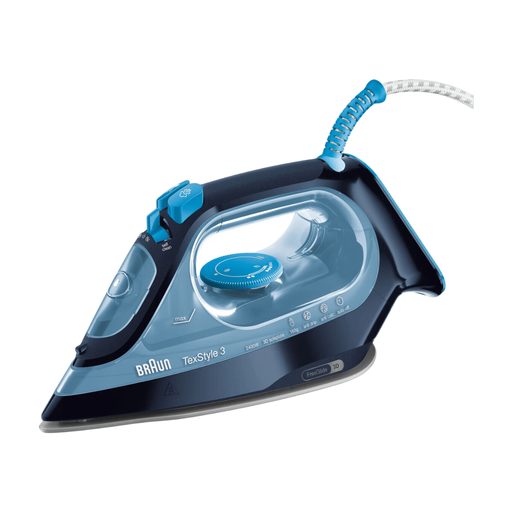 No image available
The product information lists a precision tip and automatic shut-off; check the temperature setting against the care label.
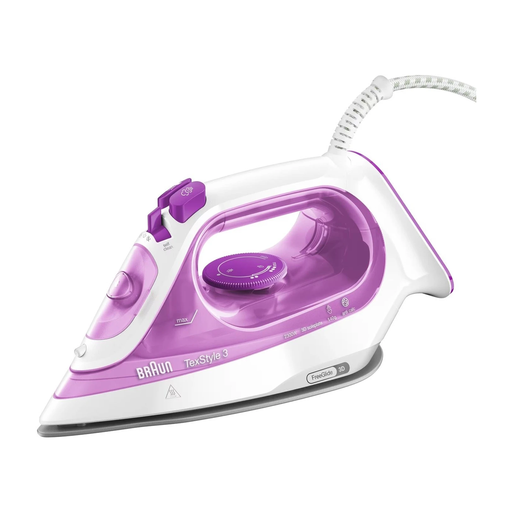 No image available
The product information lists a ceramic soleplate, precision tip and self-cleaning function. Follow the tie’s care instructions for temperature and steam settings.
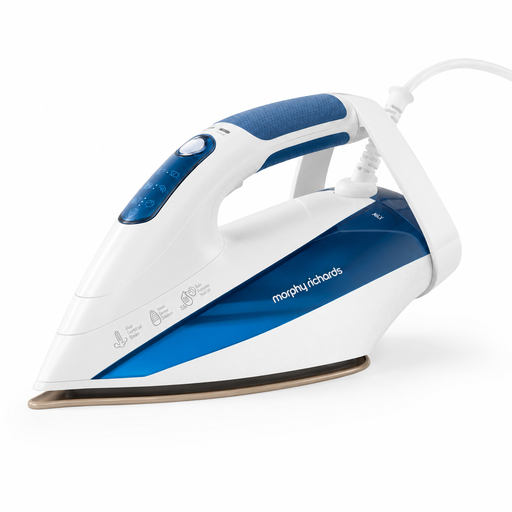 No image available
The product name lists a power rating of 2400–2800 W, steam output of 50 g/min and a 350 ml water tank.
Also listed: anti-drip feature and self-cleaning function. These features alone don’t determine which setting is suitable for a tie.
Don’t choose a setting based only on the outer fabric. Follow the tie’s care instructions, which tell you whether it can be ironed and at what temperature. Press gently through a cloth, without applying much pressure.
Use only as much water or steam as you need, and let the tie dry. Follow your iron’s care instructions; the Dutch Consumers' Association points out that an anti-scale feature doesn’t make maintenance unnecessary.
The Dutch Consumers' Association says steam irons are generally designed for tap water. Follow the water and descaling instructions for the exact model, especially if you want to use softened water.
For eligible distance purchases from a business, the Dutch government generally provides a 14-day cooling-off period. Before you buy, the seller must give you information about the product and cooling-off period, among other things. Any manufacturer’s guarantee offered is in addition to your statutory consumer protection.