
Quick tie ironer
You want to tidy up a cotton tie just before heading out and mainly need an adjustable appliance for a quick ironing session. The Consumers’ Association describes an ordinary steam iron as suitable for people who do little ironing.


For a single cotton tie, an ordinary steam iron with adjustable settings is usually a practical choice, as long as the care label allows ironing; adjust the heat and steam accordingly. A clothes steamer is useful for a quick refresh without an ironing board, but it won’t give you the same pressed finish. A steam generator is mainly worth considering if you also regularly iron larger loads of laundry, as explained by the Consumers’ Association and Philips.
You want to tidy up a cotton tie just before heading out and mainly need an adjustable appliance for a quick ironing session. The Consumers’ Association describes an ordinary steam iron as suitable for people who do little ironing.
You want to preserve the shape or finish of your tie, so you check the care label and permitted heat and steam settings first. GINETEX explains that care labels indicate the treatment an item can withstand.
You’re not buying just for your tie: the amount of other laundry you iron, refilling and maintenance all matter too. The Consumers’ Association lists the amount of ironing you do as a factor when choosing between an iron and a steam generator.
Best for: a quick, targeted ironing session when the tie’s care label allows ironing.
Trade-off: the water tank is usually smaller than a steam generator’s; a powerful steam boost is no substitute for following the care label.
Best for: lightly smoothing creases or refreshing a hanging garment, if it can be steamed.
Trade-off: Philips says a clothes steamer won’t give the same results as an iron, especially on thicker cotton.
Best for: regularly ironing larger loads of laundry and tackling stubborn creases as well as your tie.
Trade-off: the larger setup takes up more space and usually offers extra capacity if you’re only ironing one tie; the Consumers’ Association considers an ordinary iron suitable for people who do little ironing.
| What to consider | What to look for | Who should pay particular attention? |
|---|---|---|
| Targeted ironing | Check whether the temperature and steam can be adjusted, and whether the appliance is easy to store. | If I want to smooth out one cotton tie just before heading out, I want to work quickly and precisely; around 36% of consumers say a quick ironing session is their main buying concern. |
| Protecting your tie | Follow the care label; for areas that are sensitive to pressure or prone to shine, consider using a clean pressing cloth if the care instructions allow it. | If your main concern is preventing marks or damage, check the permitted treatment first; around 29% of consumers prioritise protecting their tie. |
| Other laundry | Consider how much laundry you iron, and how often, before choosing the capacity of a steam generator. | If I regularly iron a lot of laundry as well as my tie, extra capacity may be worth considering; around 21% of consumers say other ironing is their main buying concern. |
| Maintenance and aftercare | Follow the descaling instructions for the exact model and check who the seller is. | If you want to be able to arrange maintenance and help with a possible fault, check the manual and seller too; around 14% of consumers say maintenance and aftercare are their main buying concern. |
The maximum permitted treatment depends on the care label for the whole tie, not just the name of the fibre. GINETEX describes the care label as a guide to the treatment an item can withstand.
Read the care label before setting the heat or steam.
The extra tank capacity and steam are mainly useful if you also regularly iron larger loads of laundry; if you’re only ironing a tie, the larger setup may take up more space than you need.
Consider how much other ironing you do before choosing a generator.
Refreshing clothes without an ironing board and pressing them precisely are two different things. Philips notes that thicker cotton can be a challenge for steaming.
Choose a steamer for a light refresh and check that the garment can be steamed.
ACM ConsuWijzer explains that if a product breaks sooner than you could reasonably expect with normal use, the seller may be responsible for providing a suitable solution free of charge. A manufacturer’s guarantee does not replace your statutory rights.
Keep your proof of purchase and contact the seller if you think there may be a fault.
The Express Steam FV2838E0 is an example of an ordinary steam iron with settings for smaller ironing jobs.
According to Braun, the TexStyle 3 SI 3041 Green has a thermostat dial for anyone who wants to set the temperature themselves.
The 3000 Series DST3041/80 is an example of an ordinary steam iron; Philips also offers clothes steamers for a different way to refresh garments.
This selection includes adjustable ordinary steam irons for targeted ironing sessions, and steam generators for people who iron more regularly as well. According to the Netherlands Food and Consumer Product Safety Authority, a new electric iron covered by the Dutch Commodities Act (Electrical Equipment) Decree must carry a CE marking; check that it is present on the item delivered.
 No image available
Manual temperature and steam controls are useful if you want to match the settings to the garment’s care label.
Compact design; 0.77 kg; 0.15 L tank; vertical steam function.
 No image available
Suitable if you want to set the temperature according to the garment’s care label and iron carefully around details.
Variable steam; steam boost; narrow soleplate tip; dry ironing setting without steam; 1.6 m cord.
 No image available
The larger setup is better suited to longer ironing sessions with other laundry than to ironing just one tie.
Removable 1.4 L tank; temperature selection according to fabric type; vertical steam; ceramic soleplate.
 No image available
Automatic temperature control is useful if you don’t want to use a temperature dial; for a single tie, the generator setup offers extra capacity.
OptimalTEMP; 1.3 L tank; vertical steam; automatic shut-off. This model does not have a temperature dial.
 No image available
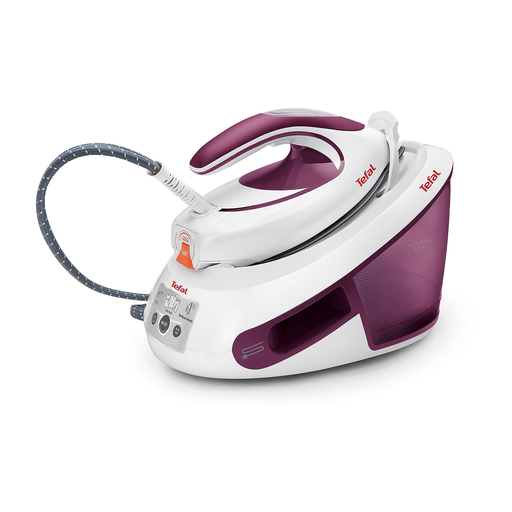
The generator setup and tank capacity are better suited to longer ironing sessions with other laundry than to ironing just one tie.
1.8 L tank; variable steam; 3D precision tip; temperature selection according to fabric type; Durilium soleplate.
No. Check the care instructions for the whole tie first. GINETEX describes the care label as a guide to the maximum soleplate temperature; the name of the material alone does not determine that limit.
A pressing cloth can help protect shiny or pressure-sensitive areas if the care instructions allow ironing at a low temperature. GINETEX also mentions ironing inside out as an option; don’t use these methods to get around a no-ironing instruction or temperature limit.
Follow the manual for the exact model. Tefal warns that descaling methods vary by type and advises against using vinegar or descaling products in the steam tank when rinsing it through.
According to the Netherlands Food and Consumer Product Safety Authority, products covered by the Dutch Commodities Act (Electrical Equipment) Decree must carry a CE marking. Check the item delivered; a product listing alone does not prove that the marking is present.
No. ACM ConsuWijzer explains that, in the Netherlands, statutory rights apply alongside a commercial manufacturer’s guarantee. If a product breaks sooner than you could reasonably expect with normal use, the seller is responsible for providing a suitable solution free of charge.